MackCollier.com

  • Blog
  • Mack’s Bio
  • Work With Mack
    • See Mack’s Work
  • Buy Think Like a Rock Star
  • Book Mack to Speak

January 25, 2011 by Mack Collier

How to write good blog content

During the last #Blogchat, at one point the discussion shifted to writing good content on your blogs, and what defined ‘good’ content.

Most of us seemed to fall into one of two camps: People that said that good content created value for your audience, and people that said that good content created value for the blogger.  With the general consensus being that if you are a business blogger, that your content was written for someone else.  And if you are a personal blogger, you are writing for yourself.

Then I got to thinking about my blogging here.  Ultimately, this blog is a business development tool for me.  I use it as a tool to grow my business and get more consulting and training clients.  But I also want and am very thankful for those of you that leave comments here and contribute to the conversation.  So while the actual comments and conversations we have might not have as much of an impact on my business as the content itself, it has an impact on ME.

Which I think is an important issue to consider.  Even those of us that are business bloggers need to get a sense of personal fulfillment from our blogs.  It keeps us motivated and inspired.  Sure, getting money from your blog is always inspiring, but making personal connections with people and creating value for them via your content, is also very rewarding.

In my mind, the best bloggers are the ones that create their content with a specific audience in mind, but they also have a personal attachment to their readers.  As a result, even their ‘business’ blogs aren’t stiff and boring, they are even personable and inviting.

What do you think?  Should your blog content and approach combine personal and professional elements to be more effective?  Or should your blog’s focus be completely one or the other?

How do you write for your blog?  What’s your approach?

Share this:

  • Share on X (Opens in new window) X
  • Share on Facebook (Opens in new window) Facebook
  • Share on LinkedIn (Opens in new window) LinkedIn
  • Email a link to a friend (Opens in new window) Email
  • Share on Reddit (Opens in new window) Reddit

Like this:

Like Loading...

Filed Under: #Blogchat, Blogging

January 24, 2011 by Mack Collier

Will there be a LIVE #Blogchat at SXSW?

One of the most frequent questions I have gotten in the past few months when I attend or speak at events is ‘Have you ever thought about doing a live #Blogchat?’

In fact, I have.  And what I would like to do is find a smart company that wants to sponsor a LIVE #Blogchat during SXSW.  In looking at the SXSW schedule, we could even do it on Sunday nite, March the 13th.  That way, we could have a live #Blogchat in Austin, but also have the regular #Blogchat on Twitter during the same time.  Which would mean we could also take points raised and questions asked on Twitter by #Blogchatters, and incorporate them into our live conversation at SXSW.  Additionally, we usually start mingling and networking an hour before #Blogchat starts each week, at 7pm Central.  We could do the same thing at SXSW, this would give the people that are going to join us live in Austin a chance to meet each other, and the sponsor as well.

For participants, I think it would be an amazing learning experience, and a great way to meet so many people we’ve probably already connected with during past #Blogchats.

For the sponsor, I see several key benefits:

  • Minimum of 2 hours exposure with some of the true leaders in the social media space, both at the event, and on Twitter.
  • Since it will be the 1st LIVE #Blogchat, I will be promoting it on Twitter and my blog for the next 2 months, which will only draw a bigger crowd.
  • You’ll get a TON of useful advice from some of the smartest minds in social media.  This alone would pay for the sponsorship.
  • Sponsoring the event would bring a good deal of positive exposure to the sponsor.

Also, if it makes sense from the sponsor’s point of view (especially if they are a blogging company), I’d like to have a representative from the sponsor join me at SXSW and co-host the live #Blogchat.

And to be clear, I’ve already talked to a few potential sponsors who have expressed interest in this idea, but no one has committed yet.  So if this idea sounds like something your company or organization is interested in learning more about, please email me.

Share this:

  • Share on X (Opens in new window) X
  • Share on Facebook (Opens in new window) Facebook
  • Share on LinkedIn (Opens in new window) LinkedIn
  • Email a link to a friend (Opens in new window) Email
  • Share on Reddit (Opens in new window) Reddit

Like this:

Like Loading...

Filed Under: #Blogchat, Blogging, Social Media, Social Media Monitoring, Social Networking, Twitter

January 24, 2011 by Mack Collier

5 reasons why companies should spend LESS time listening to social media experts

If you work at a company and are passionate about social media, and passionate about getting your company to use social media, then you are probably spending a lot of attention to the supposed social media experts.  The most influential bloggers and Twitter users.  The ‘rockstars’.

Here’s 5 reasons why that’s probably not a good idea.

1 – Social media experts gravitate to shiny things.  If you are active on Twitter especially, then you have probably heard about the shiny social media site of the moment; Quora.  Quora is basically a Q&A site that despite having functionality similar to most other Q&A sites, seems to suddenly have everyone buzzing.

The problem is, ‘shiny’ doesn’t always equal ‘useful’ when it comes to social media for companies.  What you should do with Quora is monitor company mentions.  You should already have a monitoring system in place (even if it’s just Google Alerts, which you can set up in 5 mins), and this will let you track company mentions on Quora and other sites.

With most ‘shiny’ social media sites and tools, it’s best to be aware, but to not jump in headfirst.  Why?  Because often the ‘buzz’ around a shiny social site is driven by hype more than utility.  In general, it’s best to let the hype die down then see what happens.  If the value is there, people will stick with it.

And before anyone comments, I am not slamming Quora.  I have plenty of friends that love the site, and to be honest, I have barely spent an hour with it.  My only point is, I tend to tune out and wait when I see sites like Quora suddenly getting super-hyped.  I did the same thing with Identica and Kwippy, and yes, even Twitter.

2 – What works for social media experts might not work for your company.  Most social media experts will tell blogging companies that they must have as many comments as possible.  That interaction and engagement is all that matters.  They probably get a bunch of comments on their blog, so they tell companies they need comments as well.

Guess what?  Most companies could give a rat’s rump if they ever get a comment on their blog.  They want LEADS and BUSINESS from the blog.  But most social media experts have difficulty explaining how companies can get leads and business from their blogging efforts, so they talk about things they know: such as getting comments and RTs.

3 – There is no one-size-fits-all solution to social media.  Twitter is the textbook example of this. I have literally changed the way I use Twitter a dozen or more times in the last 4 years.  I used to follow more people than followed me.  Then I followed almost no one, now I follow anyone that interacts with me on Twitter, or that I have met.

The point is, there are few, if any, social media rules that apply to EVERY company’s efforts.  For example, many social media experts will say that a blogging company should try to blog every single day.  And at minimum, they should write 3 new posts a week.

And confession time, I used to think this as well when I started blogging almost 6 years ago.  The a funny thing happened: I started getting so busy with consulting work that I couldn’t blog every day.  I had to make the choice between blogging every day, or working on client work every day.  Guess which one won?

The solution is: Pick a posting schedule that works for YOUR situation.  My best advice is to pick a schedule that you can stick with.  If you *think* you can write 2 new posts a week, start out shooting for once a week, then build up to 2 a week if you can.

4 – Social media experts often write for each other, not for companies.  How many times have you read a well-known social media person write a blog post or a tweet just ripping another well-known social media person?  It happens far too often.  So why does it happen?  Because almost every time there is an ‘I’m calling bullshit on…’ post, it gets views.  And comments, and RTs.  And traffic.

But does it get them business?  Maybe it does, but the next time I hear a social media consultant tell me they got a project because they ripped one of their peers, will be the 1st time.  But I often hear of companies that have specifically NOT hired an expert or consultant based on something they said online.  Good manners matter, and no amount of RTs or pageviews or comments make up for a lack of civility.

5 – Social media experts are using social media in a way that works for THEM.  One person.  So obviously, attempting to mimic the way one person uses social media and applying it to the social media efforts of a Fortune 500 company, might not be the best course of action.

This is not to say that you can’t learn from how the experts and thought leaders are using social media.  Because you can, and yes I am being slightly self-serving when I say that.  But you should never assume that you should use social media in a certain way, simply because someone you read or follow, does.  Maybe their method for using a particular site or tool can work for your company as well, but you shouldn’t blindly adopt using the site or tool the same way simply because that’s how they do it.

Don’t blindly adopt, but don’t blindly dismiss either

Your company should be aware of what the leaders and experts in this space are saying and doing.  But you shouldn’t do anything simply because they are, nor should you dismiss their methods simply because you believe that ‘social media experts’ are all ‘snake oil salesmen’.  Look for trends, ways that most of the leaders in this space are using social media, or what they are teaching, and look critically at their lessons and if they can apply to your company’s efforts.  Don’t view them as a ‘cheatsheet’ for using social media, but rather as another resource for your company.

Share this:

  • Share on X (Opens in new window) X
  • Share on Facebook (Opens in new window) Facebook
  • Share on LinkedIn (Opens in new window) LinkedIn
  • Email a link to a friend (Opens in new window) Email
  • Share on Reddit (Opens in new window) Reddit

Like this:

Like Loading...

Filed Under: Blogging, Social Media, Twitter

January 23, 2011 by Mack Collier

#Blogchat topic for 1-23

Ok guys I’ve created a poll for tonite’s #Blogchat topic!  Vote for your favorite, the poll will close at 7pm Central, or an hour before #Blogchat starts!

Online Surveys & Market Research

And if you’ve never joined #Blogchat, here’s what it’s all about.

Share this:

  • Share on X (Opens in new window) X
  • Share on Facebook (Opens in new window) Facebook
  • Share on LinkedIn (Opens in new window) LinkedIn
  • Email a link to a friend (Opens in new window) Email
  • Share on Reddit (Opens in new window) Reddit

Like this:

Like Loading...

Filed Under: #Blogchat, Blogging, Social Media, Twitter

January 23, 2011 by Mack Collier

All types of Social Media Engagement are not created equally

Sankar left a great comment to my last post about Measuring What Matters in Social Media:

In my understanding, I think that instead of going by just the number of fans, followers, friends, a company has, it would be practical and logical to understand their level of participation.

Just to give you an example, if we are going to find out the success of Starbucks’s the Betacup challenge, we can see how many have read/viewed/tweeted/bloged about it – first level of participation, and how many have become registered members and reviewed others ideas, (this denotes a higher level of participation), and how many have actually proposed new ideas (obviously, a higher level of participation).

I think this reinforces a great point: You should think about not only the different types of participation and engagement you want around your social media efforts, but also, how you prioritize and link those activities.

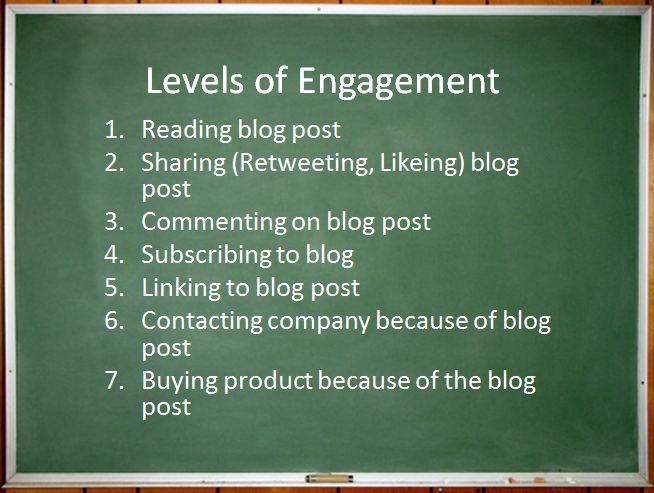
For example, let’s say you are using the list in the graphic above to prioritize the levels of engagement you want on your company blog.  Sharing the blog posts would be lower than commenting on them.  But if you knew from examining your analytics that people that share one of your posts on a social site were far more likely to subscribe to the blog (which is a higher priority than commenting), then perhaps you would want to encourage sharing, since it would lead to the higher-priority activity of subscribing to the blog.

Also, how can you encourage a visitor to engage in a more ‘valuable’ activity to you?  How can you convert a reader into a subscriber, or a commenter, into a buyer?  By prioritizing the level of possible engagement activities associated your blog, you can get a better sense of how each activity relates to your ultimate goal for the blog.

Does this help?  Have you made a list of which types of activities you want your readers to take on your blog, and how each ties back to your company’s blogging goals?  Please leave a comment, or if you would rather, email me your thoughts, I’d love to hear from you.

Share this:

  • Share on X (Opens in new window) X
  • Share on Facebook (Opens in new window) Facebook
  • Share on LinkedIn (Opens in new window) LinkedIn
  • Email a link to a friend (Opens in new window) Email
  • Share on Reddit (Opens in new window) Reddit

Like this:

Like Loading...

Filed Under: Blogging, Social Media, Social Media Monitoring, Twitter

January 22, 2011 by Mack Collier

Measure what matters when it comes to social media

Just read a great eMarketer interview with Nationwide’s Director of Social Media, Shawn Morton.  Check out this quote from Shawn on social media measurement:

“Social media and digital are really easy to measure, but we don’t always know what the values are. You can easily count clickthroughs. You can easily count Facebook fans. You can easily count Twitter followers. But until you put a value on those, as a company, or sometimes for a specific campaign, they can be difficult to evaluate.”

Bingo.  The same thing we were talking about when we discussed fixing a broken social media strategy.  If you are going to measure Twitter followers and use it as a way to quantify the success of your efforts, then you’d better have a internal value attached to each Twitter follower.

Pretty interesting interview with Shawn (who’s a great guy, BTW), so check it out!

Share this:

  • Share on X (Opens in new window) X
  • Share on Facebook (Opens in new window) Facebook
  • Share on LinkedIn (Opens in new window) LinkedIn
  • Email a link to a friend (Opens in new window) Email
  • Share on Reddit (Opens in new window) Reddit

Like this:

Like Loading...

Filed Under: Blogging, Social Media, Twitter

January 21, 2011 by Mack Collier

Breaking Marketing Barriers From the Top of a Harley

In 2007 I was honored to be one of over 100 authors that contributed to the first Age of Conversation edition.  The project was conceived and executed by Gavin Heaton and Drew McLellan.  Gavin and Drew brought together over 100 of the smartest marketing minds to give their thoughts on what The Age of Conversation meant to them.  What’s fascinating about the book is it’s a snapshot of an online world in 2006-2007 where social media was still very new for many companies.  We were writing with eyes wide open about the possibilities of a hyper-connected world where customers were more empowered than ever.

The proceeds from this edition benefited Variety, The Children’s Charity, which is a big reason why I was so excited to be involved.  The book itself was written by over 100 of the smartest online marketers on the planet (Gavin and Drew, Ann Handley, David Armano, CK, Scott Monty, etc etc etc) and Amazon still has a few copies of the original edition left.

For the first time ever, here is my chapter from The Age of Conversation, I hope you enjoy it:

Breaking Marketing Barriers From the Top of a Harley

How Companies Can Better Understand Their Customers, By Joining Them

Willie Davidson, the Chief Styling Officer at Harley-Davidson, was once asked if the company makes any special efforts to better understand its customers.  Davidson replied that the motorcycle maker was in constant contact with its customers, because they rode with them all the time.

What may at first seem like a flippant response, actually makes perfect business sense.  What better way to understand your customers, than by using your product with them in their space?  When Davidson rides his Harley with fellow Harley owners, he is able to not only experience the motorcycle as other owners do, but to also share that experience with them.  The company/customer barrier is removed, and Willie instead becomes a member of the community of Harley riders.

Why is this so important?  Because people don’t trust advertising, they trust each other.  And companies can’t market their products effectively if they don’t understand their customers’ wants and needs.  When a company begins to interact with its customers in their space, they begin to communicate with them.  This communication leads to understanding.  And when a company better understands the wants and needs of its customers, it can more effectively market its products to them.  And more efficient marketing is cheaper marketing.

Willie knows that he could spend thousands of dollars on marketing research and surveys that would be designed to tell him more about Harley-Davidson’s customers.  Or he could simply hit the open highway with fellow Harley owners, and become a part of their community.  He could hear firsthand what fellow Harley owners liked and disliked about their motorcycle.  He could better explain Harley Davidson’s products and marketing.  By communicating, both parties have a better understanding of each other.

The problem is that in many cases there are two communities; the company, and its customers.  Each community has its own wants and needs, and its own way of talking to each other.  As a result, neither group really understands or trusts the other.

But when a company makes an effort to join its customers in its space, that barrier begins to fall.  The ideas and language of the company begins to seep into the customers’ space.  Likewise, the thoughts and opinions of the customers start to become understood by the company, and shape its marketing messages.  Slowly, the line that divides a company from its customers begins to disappear.

Eventually, conducting market research can become as simple as riding a Harley with your friends.  Wouldn’t that be nice?

Pic of Harleys on the Open Road by Flickr user DanieVDM

Share this:

  • Share on X (Opens in new window) X
  • Share on Facebook (Opens in new window) Facebook
  • Share on LinkedIn (Opens in new window) LinkedIn
  • Email a link to a friend (Opens in new window) Email
  • Share on Reddit (Opens in new window) Reddit

Like this:

Like Loading...

Filed Under: Blogging, Social Media, Social Networking, Twitter

January 20, 2011 by Mack Collier

How to Fix a Broken Social Media Strategy

Let’s say three months ago you convinced your boss to let you put up a page for the business on Facebook.  Then a couple of weeks later, the boss gave you the go-ahead on spending a few minutes a day on Twitter.

But that was three months ago.  And you’ve been spending more and more time on Facebook and Twitter, and the boss is noticing.  So tomorrow, the boss is going to mention all this to you, how he’s noticing that the 5 mins a day you used to spend on Facebook has ballooned into an hour a day.

He’s going to ask you the logical business question: What are we getting for that hour a day you spend on Facebook and Twitter?

Choose your next words VERY carefully.  The natural thought process may be to tell the boss that the company has X number of Likes on Facebook, and X number of Twitter followers.  But the problem is, your boss doesn’t care about the conversation.

If you want to be successful at social media, you pick the strategy first, then the tactics.  You can’t pick the tactics first, then the strategy.

Here’s some examples of strategies for companies that want to use social media:

  • Establish thought leadership
  • Build brand awareness
  • Generate sales
  • Lower customer service costs

And here are some examples of social media tactics:

  • A blog
  • A Facebook page
  • A Twitter presence
  • A YouTube channel

See how the strategy has to come first?  The tactics flow from the strategy.

Now comes the fun part: “Mack this is great information that I wish I’d had 3 months ago.  Now I have a Facebook page and I think we should have launched a blog.  What should we do?”

First, let’s start with this: How are you measuring the impact of your social media efforts?  How are you ‘moving the needle’?  Your strategy will tell you what you should be measuring.  Let’s go back to the strategies, then look at the metrics you could be measuring:

  • Establish thought leadership (Inbound links, Search Traffic, Coverage on Industry Sites/Blogs)
  • Build brand awareness (Online mentions, Search Traffic, Comments)
  • Generate sales (Sales, Calls/Emails about Products, Email Newsletter subscribers)
  • Lower customer service costs (Customer Service issues resolved via social media, Volume of customer service calls/emails)

And here’s a tip: Make sure the metric you measure is helping you reach your goals.  For example, a lot of companies think traffic is a good metric to measure.  But traffic only indicates people that have visited your blog (for example).  You still need for these people to perform an ACTION.  So you don’t measure metrics associated with the people (such as traffic), you measure metrics associated with the actions you want the people to take.  Such as signing up for an email newsletter, leaving a comment, or emailing you about a product.

So to review:

1 – Pick the strategy for what you want to accomplish via social media

2 – Pick social media tactics based on the strategy you have chosen

3 – Measure your efforts by choosing metrics that tie back to the desired outcomes, based on your strategy.  BONUS: Baseline your metrics if at all possible.  For example, if you decide that you want to use social media to build brand awareness and you want to measure online mentions.  Wouldn’t it be helpful to know what your volume of online mentions was when you LAUNCHED your social media strategy?  Then 3 months later you could look at the CHANGE in online mentions, and report back to your boss that your strategy to build brand awareness via social media had netted a 27% increase in online mentions.

4 – Don’t be afraid to tweak, adjust, or outright change your strategy.  You should constantly track, measure and study your efforts, and the results you are seeing.  As you start to execute your strategy, you might see that you need to shift gears and move in a slightly different direction.  There’s no harm in changing, all you’re really doing is improving your efforts.

Does this help?  What did I miss?  Have some questions about how your company can fix its social media strategy?  Please ask in the comments, or if you want, email me.

Share this:

  • Share on X (Opens in new window) X
  • Share on Facebook (Opens in new window) Facebook
  • Share on LinkedIn (Opens in new window) LinkedIn
  • Email a link to a friend (Opens in new window) Email
  • Share on Reddit (Opens in new window) Reddit

Like this:

Like Loading...

Filed Under: Social Media, Social Media 101, Social Networking, Twitter

January 19, 2011 by Mack Collier

Guess what bloggers? Self-promotion is just fine, as long as it is relevant

Amy Africa is one of my favorite people.  One of the things I like about Amy is that she has a very different perspective toward blogging and social media than most of my friends that are immersed in using these tools.  In fact, she often does things the exact opposite of many social media ‘experts’, and her favorite hashtag is #yousocialmediapeoplekillme.

I was thinking of this when I read Amy’s fantabulous post today on how bloggers can create an email newsletter (Seriously the post is must-read.  Please go, we’ll be here when you get back).  But as I was reading the post, I quickly noticed something: She had a TON of links in her post.  So I counted, and she had EIGHT links!  And what’s worse, SIX of them were to HER CONTENT!  And then she was bold enough to add a call-to-action at the end asking readers to email her!

And you know what?  It all works out perfectly.  Every link, even the 6 to her own content, are enhancing the post.  They are offering reference points that make us smarter.  Sure, they are links to Amy’s content, but she’s not positioning the links as being self-promotional, she’s adding the links cause they expand upon points she is making in the post.

And then she closes with a perfect call to action: “Any more questions?  Jot them in the comments below or send me an e-mail to info@amyafrica.com.  Thanks for writing!”

Sheer smartitude.  But how many of us would cringe at linking to our own content even twice in one post, much less 6 freakin’ times!

I don’t think most of us would, so to test my theory, I visited the latest post from a few of my favorite bloggers.  These are all people and blogs that are very well-known and popular.  But I wanted to see how often they link to their own content.  Here’s what I found:

1 – Convince and Convert – Post: Can Courtney Love Be Sued For Tweeting.

# of links to bloggers’ content in the post: 0 (but 2 in the bio before post)

2 – Chris Brogan – Post: Bartering in the Digital Age.

# of links to bloggers’ content in the post: 1 (company)

3 – The Harte of Marketing – Post: Saturday Morning Reads: Personas…Do You Really Know Your Customers?

# of links to bloggers’ content in the post: 2 (Both to past posts)

4 – Conversation Agent – Post: Michael Port Wants You to Think Big.

# of links to bloggers’ content in the post: 0

5 – Social Media Explorer – Post: The Cowbell of Communications.

# of links to bloggers’ content in the post: 0

And to be fair, I only added one link to my content in my last post, to The Viral Garden.  So in ONE post, Amy added as many links to her content as all SIX of us did in our last post.  I think this is another example of how some bloggers, especially in the social media space, need to get over our hangups about self-promotion.  If you told most bloggers that someone added 6 links to their own content in each post they wrote, many people would call them ‘shameless self-promoters’.  But every one of Amy’s links makes perfect sense, and improves the overall quality of the post.

Remember when I recently blogged about the Popular Posts plugin for WordPress and how smart it is to give your readers a way to find your older content?  How is what Amy did in her post any different?

How often do YOU link to your older posts in your newer ones?  If you do this often, what benefits have you seen on your blog?

Share this:

  • Share on X (Opens in new window) X
  • Share on Facebook (Opens in new window) Facebook
  • Share on LinkedIn (Opens in new window) LinkedIn
  • Email a link to a friend (Opens in new window) Email
  • Share on Reddit (Opens in new window) Reddit

Like this:

Like Loading...

Filed Under: Blogging, Social Media, Twitter, Uncategorized

January 18, 2011 by Mack Collier

What Plurk can teach you about building an online community, and killing it

If you’re a long-time reader of The Viral Garden, you know that in the summer of 2008, I was pretty much in love with Plurk.  If you’ve never heard of Plurk, it’s a micro-blogging site like Twitter, but the main difference is that its timeline doesn’t scroll vertically, it scrolls horizontally.  And when you leave a Plurk (as opposed to a Tweet on Twitter), you can click on the Plurk and reply directly on it, very similar to the old IM windows on AOL.  So it’s possible to have a conversation among several people right below one Plurk.  This bit of functionality addresses one of the problems that Twitter users have always encountered: Keeping up with the conversation flow among multiple users.

In 2008, a lot of people started checking out Plurk because Twitter was having a ton of outages at the time.  Since many of us couldn’t get on Twitter, so we experimented with Plurk.

One of the tenents of building an online community, whether it’s on a site or a blog, is to reward the type of behavior you want to encourage.  Plurk users are given a Karma score when they sign-up, which starts at 0.00.  As they use Plurk more, their karma score rises, and when they reach certain point totals, additionally functionality is unlocked.  I believe most/all of the functionality revolved around additional emoticons (dancin’ nanner FTW!).  The point is, Plurk did a great job of rewarding users for engaging in the exact type of behavior they were trying to encourage.

But the problem is, just as your karma score rises on Plurk as you use the site, it falls back down if you stop using the site.  By the fall of 2008, Twitter had become much more stable, and a lot of us that were trying out Plurk over the summer started spending more time on Twitter.  Which meant we were spending less time on Plurk.  In my case, I didn’t spend a lot of time on Plurk in the early fall, and the few times I did visit Plurk, I noticed that each time my karma had dropped a dozen or more points.  And so had my access to certain emoticons and what not.

So just as Plurk had encouraged me to use the site more by giving me additional functionality in the early summer, by the fall as my karma score fell, they were taking that functionality back away from me.  And as you might have guessed, they were also taking away my desire to use the site anymore.

So Plurk did one thing really well:  It rewarded the type of behavior it wanted to encourage via the Karma score.  The problem was, it also PUNISHED you if you did NOT engage in the type of behavior it wanted to encourage.  Which would lead to some users changing their behavior, and it would lead to some users leaving the site.

Which is what I did.

This can happen on blogs as well.  I’ve seen plenty of bloggers that replied to every blog comment when they were 1st getting started, then after their blog got popular and they went from getting 5 comments a post to 50, suddenly they stopped replying to comments as often.  Which then led to fewer comments.

So if you are trying to build a community on your site or blog, make sure you are rewarding the type of behavior you want to encourage, but also make sure you are NOT punishing users as well.

Share this:

  • Share on X (Opens in new window) X
  • Share on Facebook (Opens in new window) Facebook
  • Share on LinkedIn (Opens in new window) LinkedIn
  • Email a link to a friend (Opens in new window) Email
  • Share on Reddit (Opens in new window) Reddit

Like this:

Like Loading...

Filed Under: Blogging, Social Media, Twitter

  • « Previous Page
  • 1
  • …
  • 104
  • 105
  • 106
  • 107
  • 108
  • …
  • 119
  • Next Page »

Recent Posts

  • My Substack Conversion Rate Went From 0.5% to 13% in Six Months, Here’s How
  • A Solid Conversion Strategy is Vital on Substack, Here’s the Proof
  • Empathy is Your Customer Service Secret Weapon
  • Understanding Substack’s Three Growth Stages
  • Blogging Isn’t Dead, it’s Morphed Into Substack

Categories

Archives

Comment Policy

Be nice, be considerate, be friendly. Any comment that I feel doesn't meet these simple rules can and probably will be deleted.

Top Posts & Pages

  • Why Did Jesus Send His Apostles Out With Nothing?
  • Let's Take a Closer Look at Patagonia's Worn Wear Road Tour
  • I Do Not Deserve to Suffer Like This...
  • Understanding Substack's Three Growth Stages
  • The Difference Between a Brand Ambassador and a Brand 'Spokesperson'
  • 10 Things You Can Do TODAY to Make Your Blog Better
  • Case Study: Patagonia’s Brand Ambassador Program Focuses on Product Design and Development Over Sales
  • How Much Money Will You Make From Writing a Book?
  • Five Tips For Sharing Content Like a Pro on Twitter
  • Why You’re Not as Good at Customer Service as You Think You Are

  • Blog
  • Mack’s Bio
  • Work With Mack
  • Buy Think Like a Rock Star
  • Book Mack to Speak

Copyright © 2026 · Executive Pro Theme on Genesis Framework · WordPress · Log in

%d