MackCollier.com

  • Blog
  • Mack’s Bio
  • Work With Mack
    • See Mack’s Work
  • Buy Think Like a Rock Star
  • Book Mack to Speak

March 19, 2015 by Mack Collier

Twitter Doesn’t Have a ‘Noise’ Problem, it Has a ‘No One is Talking There Anymore’ Problem

Gary is wrong on this one.  Twitter’s problem isn’t noise, it’s a lack of organic conversations.  The one thing that attracted many of Twitter’s hardcore users from 2006-2008, is now all but dead in 2015.  The beauty of Twitter in those early days was that it was an incredible discovery tool.  You could meet new people seamlessly, and you could expand your network (personal or professional) all at the same time via simply chatting with people on Twitter.  It was a huge chat room open to everyone, 140 characters at a time.

Then in 2008, Twitter decided that it didn’t have the bandwidth or funding to pay for all these ‘silly’ conversations.  So it changed the rules, and said that you couldn’t see a reply a friend left unless you were also following that 3rd person.  This effectively killed any chance we had of organically expanding our networks on Twitter.  Which was one of the key attractions of the site prior to 2008.  This alone caused many of Twitter’s early adopters to either leave the site, or spend far less time there.

Then…came the celebrities.

Ashton Kutcher killed Twitter 

aplusk

It was 2009 and I was looking at a billboard in Alabama telling traffic up and down Woodward Avenue to follow Ashton Kutcher.  I had to pull over and take a picture, because this was a huge deal, right?  Finally that little site I loved was getting mainstream attention!

Which, of course, was the beginning of the end.  Ashton had found Twitter.  Oprah had found Twitter, which meant everyone was about to find Twitter.  The mainstream floodgates opened, and suddenly everyone was joining Twitter.

And the user experience was about to change dramatically.  When the marketers found Twitter, the marketers did what marketers do: They turned Twitter into their new marketing channel.  Another blow to early adopters that had come to Twitter for the conversations, which were increasingly being choked out by self-promotion.

The Rise of the Twitter Chats  

In late 2008, the Twitter chat was born.  And in great part, this was a direct response to the increasing difficulty in creating and cultivating organic conversations.  Prior to 2009, I could go on Twitter almost anytime I wanted and ask a simple question and within 5-10 mins be involved in a deep conversation with a dozen people.  And that was when I had maybe 5,000 followers.  In fact, I started #blogchat simply because 6 years ago I asked a simple question about blogging and in less than an hour, there were over 200 tweets in that conversation, and I wanted to add a hashtag to it so I could keep up with everything said around the topic.

But even the increasingly use of Twitter chats points to the fact that organic conversations have increasingly left Twitter.  So much so that we had to schedule them!  Let’s meet on Twitter every Sunday night at 8pm Central to talk blogging!  Because otherwise, it won’t happen.

User Behavior Has Adapted as the Experience Has Changed

More and more, Twitter has become a content stream where it used to be a conversation stream.  It’s not about interactions and discussions, now it’s about sharing links.  The way I use Twitter has completely changed in the last few years.  I used to use Twitter as a networking tool, I’d go there, say hi to a few friends, and over the course of a couple hours I’d reconnect and catch up with friends, I’d be introduced to some new ones, maybe even grab a work lead or two.

Today, the primary way I use Twitter is as a content stream.  Every day I send out more links to my own content than I would in a month in 2009.  The type of engagement when from conversations to clicks and RTs.  And we all changed our behavior as a result.  At least those of us that stayed did.  The result is that there’s more ‘stuff’ on Twitter and none of it is getting the eyeballs or engagement that it once did.

I’d Like to Order a Tweet, and Can You Upsize My Engagement? 

Back to the issue of falling engagement for a minute.  I currently have about 50,000 followers on Twitter.  When I send a tweet out, obviously not all 50,000 followers will see that tweet.  I get it.  But according to Twitter’s analytics, only about 1-2% of my followers see the majority of my tweets.  That means that less than 1,000 of my 50,000 followers see the average tweet I leave.

That sounds impossibly low, so on a whim I decided to spend $10 promoting one of my Tweets to see if I saw similar engagement numbers.  Here’s what happened:
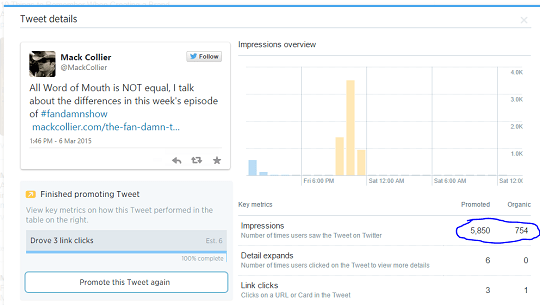
TweetPromotedNumbers are a bit hard to read, but what this means is that organically (free), my tweet reached 754 of my followers.  When I paid Twitter $10, they were able to reach 5,850 of my followers.  Which brings us to the second way to get engagement for your social media content: Pay for it.

Twitter is Dead and it’s Never Coming Back

I joined Twitter exactly 8 years ago.  For the first 18 months I was there, it was truly a magical place because of all the wonderful people I came to know.  But when ‘everyone’ found Twitter, the experience began to change.  And Twitter began to devalue the role of organic conversations on the site.  The core experience that attracted many of us to Twitter in the first place began to erode.  Now that Twitter has gone public, shareholders and Wall-Street will push for more monetization efforts.  Which means the experience that drew me to Twitter in the first place will continue to disappear.

And the irony is I’ll post this on Twitter, and a lot of the people that would agree with me, the people I connected with in those first 18 months will never see this post.  And it won’t be because there’s so much ‘noise’ on Twitter that my post gets lost in the content stream.

It will be because they’ve already left Twitter.

Share this:

  • Share on X (Opens in new window) X
  • Share on Facebook (Opens in new window) Facebook
  • Share on LinkedIn (Opens in new window) LinkedIn
  • Email a link to a friend (Opens in new window) Email
  • Share on Reddit (Opens in new window) Reddit

Like this:

Like Loading...

Filed Under: Twitter

March 18, 2015 by Mack Collier

The Fan-Damn-Tastic Marketing Show Episode 18: Your Customer Cultivation Strategy

Hey y’all!  Welcome to the 18th episode of The Fan-Damn-Tastic Marketing Show!  Last week’s episode talked about cultivating customers, and I wanted to talk a bit more about that this week and give you a few very simple examples of how you can do this on Twitter by showing you how I do the same thing in growing the #blogchat community.

Show Notes:

1:20 – The problem with focusing on customer acquisition vs retaining existing customers.

2:15 – How I cultivate new members for #blogchat and how you can do the same thing to cultivate existing customers on Twitter into fans of your brand.

3:00 – Segmenting your customers and understanding how each group has different needs and how you can engage with each to move them to the next level and cultivate them into ultimately being fans of your brand.

4:15 – New #blogchat users vs new customers of your brand.  What I do to help them come back the following week and how you can do the same to convince them to keep interacting with you and buying from your brand.

9:15 – How I engage existing #blogchat members and how you can do the same with existing customers.

12:00 – How I look to engage and reward the most active members of #blogchat and ideas for how you can do the same with customers that frequently engage with you, especially in a positive way.

The idea is, how can we first identify which segment a customer falls into (New, Existing, Customer with some affinity toward our brand, Brand Advocate), and what can we do to move them to the next level?  I think this episode will really help you frame your thoughts for how to do this and create a Customer Cultivation Strategy.

Here’s where you can download the episode directly.  And if you can, please subscribe to The Fan-Damn-Tastic Marketing Show on iTunes, and I would *love* it if you could review the podcast on iTunes as well.  Also, #FanDamnShow is now available on Stitcher as well! Thanks for listening!

[smart_track_player url=”http://traffic.libsyn.com/fandamnshow/Episode_18_-_CustomerCultivationStrategyFINAL.mp3″ title=”Your Customer Cultivation Strategy” ]

[smart_podcast_player]


Share this:

  • Share on X (Opens in new window) X
  • Share on Facebook (Opens in new window) Facebook
  • Share on LinkedIn (Opens in new window) LinkedIn
  • Email a link to a friend (Opens in new window) Email
  • Share on Reddit (Opens in new window) Reddit

Like this:

Like Loading...

Filed Under: Community Building, Fan-Damn-Tastic Marketing Show

March 18, 2015 by Mack Collier

Review: Paper.li’s iPhone Content Sharing App, Juice

(Disclosure: Over the last year I worked with Paper.li on its marketing and user-engagement strategies, but not on the development of its Juice app. I agreed to review the app here in exchange for letting me have a sneak-peek at it before it went public.)

Earlier this week, Paper.li launched its first iPhone app, Juice.  The idea behind Juice is simple:  Every day it analyzes your Twitter followers, and finds the 10 most popular links they are sharing, and gives them to you so you can share them as well.  Now at first this seems counter-intuitive, why would you want to share back the same content that’s already been shared?  But believe me, most of your Twitter followers have not seen the stories, and for most of them it’s great content that they enjoy seeing.

So when you download the app (You can get it here from the site and here from the iTunes app store), you sign in and it starts analyzing your Twitter followers to see what they are sharing.  Then, it gives you the 10 recommended stories for that day.

Here’s a couple of screenshots of what the suggested stories look like:

JuiceScreenshotsThen you can read the source, and/or share it. One thing I love is notice underneath the story it gives you some data either on the story, or the source.  Like for the Moz article on the left, underneath it adds that the story is ‘Shared 104.0x above average rate’.  This can help you decide which stories to share.

Then when you select to share a story, you get this view:

IMG_0461Guys look closely, when you share a story from Juice, the app automatically pulls a picture from the story and includes it in the tweet.  Adding a picture to your tweet is HUGE for bumping engagement.  I am constantly looking for stories to share from my feed reader or on other social sites, and when I click the RT button on a site, 99% of the time it does not add the post’s picture to the tweet.  Just the title of the story, and the link.  Which is crazy (click the blue Twitter button at the top of this post and you’ll see that the picture is automatically added to the tweet you’ll send out).  Adding the photo means a higher engagement rate.

Now there is one thing I don’t like about Juice, it currently doesn’t have an option for scheduling when the tweets can go out.  For example, let’s say Juice gives me 10 suggested stories to share today, and I decide that I want to share 7 of them.  The tweets will go out as soon as I send them.  I would like a way to schedule the tweets so that they go out say one every hour.  That way I can share the 7 stories over the span of the next 7 hours, instead of blasting out 7 links in 7 minutes.  By doing that, it limits the visibility that these tweets will get.

Other than that, I think Juice is a pretty lightweight and easy way to find and share content that your followers will enjoy.  It’s currently only available for iPhone users, but I believe they will be rolling out a version for Android users soon.  You can download the Juice app here from the site and here from the iTunes app store.  If you do use Juice, let me what you think!


Share this:

  • Share on X (Opens in new window) X
  • Share on Facebook (Opens in new window) Facebook
  • Share on LinkedIn (Opens in new window) LinkedIn
  • Email a link to a friend (Opens in new window) Email
  • Share on Reddit (Opens in new window) Reddit

Like this:

Like Loading...

Filed Under: Content Marketing, Social Media

March 17, 2015 by Mack Collier

Marketing Your Customer’s Passions: How Pedigree Invests in Happier Dogs

PedigreeAdoption
Pedigree isn’t marketing dog food, it’s marketing happier dogs.

A couple of weeks ago I wrote a post talking about how smart brands don’t market their products, they market the passions of their customers.  Red Bull isn’t selling energy drinks, it’s marketing and investing in extreme sports and activities.  Or what happens after you drink its product.  Patagonia isn’t marketing its clothing, it’s marketing the beliefs and passions of its customers, such as sustainability, being active outdoors, and protecting the environment.  Both companies are smart enough to focus on their customers’ passions, moreso than just their products.  Any marketing done for its products is done in a way that relates and connects with the passions of its customers.

Pedigree is another company that taps into its customers’ passions with its marketing efforts.  Pedigree is marketing to dog owners.  Obviously.  But dog owners don’t just love their dog, they love all dogs.  They care for all dogs and want all dogs to live happier and healthier lives.

Pedigree does too.  Of course, Pedigree markets that its dog food helps dogs live happier and healthier lives.  But that’s not going to resonate with customers, because all dog food manufacturers market that their dog food will improve the life of your dog.  So when Pedigree says that it loves dogs like you do, it doesn’t resonate because it sounds like marketing.

But that’s not all Pedigree does.  The dog food manufacturer actively invests in creating better lives for dogs, especially shelter dogs.  Pedigree is committed to helping shelter dogs live happier and healthier lives, and here’s three ways they follow through on this commitment:

1 – The Pedigree Feeding Project.  Pedigree partners with shelters across the country to provide them with free dog food.  The idea is that by getting better food and a better diet, these shelter dogs will be healthier, more active and energetic, which will increase their chances of being adopted.  Plus, it helps alleviate the costs of running the shelter for the owners, allowing them to spend more time and money on finding parents for their dogs.

2 – Pedigree Shelter Renovation Project.  Pedigree has partnered with GreaterGood.org and country music superstar Miranda Lambert to renovate dog shelters around the country, giving dogs places to play, and free dog food.  The idea again being that happier and healthier dogs will be adopted faster.

3 – Pedigree Adoption Drive.  This is the effort you are probably the most familiar with from Pedigree’s commercials.  The message is simple, adopt a dog.  You see commercials like this featuring Echo, who isn’t adopted:

And then he is….


By actively investing in initiatives that help dog shelters and make it easier for shelter dogs to be adopted into caring families, Pedigree is communicating to its customers that it shares their passion for happier and healthier dogs.  This makes the brand more interesting (and trustworthy) to customers because its rooted in larger ideas and themes (dog adoption, helping dog shelters renovate, helping shelter dogs get adopted by loving families) that the customer is passionate about.

It’s not about marketing the product.  It’s about marketing the larger passion that the product is a part of.  That larger passion is what customers care about.  Customers don’t care about your product until you help them realize how your product connects to the larger idea/theme/belief that they are truly passionate about.

If you can do that, then your customers will become just as passionate about your brand.

PedigreeAdopt


Share this:

  • Share on X (Opens in new window) X
  • Share on Facebook (Opens in new window) Facebook
  • Share on LinkedIn (Opens in new window) LinkedIn
  • Email a link to a friend (Opens in new window) Email
  • Share on Reddit (Opens in new window) Reddit

Like this:

Like Loading...

Filed Under: Brand Advocacy, Marketing

March 13, 2015 by Mack Collier

Creating Content or Memories; Is Social Media Warping Our Priorities?

5814285236_d3d0271449_z

In 2008 I spoke at a small business conference and during the event for the first time I started tweeting takeaways from the sessions I attended.  The attendees, many of who had no idea what Twitter was, were floored.  They couldn’t believe that there was a conversation happening inside the session they were attending, yet there was an online conversation happening about that same session.  They were hooked on Twitter, and I was hooked on live-tweeting conferences.  I gained dozens of followers an hour.  I looked forward to going to events just to live-tweet the sessions, cause I knew that if the session had a big name speaker, I could possibly gain 100 followers in an hour’s time.  Just from tweeting key takeaways to people sitting at home on their coach.

But after attending a few events I began to realize that while I was expanding my Twitter network, I wasn’t expanding my learning because I wasn’t paying attention during the session.  I told myself that my live-tweeting was a sort of digital note-taking, but the fact was, I wasn’t ‘present’ in that room and involved in the learning that was happening there.  I was on Twitter.

In 2009 I attended SXSW and one of the sessions I couldn’t wait to attend was Kathy Sierra’s talk.  As the talk was getting ready to start, I realized that I had to make a choice between live-tweeting the session, and actually paying attention.  I knew that Kathy’s talk would be wonderful, but would demand my attention.

So I turned off my laptop, and pulled out my notebook.  I took about 10 pages of notes and it was one of the most informative sessions I’ve ever attended at any event.  From that point on, I stopped live-tweeting events and decided that it was more important to be present.

It seems that for many of social media’s heavy users, documenting the moment is more important than living the moment.  Facebook and Twitter has created a culture of narcissism where creating content trumps creating memories.  The allure of Likes and Favs is too great for many of us, and I’m just as guilty as anyone.  Last year I was at an Alabama football game and Bama was about to score and I had my camera out trying to take a picture as they did, and I suddenly realized that I might get a picture of a touchdown, but in the process I will miss seeing it happen.

It’s important to document our experiences, but not if they get in the way of us having those experiences.  It’s a fine line to walk between creating content and living life.  How do you walk that line?  BTW VentureBeat has a fascinating study on this topic.

Pic via Flickr user Andrew Vargas

Share this:

  • Share on X (Opens in new window) X
  • Share on Facebook (Opens in new window) Facebook
  • Share on LinkedIn (Opens in new window) LinkedIn
  • Email a link to a friend (Opens in new window) Email
  • Share on Reddit (Opens in new window) Reddit

Like this:

Like Loading...

Filed Under: Being Alive, Social Media

March 12, 2015 by Mack Collier

What Every Blogger Wishes You Knew About Pitching Them

J0284982

You’re working for an agency that wants to get the word out about this cool new product/app/website that your client is releasing.  Here’s what you do:

1 – Google “(industry your product/app/website is in) bloggers”

2 – Get contact info of X number of bloggers based on Google search results and those ‘The 50 Best X Bloggers” lists.

3 – Cut and paste contact info into your database/spreadsheet/doc, etc.

4 – Cut and paste press release and send to each blogger, asking them to please email you with a link to their new article promoting your client.

5 – Sit back and wait for a flood of new posts from some of the most influential bloggers on the planet, all gushing about your client.


Any blogger that’s been pitched more than once knows there’s zero exaggeration to the above.  At least 90% of agencies and company’s pitching something to bloggers do this, and it never works.  The only good thing about this from the agency’s point of view is that they have been doing it for so long that most bloggers don’t even bother to publicly shame their crappy pitches.

Here’s why this strategy never works:

1 – You start off by building a list of bloggers that you don’t know.  It’s impossible to know every blogger, but uninvited pitches from agencies a blogger doesn’t know isn’t very endearing to that blogger.

2 – You target the most ‘popular’ bloggers.  These are the ones getting the most pitches, right?  So by default, you are setting the bar pretty high for your pitch.  When you simply cut and paste a press release, you are ensuring that your pitch goes straight in the Trash.

3 – You shouldn’t collect contact info to pitch bloggers, you should be collecting contact info to study those bloggers.  Actually read their blogs!  Try to learn a bit about who they are and what they do.  And most importantly, why your pitch would be relevant to them.

4 – Never pitch a stranger then ask them to please let you know when they have written their article promoting you.  That’s the fastest way to get your email posted on Facebook for public ridicule.


If I had to pitch bloggers today on a story, here’s the steps I would follow:

1 – Start with my own network.  Is there anyone I know that would be interested in this story?

2 – Start researching the space for X bloggers.  I’d do the same Googling as Step #1 at the top, but I’m not looking for the ‘A-List’ bloggers.  I am looking for B-List bloggers that appear to have a strong community on their blog.  These are bloggers that aren’t getting as many pitches as the A-List, but their strong connection with their readers shows that those readers trust them.  Plus it indicates that they will eventually become A-List bloggers, so it’s better to get on their good side now.

3 – Assemble my list of bloggers I want to pitch, then invest time reading each of their blogs.  I want to take the time to get to know who they are so I can determine if and why my pitch is relevant to them.  Yes, this is time-consuming.  And yes, it can be tedious work.  It can also be the difference between having a 0% response rate, and a 50% response rate.

4 – Once I have culled down my list to only the bloggers that I think would be interested in my pitch, then I start emailing them.  I tailor every pitch to that blogger, zero cutting and pasting is allowed.  I refer to them by their first name, not ‘Dear Blogger’ or ‘Dear Webmaster’ and for pete’s sake not ‘To Whom It May Concern…’  Oh and I make sure I call them by their correct name, as someone that gets pitched constantly as ‘Hey Mark!’, this matters.

5 – I make my pitch as short and relevant as possible.  I point out the nature of my pitch, and how it aligns with the focus of their blog (Which I know, because I took the time to read their blog).  If possible, I reference any posts they have already written about the same space or industry that relates to the story I am pitching.

6 – I end the email by thanking them for their time, and give them my contact info if they have any questions I can help them with.  I don’t ask them to write an article and place no expectations for them other than reading my pitch, and then I thank them for doing so.


And to be completely honest, my response rate is still going to be really low.  It will be much better than yours, but the cold, hard reality is that you have been sending crappy pitches to bloggers for so long that most of them have tuned out ALL pitches.  I get up to a dozen a day, and I delete 99% of them without even reading.

But if you are willing to do some legwork and actually give a damn about your job, it’s very possible to successfully pitch bloggers.  This is the best pitch I have ever gotten in 10 years of blogging.  Here’s what Kaitlyn did that made this pitch so great:

1 – She only targeted a handful of bloggers that she knew personally.

2 – She only targeted bloggers that covered marketing on their blogs.

3 – She made her pitch unique and creative.  She didn’t cut and paste a press release, she gave us a chance to ask the CMO at one of the world’s biggest brands a question and have him answer our question on video.  Gold!

4 – She created a pitch that was so useful to the bloggers she reached out to that they dropped everything to be involved.

5 – The pitch created insanely useful content for the bloggers, and free publicity for the client.  A huge win-win.  In fact, the post I wrote (linked above) ended up being one of the most popular posts I have ever written because the CMO gave me a huge nugget in his answer that created a story in and of itself.  Click the link to see what he said that was so interesting.


The bottom line in pitching bloggers is that your response rate goes up the more work you put into making sure your pitch is relevant to the bloggers you pitch.  Yes, that means spending some time reading blogs and actually attempting to learn something about the bloggers you pitch.  You’ll thank me when your response rate is 10X better than the competition.

UPDATE: Just checked my email, 1 min after I published this post, I received an email from someone I’d never heard of, all the email contains is a cut and paste of a press release.  Flagged as Spam.

Share this:

  • Share on X (Opens in new window) X
  • Share on Facebook (Opens in new window) Facebook
  • Share on LinkedIn (Opens in new window) LinkedIn
  • Email a link to a friend (Opens in new window) Email
  • Share on Reddit (Opens in new window) Reddit

Like this:

Like Loading...

Filed Under: Blogger Outreach, Blogging

March 11, 2015 by Mack Collier

The Fan-Damn-Tastic Marketing Show Episode 17: Customer Acquisition vs Customer Cultivation

TheCommunicationGap

This is a graph I drew to give you a visual representation of The Communication Gap between most companies and their customers.  The blue shading on the left represents the desired level of communication from the company’s side.  The company wants to communicate with almost all new and potential customers.  The number of existing customers the company wants to communicate with falls sharply, and the company makes little effort to communicate with its customers that have some brand affinity, and its brand advocates.

On the right side, the red shading represents that customers that do want to communicate with the company.  It’s almost all brand advocates, some customers with brand affinity, then a sliver of existing and new customers.

But note the purple sliver at the bottom.  This represents customers that want to communicate with the company, and that the company is communicating with them.  Also note that the company tries to communicate with its customers when they aren’t looking for communication (new and existing customers) then when they are wanting to connect (when they develop some affinity for the brand and become advocates), the company stops trying to talk to them.  It’s completely backwards and creates a huge communication gap in the middle of the customer’s journey from being a new customer to becoming an advocate.

When it comes to communication there’s a massive disconnect between what customers want and what companies are giving them.  The reason why is because companies are focused on customer acquisition when they should be focused on customer cultivation.

And that’s what I’ll be talking about during this episode of The Fan-Damn-Tastic Marketing Show!

Show Notes:

0:40 – The disconnect between customer acquisition and customer cultivation.

1:00 – Companies focus on acquiring new customers, but do little to cultivate existing customers.

1:30 – An explanation of The Communication Gap graph, which is posted above.

4:15 – Most of us do not want to talk to brands that we have no affinity toward.  ‘Your brand is not my friend.’  But if I am an advocate for your brand, I do want to connect with you.

5:00 – There needs to be a balance between focusing solely on acquiring new customers, and cultivating existing ones.  Customer cultivation helps transition existing customers into advocates for your brand.

6:10 – Can your company connect with me on a bigger level than simply your product?

6:40 – Notice how the orange shaded area almost perfectly overlaps the customers that rock stars focus on.  Rock stars do the exact opposite of companies, they focus almost solely on marketing to current fans, vs new customers.

7:45 – The Communication Gap is basically a hole where customers leave you.

9:00 – The value of creating a communication plan that focuses on the differing communication needs of each type of customers, to help new customers transition to eventually becoming brand advocates.

11:00 – We trust fellow customers more than we do a brand we have no connection with.


Here’s where you can download the episode directly.  And if you can, please subscribe to The Fan-Damn-Tastic Marketing Show on iTunes, and I would *love* it if you could review the podcast on iTunes as well.  Also, #FanDamnShow is now available on Stitcher as well! Thanks for listening!

[smart_track_player url=”http://traffic.libsyn.com/fandamnshow/Episode_17_-_Customer_Acquisition_vs_Customer_Cultivation_.mp3″ title=”Customer Acquisition vs Customer Cultivation ” ]

[smart_podcast_player]

Share this:

  • Share on X (Opens in new window) X
  • Share on Facebook (Opens in new window) Facebook
  • Share on LinkedIn (Opens in new window) LinkedIn
  • Email a link to a friend (Opens in new window) Email
  • Share on Reddit (Opens in new window) Reddit

Like this:

Like Loading...

Filed Under: Brand Advocacy, Fan-Damn-Tastic Marketing Show, Marketing, Uncategorized

March 4, 2015 by Mack Collier

The Fan-Damn-Tastic Marketing Show Episode 16: Building Better Word of Mouth

Hey y’all! Welcome to another episode of The Fan-Damn-Tastic Marketing Show.  This is the business podcast devoted to helping your company create and cultivate new fans, as well as helping you better connect with your existing fans.  Today’s episode talks about Word of Mouth, and the different types of WOM.  Did you think that all WOM, even all positive WOM is the same?  It definitely is not, and this episode talks about how WOM is different based on the customer and how to cultivate the best WOM among your fans.

Show notes:

1:00 – The business value of Word of Mouth

1:20 – Different types of Word of Mouth created by customers

1:45 – Better Word of Mouth is more effective WOM.  But what constitutes ‘better’ Word of Mouth?

3:00 – Customers that have more in-depth knowledge of your products can create better Word of Mouth about your products.

5:10 – Most companies leave their ‘high-level’ fans alone, but these fans create the best WOM, and should be encouraged.

6:10 – What can you do to improve the understanding and WOM generated by your customers that only have a basic understanding of your products and how to use them?

8:00 – There are levels to Word of Mouth. Fans that have a better understanding of your products create ‘better’ WOM.  Think of 101 level understanding creating 101 level WOM vs 401-level understanding creating 401-level WOM.

9:00 – What can you do to move the 101-level fans up to 201, then 301 then 401-level?


As always, #FanDamnShow’s amazing opener and closer is produced by the fantabulous Kerry O’Shea Gorgone.

Here’s where you can download this episode directly.  And if you can, please subscribe to The Fan-Damn-Tastic Marketing Show on iTunes, and I would *love* it if you could review the podcast on iTunes as well.  Also, #FanDamnShow is now available on Stitcher as well! Thanks for listening!

[smart_track_player url=”http://traffic.libsyn.com/fandamnshow/Episode_16_-_Building_Better_WOM.mp3″ title=”Building Better Word of Mouth” ]

[smart_podcast_player]


Share this:

  • Share on X (Opens in new window) X
  • Share on Facebook (Opens in new window) Facebook
  • Share on LinkedIn (Opens in new window) LinkedIn
  • Email a link to a friend (Opens in new window) Email
  • Share on Reddit (Opens in new window) Reddit

Like this:

Like Loading...

Filed Under: Brand Advocacy, Fan-Damn-Tastic Marketing Show, Marketing

March 3, 2015 by Mack Collier

My Blog Traffic and Podcast Audience Results For February

For every month in 2015, I’ve set specific goals for growing my blog readership, and podcast audience.  The end goal is that by December this blog will have at least 100,000 visitors for that month, and the podcast will be downloaded at least 10,000 times for December.  Every month I am going to write a post like this recapping how I did in the previous month, and share any lessons I have learned.  The goal is to help you learn how to build a blog readership and podcast audience as I do.

First, here were my goals for February:

Blog – At least 54,000 visitors

Podcast – At least 850 downloads

Now right off the bat I have to admit that I forgot when setting both goal amounts that there were only 28 days in February.  Oops!  My goals for last month should have been about the same as January.

Which is part of the reason why I didn’t hit either goal.

Let’s start by looking at how the blog did in February:

My total blog traffic for February was 50,225 visitors, averaging 1,794 visitors a day.  My average daily traffic in January was 1,735 visitors a day, so traffic increased slightly last month.

Here’s where my traffic came from in February:

Organic Search – 81.3%

Direct – 11.3%

Referral – 4.1%

Social – 3%

Email – 0.3%


Organic Search traffic went down slightly, and everything else went up slightly.  I am hoping that trend continues in March.

Posts written in February – 10.  My goal was to have at least 2 posts a week, so I hit that goal.  For March, I’m going to bump that goal up to at least 12 posts and 3 a week.

One of the things I’ve noticed about having goals for the blog for this year is that it’s forcing me to pay more attention to all the details.  Also, it’s prompting me to always look for ways to improve the experience here, which will improve the numbers.  One of the nagging issues on this blog has been slow load times. Up until a couple of weeks ago, it typically took over 6 seconds to load a page on this blog.  I’ve known for a long time that such a high load time was creating a subpar experience for many visitors, and a lot of people were probably leaving before the blog even loaded.

There were two main reasons for the slow load times:

1 – I was using Godaddy’s ‘Economy’ hosting.  The economy hosting is shared, meaning that it’s stuck on a server with hundreds if not thousands of other sites, which creates longer load times for all those sites.  A big reason why I never switched to a faster hosting method was because I was scared to death of the migration process.  I was afraid it would break my blog.

2 – The 2nd reason for the long load times were all the plugins I had.  Plugins do two things for your blog: They add functionality, and add load time.  So every plugin is a tradeoff between increased functionality for you and your readers, and increased load time.  I had always focused on the increased functionality, and ignored the increased load times.


So a couple of weeks ago I put my foot down and decided that it was time to get the load times for this blog down drastically.  When I started checking with a site called Pingdom, the blog was loading in a range of 5.5 to 6.5 seconds.  So an average of about 6 seconds to load.  Insanely high.  Here’s what I did to lower load times:

1 – I switched from Godaddy’s Economy Hosting to Managed WordPress Hosting.  This immediately shaved 1 to 1.5 seconds off the load times.

2 – I disabled any unnecessary or redundant plugins.  This saved 0.5 to 1 second of load time.

3 – I added the WP Smush.It plugin.  This plugin optimizes the images used on your blog.  More images means more time to load, and this plugin strips out any uncessary bits and bytes to make the images smaller and quicker to load.  This lowered the load time by about half a second.

4 – I turned off pingbacks.  This saved another 0.5 to 1 second off load times.

5 – I disabled the Jetpack plugin.  This saved another 0.5 to 1 second off load times.  This one was a big tradeoff.  The Jetpack plugin had a lot of functionality I needed, but that load time of an extra second or so was a lot.

6 – I changed the frontpage option to only display 3 posts instead of 7.  7 posts means more stuff to load, and longer load times.  This saved 0.5 to 1 second.


So at this point when the smoke had cleared, here’s how fast my blog was loading:

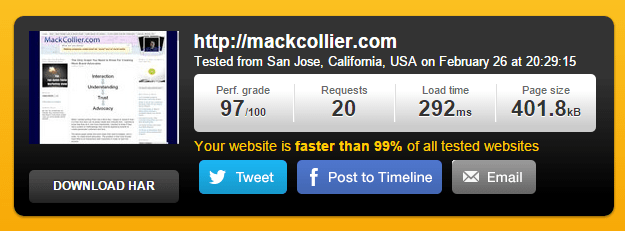
SIteSpeed4My blog had gone from loading in over 6 seconds, to loading in 3 tenths of a second!  That is freaking FAST.  Now that was with almost no plugins other than the bare essentials activated.  I wanted to strip out all of the fat, and get the blog loading as fast as possible.  I also wanted to give myself some leeway, because I would need to add a few plugins back, and those would bump the load times back up a bit.

The first problem I noticed was, I had no sharing buttons here.  Gotta have sharing buttons.  So I started researching sharing plugins, I specifically wanted a plugin that would add sharing buttons before the post, but also I wanted a plugin that wouldn’t add much load time.  I quickly discovered the Premium plugin Social Warfare.  The plugin got very good reviews, and I noticed that the developers promised ‘virtually instant load times’.  So I went with it and am using it on the blog now.  I really like it so far, and I’ve noticed it added about 3 to 7 tenths of a second of load time to my blog.  Which is pretty low.

So at this point, my blog is consistently loading in 0.7 to 1 second.  Very fast.  So what’s an ideal load time?  It really depends and you’ll hear a lot of different answers.  Personally, I think your goal should be to get your load time down to 2 seconds.  If it only takes 2 seconds to load your blog, most visitors probably won’t even notice that.  But if it takes you 3 seconds or longer, that can quickly become an irritant.  You can use Pingdom to check your site’s load time.  Don’t fret if your load time is over 3 seconds, the odds are you can make some very simple and quick changes to your blog to get that load time down by at least a second.

Podcast Numbers and Overview for February      

I made the same mistake in setting my podcast goal for February as I did with my blog: I forgot that there were only 28 days in February.

Goal for February – At least 850 downloads.

Actual number of downloads for February – 574

Oops.  This wasn’t even close.

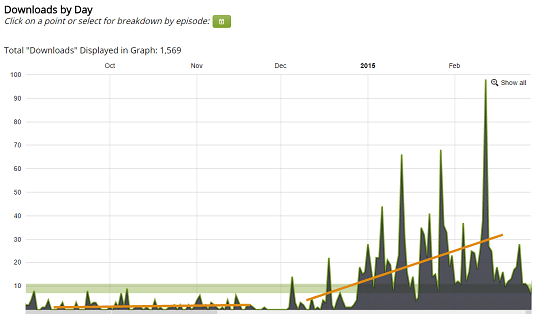
Here’s the podcast daily downloads over the last 6 months:

PodcastNumbersFeb

Now, there’s an explanation for why the numbers were down in February for podcast downloads.  In January I started to notice that my laptop’s keyboard was acting funky.  By early February it had gotten really bad, so I decided it was time to get a new laptop.  I found a Dell laptop that had all the bells and whistles I needed, but the problem is that it was a brand new model, and as such it wasn’t available at retailers yet.  The only option was to have Dell build me one, which would take 2-3 weeks to build and ship to me.  Ok fine, I ordered it.  And sure enough, a couple of days after I ordered it, my old Dell laptop officially kicked the bucket.  Which meant I couldn’t publish new podcast episodes until I got the new laptop.  So I was only able to publish two new podcast episodes in February.  I have the new laptop now so starting this week I’ll have regular episodes up again.  But this taught me a valuable lesson: Have a few episodes of the podcast recorded ahead of time to avoid a problem like this in the future.

So that’s how my February went here on the blog and with my podcast, The Fan-Damn-Tastic Marketing Show. My goals for March are:

Blog – At least 58,000 visitors

Podcast – At least 1,100 downloads.

I’ll share my results with you in one month!

Share this:

  • Share on X (Opens in new window) X
  • Share on Facebook (Opens in new window) Facebook
  • Share on LinkedIn (Opens in new window) LinkedIn
  • Email a link to a friend (Opens in new window) Email
  • Share on Reddit (Opens in new window) Reddit

Like this:

Like Loading...

Filed Under: Blogging, Fan-Damn-Tastic Marketing Show

February 24, 2015 by Mack Collier

It’s Not About Social Media ROI, It’s About Marketing ROI

SocialMEdiaSmallLet’s say you are the CMO at your company, and the CEO is demanding that sales for Product A increase by 10% above your projections for the next fiscal year.  He also says that you can only make one change to the marketing mix.


Would you:

A – Move billboard placements in Product A’s Top 10 markets from the interstate to downtown locations?

B – Launch a company blog designed to better explain the features, qualities and benefits of Product A?

C – Divert budget to more television ads designed to show why Product A is a better fit for customers than the competitor’s Product B?

D – Move all grocery end-cap displays in Wal-Mart up to the front registers?


In Marketing 101 class we learned about the AIDA model of consumer behavior.

A = Awareness

I = Interest

D = Desire

A = Action


Awareness leads to Interest leads to Desire leads to Action.  Note that the purchasing happens at the Action portion of this model.  So if we are looking at the individual components of a marketing plan, how do you define the ROI of tactics that comprise the Awareness portion of your plan?  In theory, you cannot, because customers aren’t ready to buy at this stage of their purchase journey.  This is why you create a comprehensive marketing plan that makes customers Aware of your product, that builds Interest in the product, then a Desire to Act.

When the smoke clears, you have a marketing plan that you can judge the ROI of.  But it doesn’t make sense to judge the individual tactics of a comprehensive plan from a ROI perspective.  No matter how much it wants to, your billboard on Highway 23 can’t close a sale for you.  At best, it can make your customers Aware of your product and make them Interested and increase their Desire to buy, but it can’t convert on the Action of buying.

So what does that mean for you, the social media manager at your company that is trying to explain and perhaps even defend why your company should be using social media to connect with customers?

It starts with having an honest discussion about what social media can and cannot do for your business.  First, social media has never worked well as a channel to facilitate direct sales.  Social media works best as an interaction channel, as a way for people to engage each other and be social.  Direct sales isn’t an activity that functions well in the middle of social conversations online anymore than pitching strangers chatting on the front porch on Sunday afternoon does.

So if social media works well as a channel for people to have interactions and discussions and to share content, then your business needs to find its value within those functions of the channel.  You want to be aware of how your current and potential customers prefer to use these tools, and work within those constraints.

What type of interactions do they prefer?  And with who?  With your brand, or with fellow customers?

What type of content are they creating?

What type of content are they sharing?

The idea is that you want to use social media in a way to connect with your customers and create value for them.  You create value for your customers by enhancing their experience via social media tools.  By giving them the type of high-quality content they are looking for and need.  By helping to facilitate the type of interactions they want and need (Hint: They don’t want to be sold to, they do want help dealing with a problem setting up your new laptop they just bought).

The best way to achieve your goals for social media is to help customers achieve their goals for social media.  Understand why your customers are on social and you will understand how you can create value for them via these channels.  That value will enhance your overall marketing results, which will lead to an increase in marketing ROI.

Share this:

  • Share on X (Opens in new window) X
  • Share on Facebook (Opens in new window) Facebook
  • Share on LinkedIn (Opens in new window) LinkedIn
  • Email a link to a friend (Opens in new window) Email
  • Share on Reddit (Opens in new window) Reddit

Like this:

Like Loading...

Filed Under: Marketing, Social Media

  • « Previous Page
  • 1
  • …
  • 49
  • 50
  • 51
  • 52
  • 53
  • …
  • 119
  • Next Page »

Recent Posts

  • My Substack Conversion Rate Went From 0.5% to 13% in Six Months, Here’s How
  • A Solid Conversion Strategy is Vital on Substack, Here’s the Proof
  • Empathy is Your Customer Service Secret Weapon
  • Understanding Substack’s Three Growth Stages
  • Blogging Isn’t Dead, it’s Morphed Into Substack

Categories

Archives

Comment Policy

Be nice, be considerate, be friendly. Any comment that I feel doesn't meet these simple rules can and probably will be deleted.

Top Posts & Pages

  • The Real Reason Why the Mona Lisa is So Popular Will Surprise You
  • I Do Not Deserve to Suffer Like This...
  • Why Did Jesus Send His Apostles Out With Nothing?
  • Understanding Substack's Three Growth Stages
  • How Much Money Will You Make From Writing a Book?
  • 10 Steps to Creating a Successful Twitter Chat
  • Have You Pre-Ordered Think Like A Rock Star Yet?
  • Trust is the Currency On Which Your Content Trades
  • Use TweetDeck to track who favorites your tweets
  • Something interesting is happening in Atlanta...

  • Blog
  • Mack’s Bio
  • Work With Mack
  • Buy Think Like a Rock Star
  • Book Mack to Speak

Copyright © 2026 · Executive Pro Theme on Genesis Framework · WordPress · Log in

%d