MackCollier.com

  • Blog
  • Mack’s Bio
  • Work With Mack
    • See Mack’s Work
  • Buy Think Like a Rock Star
  • Book Mack to Speak

November 20, 2013 by Mack Collier

Time’s Running Out to Land the #Blogchat Sponsorship in December

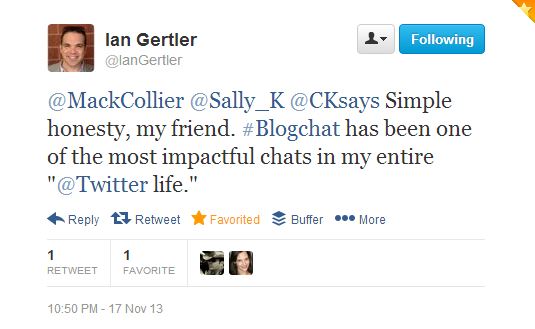
#BlogchatTweetIanHey y’all! I wanted to bring the #Blogchat sponsorship to your attention for a couple of reasons:

1 – December has 5 Sundays, so that means 5 #Blogchats.  So you are effectively getting 25% more #Blogchat for your money!

2 – Rates will increase by 33% starting in January.  Due to constant demand for sponsorships, the monthly rate starting in 2014 will increase from $1,500.00 a month to $2.000.00 a month.  So I wanted to make sure you have a chance to get the $1,500.00 rate before it disappears.

You can get full details here on what’s included in the sponsorship.

One area I wanted to cover here is that when you sign on as a sponsor of #Blogchat, I’ll work with you to make sure you get as much bang for your buck as possible.  We’ll work together to determine what you need to happen as a result of the sponsorship in order for it to be a success for your brand.  I don’t want this to just be a box you check off, I want you to see positive gains to your business from this partnership.

Also, please keep in mind that all potential sponsors are vetted.  I want to make sure that the sponsorship makes sense to you, and makes sense to #Blogchat.  In fact I have turned down three requests to sponsor #Blogchat just in the last week because I didn’t feel that the company would be a good fit for #Blogchat, or vice versa.

One of the first questions most potential sponsors have is ‘Will we have a say in the topics chosen for #Blogchat?’  The answer is ‘yes’, to a degree.  Obviously, I want to make sure that we cover topics that are relevant to you as the sponsor.  At the same time, I want to make sure the topics are relevant to the #Blogchat community as well.  Don’t worry, I am pretty creative in setting topics that create value for everyone, and here’s some examples of topics that were set for previous #Blogchat sponsors.

By the numbers, #Blogchat is one of the biggest if not the biggest Twitter chat around.  Each week 20-30 Million impressions of the #Blogchat hashtag are generated, and usually 2,000-3,000 tweets during the week.  Typically 1,200-1,500 tweets are generated during the hour of #Blogchat, Sunday at 8pm Central.  That’s an average of a new tweet every 2-3 seconds!

Additionally, I did a survey of #Blogchat participants early last year, and you can see the results here.  In general, about 1,000 people follow the #blogchat hashtag each week, half of those people blog for a company, typically a small B2B company.  And the majority of the participants are female.

If you’d like to sponsor #Blogchat in December, the rate is $1,500.00.  The sponsorship will be sold on a first-come, first-served basis, and if you are interested please email me and we’ll go from there!  Also if you know a company that would be a good fit to sponsor #Blogchat or one you would like to see sponsor #Blogchat, please share this post with them.  Thank you!


Share this:

  • Share on X (Opens in new window) X
  • Share on Facebook (Opens in new window) Facebook
  • Share on LinkedIn (Opens in new window) LinkedIn
  • Email a link to a friend (Opens in new window) Email
  • Share on Reddit (Opens in new window) Reddit

Like this:

Like Loading...

Filed Under: #Blogchat

November 20, 2013 by Mack Collier

Which Needle Are You Moving? How to Tell If Your Business Blog Is Working

BlogMouseOver the past few weeks I have, as you’ve probably noticed, seriously ramped up my blogging.  I’ve gone from writing 1-2 posts here a week to 5-6.  The reason why is because I want to see if I can turn my blog into a serious driver of work leads and referrals.  I started blogging more on October 20th, and I wanted to walk you through some of the metrics I am tracking to tell if my efforts are working.

First, a caveat:  We are talking very small numbers and very inconclusive data at this point.  After another 2 months or so, I should have some decent numbers and trends I can look at and tell if my efforts are paying off.  The goal here isn’t to pass judgement on my efforts after less than a month.  What I want to do is walk you through my thought process in measuring and tracking my efforts so you can apply this same formula to your own business blog to help decide if your efforts are working.

Traffic.  When it comes to blogging, traffic is likely the first metric that you’ll look at.  But traffic is often a ‘feel good’ metric that doesn’t always translate into actual business value.  For example, typical daily traffic here from Monday-Friday prior to October 20th was 700-800 visitors a day.  Now it’s 1,100-1,200 visitors a day.  That’s about a 50% increase in less than a month and sounds nice.  But my main goal from blogging more isn’t to get more traffic, it’s to get more qualified leads.

Now there are some ancillary benefits to increasing traffic.  For example, increasing traffic drives up readership and that makes sponsorships here or as part of a #Blogchat sponsorship more appealing to potential sponsors.

So What Metrics Should You Track to Tell If Your Business Blog is Working? 

First, you need to consider what action you want visitors to your blog to take.  For example, if you ultimately want to sell a particular product on your blog, then the metrics to track could be:

1 – Actual sales from blog visitors

2 – Visits to the product page on the blog

3 – Signups for a free trial of the product

Again, traffic to the blog doesn’t really matter unless that traffic is engaging in the actions that you want.

For me, I want visitors to engage in one of three different actions (ranked in terms of priority):

1 – Contact me about working with me.

2 – Visit pages related to working with me, such as my Work With Me page, or Speaking page, or Bio

3 – Share my content online

The idea is that if they aren’t contacting me directly about possibly working with me, I want them to either check out my info here, or at least share my content with other people so that they might be interested in working with me.

But it’s important to note that the type of engagement that’s likely to be the easiest to get (sharing my content) is the least valuable of the three.  This is common with blogging.  For example I can tell anyone how to get more traffic to their blog; Write more posts.  But just because you can easily get more traffic doesn’t mean that traffic by itself has any real value for you.  Sure, it can make your ego feel good to see that needle moving, but is that meaningful?

So when you are tracking your blog’s efforts, follow this process:

1 – Figure out what you want visitors to do on your blog.  What’s the one most important thing that a visitor could do on your blog?  Order a product?  Sign up for your newsletter?  Share your content?

2 – Track metrics that lead back to that most important goal.  If possible, you want a straight line from the metric you are measuring to the goal.  Prioritize your metrics so that you are tracking the one that most directly leads to your goal for your blog first.

3 – Only track metrics that feed back to your goal for the blog, either directly or indirectly.  If a metric doesn’t impact your ability to reach your goal then don’t track it.

Share this:

  • Share on X (Opens in new window) X
  • Share on Facebook (Opens in new window) Facebook
  • Share on LinkedIn (Opens in new window) LinkedIn
  • Email a link to a friend (Opens in new window) Email
  • Share on Reddit (Opens in new window) Reddit

Like this:

Like Loading...

Filed Under: Blog Analytics, Blogging

November 19, 2013 by Mack Collier

The Key to Social Selling is to Make Buying More Convenient, Not Marketing

Today Entrepreneur ran an article on FourSquare’s new ‘passive check-in’ feature where, apparently, when you are in proximity to a business, your phone will receive tips and information about the business.

Immediately, you can see how this feature could hold great potential for creating value for members, as well as spamming them.  On the one hand, relevant tips and suggestions upon entering a retail business could create value and convenience for the user.  On the other, it’s frustrating to pull your phone out every time you enter a new store just to hear about the weekly special, which you have no interest in.

In many ways, this represents the demarcation  line between success and failure when it comes to social media marketing.  On one side of the line you have the ability to create value more easily for customers, while on the other you have the ability to more easily market to customers.

Many marketers are drawn to the appeal of being able to more easily market to customers via social media tools and mobile devices.  The problem is, those customers aren’t using their social tools and mobile devices to receive marketing messages, they are primarily using these tools and devices to facilitate personal communications with friends and people they know.

For example, if I walk by a Target and get an ad sent to my phone saying Pepsi is on sale for $1.89 a 2 liter, that has no value for me, as a Dr Pepper drinker.  But if I get a text from my friend Tim that tells me that the Publix in Florence is running a special today on Dr Pepper for $1.00 a 2 liter, that might prompt me to go there to buy some.

So the key, especially with a mobile app like FourSquare is to give me relevant content that also moves me closer to the sale.  And be brave enough to understand that content might not need to come from you or your partners, but instead it might be more value if it comes from other users.  That might not always be your best sales opportunity upfront, but its likely your best way to create more satisfied users.

Share this:

  • Share on X (Opens in new window) X
  • Share on Facebook (Opens in new window) Facebook
  • Share on LinkedIn (Opens in new window) LinkedIn
  • Email a link to a friend (Opens in new window) Email
  • Share on Reddit (Opens in new window) Reddit

Like this:

Like Loading...

Filed Under: Mobile Marketing, Social Media

November 18, 2013 by Mack Collier

Post This, Not That: Social Media Etiquette for Brands

6129906404_23b3c21065_zNote from Mack: This is a Guest Post from Kerry Gorgone, who is an instructor at Full Sail University, a lawyer, and Wonder Woman in her spare time.  Check out her previous guest post here on protecting yourself and your works online.

Your brand needs to participate in the conversations that people are having about you in social media. 44% of Americans get information about brands via social networks, and more than half of consumers who mention a brand on Twitter expect a response within one hour. You can’t have a positive impact on brand sentiment or customer service until you join the discussion.

Consequently, going where your audience is makes good sense, provided the content you post there enhances your audience’s experience, rather than disrupting it. Here are some pointers.

Be conversational, not promotional.

For starters, don’t overtly shill. No matter which social network your brand is on, every post can’t be “Enjoy a hot cup of Brand X coffee!” People will unfollow you—or at least hide your posts—if your content is too self-serving.

Hidden posts are especially detrimental for marketers, because it looks as though you have a certain number of “Likes” for your business page, but people aren’t seeing your content, so engagement rates plummet.

Facebook’s algorithm already engineers things so that only a small percentage of people who have liked your page will see your posts, so you can’t afford to lose any.  For some general guidelines on how to behave on Facebook, check out Jennifer Kane’s excellent primer.

Instead of pitching or selling via social, ask questions, share tips or quotes, or share photos. Visuals are playing an increasingly important role across the board. Multi-photo posts on Facebook increased engagement 1290% in one case (and that’s not a typo).

Exercise caution when “newsjacking”

“Newsjacking” done right can masterfully direct traffic to your social media profiles and site while the news story you’re playing off of remains “hot.” Newsjacking done wrong can really damage your brand.

Social media posts during a crisis demand extra-thoughtful consideration. While your brand may well want to express sympathy for people impacted by a tragedy, it’s better to say nothing than to post something that people perceive as insensitive or exploitive.

Entrepreneur suggests asking 5 questions to guide you through the decision-making process on social media posts about the news. Run through them before you post: you won’t regret taking the time to reflect.

Match the tone of the conversation

Also remember that each social network has its own culture, so people who follow you on Twitter will expect a different conversational tone than those who follow you on Facebook or Instagram. If you haven’t been active yet, spend some time observing how your audience posts on each social network, so you’ll know what they expect.

Amy Howell of Howell Marketing shared this apt explanation: “Twitter is like being in a crowded, noisy bar. Facebook is like your living room. LinkedIn is like the chamber of commerce.”

Know when and where to use #Hashtags

Including hashtags in your social media posts can help people to find your content and follow the conversation, but they don’t work on every social network, and even if the functionality is supported, they might not be a fit for the culture.

Tweets with hashtags get twice the engagement, but hashtags actually lower engagement for Facebook posts, and hashtags don’t work on LinkedIn at all.

Understand your unique audience

Social media statistics provide a good starting point, but understanding your own audience will help you to deliver the kind of content that users will truly appreciate. Gather information on your audience through analytics and customer surveys, and test different types of posts, as well as post times.

Whether you sit down in a “noisy bar” or network at the “chamber of commerce,” think of social media as an extension of your relationship with your audience.

Is a brand you follow doing it right (or wrong)? Post a comment and tell us about it!

Pic via Flickr user Brett Jordan

Share this:

  • Share on X (Opens in new window) X
  • Share on Facebook (Opens in new window) Facebook
  • Share on LinkedIn (Opens in new window) LinkedIn
  • Email a link to a friend (Opens in new window) Email
  • Share on Reddit (Opens in new window) Reddit

Like this:

Like Loading...

Filed Under: Social Media, Social Media 101

November 18, 2013 by Mack Collier

Your Field Guide to What it Means When Someone Complains About Your Brand Online

J0202218It can be a scary (online) world out there, y’all.

For brands, this online world is particularly scary because they are very visible targets.  There’s no shortage of complaints and negative comments being hurled at them.  What’s worse, if they ignore the comments, they tend to multiply.  What’s even worse, most brands aren’t sure how to respond.  It can easily become a no-win situation.

So if we accept that your brand can’t ignore negative comments and complaints online, then we need to figure out how you will respond to them.  But before you can respond appropriately, you need to properly assess who you are responding to!

The Three Types of People That Will Complain About Your Brand

When you encounter a negative comment about your brand online, you need to understand who it is coming from, because that impacts how you will respond.  Negative brand comments come from one of three sources: Angry customers, passionate fans or trolls.  Here’s how to recognize each.

1 – Angry customers.  This is the most comment source of complaints you will see online.  Typically the complaint will deal with a very specific issue that this customer is having, and nothing else.  The complaint may include some larger statements about how this issue reflects poorly on your brand, but these are typically included to stress to the brand the need to pay attention to the person and fix their problem.  

Example complaint from an Angry Customer: “I just bought your writing software program and I can’t get it installed on my PC, and I can’t get anyone to help me!  I followed the instructions I found online (no manual included, why did I have to go online for instructions?) and it still won’t start.  I called your 1-800 customer service line and it said there was a 2 hour wait!  I just left a tweet to @SoftwareCustomerService on Twitter but so far no response!  Look I just want to get this product working, but I can’t get anyone at your company to help me!  Can you please call me at 1-800-frustrated customer or email me at need.help@acustomer.com?”

Note the complaint is only about their specific issue and how they want a resolution.  That’s it.  Note also that this customer is only contacting you because he tried to get the help he needed by himself, and couldn’t.

2 – Passionate fans.  This one is difficult for the untrained eye to spot.  The difference between a complain coming from a fan is that since the fan views themselves as owners of your brand, they feel an obligation to bring the issue to your attention.  But the fan will also communicate to you how you should resolve the issue, or they will offer to help you resolve the issue.  This is the easiest way to differentiate a complaint from a passionate fan vs a complaint from an angry customer.  The angry customer simply wants you to resolve THEIR issue, then they could care less if you fix the larger problem with your brand.  Whereas a passionate fan will focus less on a specific issue and more on how this is a larger problem for your brand, that needs to be corrected.  The fan will typically offer advice and suggestions for fixing the problem or making it better.  And they will frequently volunteer to work with you to help implement their suggestions.  Again, fans view themselves as owners of your brand, so they feel they have ‘skin in the game’ and will act in what they perceive to be the brand’s best interests.

Example complaint from a Passionate Fan: “Hey there! I’m a frequent customer at your restaurant on 201 Church Ave and typically love the service I get there when I come in for lunch.  However, over the past couple of weeks I’ve noticed that lunchtime service seems to be getting slower and slower, and the line of customers waiting to have their orders taken seems to get longer each time I go there for lunch.  I do notice that there seems to be several new members working there, so perhaps it’s just a matter of them needing to get up to speed.  But I have to say, I’m starting to notice that customers are leaving due to the long lines and going elsewhere for lunch, I hate to see you lose business due to slow service!”

Here, the person is careful to identify herself as someone that frequents this location, and that she is typically happy with the service there.  Also, she is careful to point out how the long lines are having an impact on the brand, by driving customers away to a competitor.  The tone isn’t angry, instead its sympathetic, she’s hoping that your brand will correct these issues, because she is a fan.

3 – Trolls.  Trolls typically attack the brand in vague terms rather than specific issues or events.  Rather than complaining about a specific issue with your brand, they might try to attack your brand based on your brand supporting certain charities or causes or political candidates.  Or they might complain about your products or service in general, and not focus on specific interactions they have had with your brand.  ‘You suck’ is their catch-phrase.  A troll simply wants attention and engagement, whereas angry customers or fans want a resolution.  Trolls just want you to keep engaging them, and they will typically try to piss you off in order to make that happen.

Example complaint from a Troll: “Is your brand still trying to act like it cares about the environment?  You can launch all the ‘go green’ initiatives you want, but we both know it’s purely propaganda, your brand doesn’t care about the environment, you are only piggybacking on a popular marketing trend for your own benefit!”

Note the attack is very vague and the claims are difficult/impossible to substantiate.  Again, the idea is to spark a response, ideally an angry response, at which point the troll would likely claim that they were being attacked by your brand.  Remember the saying ‘Don’t feed the troll’.

Tomorrow I’ll go more in-depth into how to respond to negative comments online.  But in short, here’s a quick cheat-sheet for responding to complaints online, based on the person making the complaint:

Angry customer – Resolve their specific issue as soon as possible.  Try to move the exchange offline so you can get specific information from them.  Also communicate to the appropriate teams internally where the customer encountered breakdowns in the customer service chain that resulted in their complaint.  Make sure you followup with the customer and ensure that their issue is resolved to their satisfaction.  Handling a complaint from an angry customer effectively is the quickest way to convert a detractor into a fan of your brand.

Passionate fan – Communicate to the fan that you are taking their feedback seriously, and will forward their recommendations to the proper people within your brand.  Ask the fan if they would be interested in giving you more feedback related to your brand.  A true fan will jump at this chance and it’s an opportunity to build an ongoing relationship with your fan.

Troll – In general, it’s best to ignore trolls.  If they are trolling on your site/blog, you are typically within your bounds to delete their comment, especially if it is a vague attack.  If they are leaving comments on another site, it’s still best to ignore them, but if they continually harass your brand you should contact the site administrator and ask them to look into the troll’s actions.

Share this:

  • Share on X (Opens in new window) X
  • Share on Facebook (Opens in new window) Facebook
  • Share on LinkedIn (Opens in new window) LinkedIn
  • Email a link to a friend (Opens in new window) Email
  • Share on Reddit (Opens in new window) Reddit

Like this:

Like Loading...

Filed Under: Social Media 201, Social Media Crisis Management

November 17, 2013 by Mack Collier

Getting and Writing Guest Posts, Tonight’s #Blogchat Topic!

CoffeeCupPad

Here’s the transcript to tonight’s #Blogchat (Click on Transcript on the left)

Tonight (November 17th, 2013) we’ll cover one of the most requested topics at #Blogchat, how to write and get Guest Posts!  #Blogchat is sponsored all month by Pencils.com, please follow them on Twitter and check out their blog!

Here’s what we’ll cover tonight at #Blogchat, starting at 8pm Central:

8:00PM-8:30PM Central – How to write Guest Posts for other bloggers.  We’ll talk about how to approach other bloggers about letting you guest post for them, and how to figure out what they want you to write about.  Writing guest posts for other bloggers is an excellent way to build awareness and exposure for yourself.

8:30PM-9:00PM – How to get bloggers to write Guest Posts for your blog.  On the flipside, if you can have other bloggers guest post on your blog, it’s a great way to get additional and valuable content on your blog, which benefits you by boosting your traffic and exposure!  Plus the blogger that wrote the guest post for you has a vested interest in promoting the post, which also promotes your blog!  Here’s a recent guest post that Kerry wrote for this blog.


So join us tonight starting at 8pm Central, or stop by a few minutes early to say hi!  You can follow the hashtag on Twitter here.

Share this:

  • Share on X (Opens in new window) X
  • Share on Facebook (Opens in new window) Facebook
  • Share on LinkedIn (Opens in new window) LinkedIn
  • Email a link to a friend (Opens in new window) Email
  • Share on Reddit (Opens in new window) Reddit

Like this:

Like Loading...

Filed Under: #Blogchat, #Blogchat Transcripts

November 14, 2013 by Mack Collier

Don’t Make the Same Mistake This Company Made With Social Media

A few years ago I talked to a company that believed they had figured out how to get ahead with social media.  This company could see that (at the time) everyone was starting to use Twitter, so they wanted to hire a ‘Twitter expert’, someone that knew how to use Twitter, who could also train their team on using Twitter so the entire company could be up to speed with using this one tool.

I replied with “Ok, so you’ll spend say 3 months with the hiring process and selecting and qualifying the candidates and hiring the right one.  Then that ‘Twitter expert’ will spend another 3 months training your staff so that 6 months from now, your team will be ready to start using Twitter effectively.  So what happens when 6 months from now, Twitter is no longer the ‘hot site’, and there’s a new cool tool and you’re back behind the 8-ball?  Do you then fire the ‘Twitter expert’ and hire a new expert for this new cool site?  Your best bet is to stop chasing the tools and start investing your time in learning how your customers are actually using these tools.’

This is what you need to do as well.  So much time is spent by companies chasing tools and trying to understand how to use the tools effectively.  This is putting the cart before the horse.  You don’t need to understand how to use Pinterest, you need to understand what activities your current and potential customers are engaging in on Pinterest and why.  Understanding the behavior of your customers using social media is far more important than understanding the social media tools they use.

For example, I spend a lot of time watching the stats on sharing around the content I share.  I spend a lot of time promoting my content on Twitter, and I know that the average post here currently gets about 40-60 retweets.  But over the last month, these two posts got over 200 retweets each:

1 – Think You Know Social Media? These Stats Will Blow Your Mind

2 – My Guide to Writing Totally Awesome Blog Posts Every Single Time

So when I see certain posts like these get shared far more than others, I try to understand why people thought this content was useful, so I can replicate that with future content I create.  I look at these two posts and I make a list of what I think ‘worked’ for people with these two posts:

1 – Both posts had a very specific headline.  You know exactly what each post will be about and that’s key because when you share posts on Twitter, your post’s headline is competing with all the other content that everyone else that they follow is sharing.  I just went to my Twitter home feed and saw these 3 new tweets come in:

Twittertimeline


Which tweet did you look at?  I bet you went straight to the tweet with the purdy pictures and ignored the first two, right?  The tweet with the picture earned your attention so you skipped over the first two tweets.  This is the point, you literally only have a couple of seconds to earn the attention of your followers, so that headline is crucial.  You have to tell people exactly what they are getting and make it interesting to them.  I actually changed the headline of this post to try to make it more interesting and relevant to people on Twitter.  Originally the headline was going to be Don’t Focus on the (Social Media) Tools, Focus on the People Using the Tools.  That headline sort of summarizes the post, and as I stated in the guide to writing awesome blog posts above, you shouldn’t do that with your headlines.  Which is why I changed the headline to be more specific, and I’ll be interested to see how many retweets and shares this post gets.

2 – Both posts addressed an exact need.  The first post on stats was a goldmine of stats about specific social media tools and usage in general.  This information is great for several different audiences: The guy or gal in the office that wants to convince their boss that they need to start using social media, the speaker that needs some great stats to add to their social media presentation or simply anyone that wants to self-educate when it comes to social media usage patterns.

The second post was a very specific How-To.  It was also a very detailed post that specific step-by-step instructions on how to solve a particular content-creation problem (creating awesome blog posts).  In fact if you read that post, you can hopefully see that I applied some of my own advice with that post, in writing this one.

BTW note that with both these examples, I’m trying to figure out how to get more retweets for my content on Twitter, but I’m doing so by trying to understand why people shared this content.  I’m not trying to figure out some ‘trick’ I can use on Twitter to get more retweets or some phrase to add in the tweet (like ‘Please RT!).  I’m far more interested in understanding customer behavior.  Why did people share these posts?  What made the content useful to them?  What did I do to earn their attention in those 2-3 seconds I had?  Because if I understand why this type of content was useful to others, then I can apply that understanding to all the content I create here from this point forward.

Don’t focus your time on understanding how to use social media.  Invest in first understanding how your customers use social media.  

Share this:

  • Share on X (Opens in new window) X
  • Share on Facebook (Opens in new window) Facebook
  • Share on LinkedIn (Opens in new window) LinkedIn
  • Email a link to a friend (Opens in new window) Email
  • Share on Reddit (Opens in new window) Reddit

Like this:

Like Loading...

Filed Under: Social Media

November 13, 2013 by Mack Collier

The Common Sense Guide For Brands That Want to Show Support Without Looking Like Asshats

One of the themes last week at #SoMeT13US was how do you create social media content that communicates that your brand supports people involved in a tragedy or situation, without giving them impression that you are simply trying to leverage the situation to promote yourself?

First, you don’t do this:

RandiTweetHere, Randi has taken a holiday that’s important to so many of us, Veteran’s Day, and she’s attempted to leverage the feelings we have for Veteran’s Day to support her book.  This isn’t the first time Randi has gotten into hot-water over an ill-advised tweet.  This tweet doesn’t honor Veteran’s Day or veterans at all, it’s a thinly-veiled promotion for her book, which many people quickly picked up on, which is why she’s caught flack over it.

Now check out how Three Dog Bakery mentioned Veteran’s Day on Facebook yesterday:

ThreeDogBakeryFB

See the difference?  The focus is on veterans, not the brand.  But notice that by including dogs in the update, Three Dogs Bakery was able to make the update somewhat relevant to its brand without making it about the brand!  That’s the difference between these two updates.  Randi’s update was about Randi.  That’s why it honked people off.  Three Dogs Bakery’s update was about honoring all veterans, ‘both two and four-legged’.  So the update was about Veteran’s Day and related to the brand.  Since it didn’t directly promote the brand, it didn’t upset people the way Randi’s tweet did.

It’s always risky to use social media to comment as a brand on an event or situation that many people have strong feelings about.  Still, many brands do want to communicate to their customers that they sympathize with their feelings and that they care about the people being affected.

So if your brand feels compelled to use social media to comment on a new event or other situation that many of your customers have strong opinions about, there are three ways you can respond:

1 – Show your support and sympathy for those involved and impacted, without any mention or promotion of your brand.  Unless your brand is a natural part of the story, then it’s incredibly risky to insert them into your update in any shape, form or fashion.  If in the future there is, God-forbid, a tragedy that affects your customers, you want to communicate that your thoughts and support are with those affected, without giving any impression that you are trying to leverage feelings associated with this event to promote your brand.  Remember that emotions will likely be high at this time for your customers, so you don’t want to send them any message that could possibly be misunderstood.

2 – If you must involve your brand in the update, mention ideas and themes related to the brand, not about the brand.  This is exactly what Three Dog Bakery did.  They didn’t insert their brand in the update, they mentioned dogs.  Which are related to its brand.  This is very tricky to do correctly, so be careful.  If it doesn’t pass the ‘smell’ test with you, then don’t post it.  At #SoMeT13US I mentioned that you should have a ‘devil’s advocate’ that comes up with all the possible objections that people might have to your update.  That can help you figure out if the tone and content of the update is too self-promotional or not.  Again, if your audience smells even a whiff of self-promotion from your brand, it will quickly backfire.

3 – Use the event/holiday/situation as an excuse to promote your brand.  This is obviously what you want to avoid in almost every possible situation.  You’re just inviting backlash and anger from the very people you want to connect with.

Before you publish that update ask yourself this simple question:  Where are we putting the spotlight?  If you are putting the spotlight on your brand, then start over.

Share this:

  • Share on X (Opens in new window) X
  • Share on Facebook (Opens in new window) Facebook
  • Share on LinkedIn (Opens in new window) LinkedIn
  • Email a link to a friend (Opens in new window) Email
  • Share on Reddit (Opens in new window) Reddit

Like this:

Like Loading...

Filed Under: Brand Advocacy, Social Media Crisis Management

November 12, 2013 by Mack Collier

How to Turn Big Ideas Into Big Gains For Your Brand

Back to work tomorrow. Anyone else having #somet13us implementation anxiety?? So much inspiration, where do I begin?

— Danielle Sparavalo (@Dani417) November 10, 2013


How many times have you attended a conference or a webinar or read an article that included that ‘big idea’ that you felt could really impact your business?  The idea that immediately sparked that ‘a-ha!’ moment and you felt that rush of excitement at the thought of implementing it.

Then you got back to the office the next day and realized that you had no idea how to implement that amazing idea!

It’s a Short Walk From Feeling Inspired to Feeling Overwhelmed 

The problem is we attend these events and connect with our peers and discuss these big ideas.  We convince each other that the big idea will have a big impact on our brand and get more excited about the prospect of acting on this big idea.  Then we go back to our office and have to implement these big ideas by ourselves.  This is when inspiration turns to feeling overwhelmed.  It’s also when many of these big ideas die before they’ve had a chance to help us.

Think Big But Start Small

The problem is that the big idea can seem like a big hassle to implement.  The key is to start small and to focus on the key element of the idea and start there.  For example, one of the big ideas that came from the Social Media Tourism Symposium was the power of embracing your fans.  Leveraging your fans to help grow your business or drive visitors to your destination is a great idea, but you shouldn’t let that great idea overwhelm you.

For example, if your company has never proactively connected with its fans, its can seem overwhelming to suddenly decide to launch a full-scale brand ambassador program.  That’s like trying to run before you’ve learned to walk.  Start small and give yourself time to grow into a place where you can fully tap into that big idea.

What’s the Core Idea of Your Big Idea?

Think about what makes that big idea a ‘big idea’.  If you want to embrace your fans, why is that important?  The main point is you want to start connecting with your most passionate and loyal customers.  If you aren’t ready to launch a dedicated program to connect with your advocates, then pick a smaller starting point.  For example, start by simply replying via social media tools like Twitter and Facebook when your fans reach out to you.  Saying ‘thank you’ when a customer says something positive about your brand might not seem like a big step, but if you start thanking all the customers that praise your brand via social media, it leads to more customers praising your brand! Starting small can grow into something big!

Starting Small is Better Than Never Starting at All

It’s far too easy to talk yourself out of getting started on that big idea.  You think about how difficult it is to get started (or to figure out how to get started!).  You think about how much work it is, how long it will take to see results, and how much work it would be.

Then three months later you read another article talking about that big idea that you forgot about because it was too difficult to implement.  You realize that if you had started working on that big idea three months ago when you discovered it, that by now it would be paying off for your brand.

What big idea are you passing on today, that three months from now you’ll wish you had acted on?

Share this:

  • Share on X (Opens in new window) X
  • Share on Facebook (Opens in new window) Facebook
  • Share on LinkedIn (Opens in new window) LinkedIn
  • Email a link to a friend (Opens in new window) Email
  • Share on Reddit (Opens in new window) Reddit

Like this:

Like Loading...

Filed Under: Brand Advocacy

November 11, 2013 by Mack Collier

Giving Up Control of Your Marketing Without Losing Your Mind

MP900438571Last week I keynoted the Social Media Tourism Symposium in Huntsville, Alabama.  It was a fabulous event and one of the recurring themes covered was the importance of giving up control of marketing to your destination’s fans and advocates.  Obviously I was thrilled with this, but at the same time I realize that this can be scary as hell for many marketers regardless of the industry you’re in.

What it comes down to is changing your mindset, and understanding the mindset of your fans and advocates.  Let’s tackle each area separately:

Changing Your Marketing Mindset

As a business/brand/destination/organization your marketing mindset is to promote yourself.  To get the word out about who you are and what you do.  Because people can’t and won’t buy from you until they know who you are and what you can do for them, right?

But in recent years the advent of digital content creation tools has changed the game for marketers.  Now there is an incredible amount of content being created every single day.  In the days before social media it was far easier to buy attention.  Today, it has to be earned.

So how do you earn attention?  By creating useful content.  Look at the content I have created here.  Hopefully you’ll look at the posts and view them as useful posts that can help people.  But when you get down to it, these posts are marketing.  I am marketing my ability to work with companies to help them better connect with their customers and cultivate advocates via social media and other marketing channels.  There’s not a lot of directly promotional content, in fact I probably should have more.  The idea is to create useful content that you will use and share with others.  In doing so, the content spreads to people that can hire me and it also helps to establish my expertise.

So instead of creating content that directly promotes your business, create content that’s customer-centric, that focuses on problems that your customers are having.  Becky McCray suggests that you should think of every question that your customers have about your products and business, and answer those questions on your blog.  In short the rule is this:  The more valuable your content is for your audience, the more it will spread and the more it will promote you.

Understanding the Mindset of Your Fans and Advocates

Many marketers view their fans and customers as being more or less the same.  Nothing could be further from the truth.  Customers feel little to no natural affinity for your brand, while fans have extremely high levels of loyalty toward your brands.  Fans want to interact with you and will in fact seek out ways to do so.  On the other hand, your average customer could care less if it ever interacts with you unless there’s a problem or issue it wants you to address.

Additionally, it’s important to know that fans consider themselves to be owners of your brand.  They consider your brand to be their brand, which is a big reason why they love your brand.

This also means that they will act in what they perceive to be the best interests of your brand.  They will actively promote it to others.  They will bring what they feel are potential problems to your attention (and be happy to help you fix the problem).

The bottom line with your fans is that they are the good guys.  They literally want to work on your behalf to help your brand, so instead of keeping them at arm’s distance, you should work with them and make sure to thank them.  Early and often.


So here’s your plan for changing your marketing and your mindset:

1 – Focus on creating content that creates value for your current and potential customers/donors/visitors/partners.  If your content creates value for others then they will use it and share it.  Which means more exposure and opportunities for you.

2 – Don’t ignore your fans, view them as your partners.  They want what’s best for you, so connect with them and give them the attention and respect they deserve.

Share this:

  • Share on X (Opens in new window) X
  • Share on Facebook (Opens in new window) Facebook
  • Share on LinkedIn (Opens in new window) LinkedIn
  • Email a link to a friend (Opens in new window) Email
  • Share on Reddit (Opens in new window) Reddit

Like this:

Like Loading...

Filed Under: Brand Advocacy, Think Like a Rockstar

  • « Previous Page
  • 1
  • …
  • 61
  • 62
  • 63
  • 64
  • 65
  • …
  • 119
  • Next Page »

Recent Posts

  • My Substack Conversion Rate Went From 0.5% to 13% in Six Months, Here’s How
  • A Solid Conversion Strategy is Vital on Substack, Here’s the Proof
  • Empathy is Your Customer Service Secret Weapon
  • Understanding Substack’s Three Growth Stages
  • Blogging Isn’t Dead, it’s Morphed Into Substack

Categories

Archives

Comment Policy

Be nice, be considerate, be friendly. Any comment that I feel doesn't meet these simple rules can and probably will be deleted.

Top Posts & Pages

  • The Real Reason Why the Mona Lisa is So Popular Will Surprise You
  • Let's Take a Closer Look at Patagonia's Worn Wear Road Tour
  • Why Did Jesus Send His Apostles Out With Nothing?
  • Understanding Substack's Three Growth Stages
  • Case Study: Patagonia’s Brand Ambassador Program Focuses on Product Design and Development Over Sales
  • The Difference Between a Brand Ambassador and a Brand 'Spokesperson'
  • How Much Does a Brand Ambassador Program Cost?
  • Case Study: Why GE Started an Employee Brand Ambassador Program to Solve One Specific Business Problem
  • #Blogchat LIVE is coming to Content Marketing World!
  • 10 Steps to Creating a Successful Twitter Chat

  • Blog
  • Mack’s Bio
  • Work With Mack
  • Buy Think Like a Rock Star
  • Book Mack to Speak

Copyright © 2026 · Executive Pro Theme on Genesis Framework · WordPress · Log in

%d