MackCollier.com

  • Blog
  • Mack’s Bio
  • Work With Mack
    • See Mack’s Work
  • Buy Think Like a Rock Star
  • Book Mack to Speak

January 13, 2014 by Mack Collier

The Free Economy: Why It’s Making Everything More Expensive

Over the past several years as publishing and content creation tools have flourished, so has the idea that anything free is inherently better or at least more desired than content or tools that cost money.  Whether you are an individual or company looking to make a name for yourself, the path is pretty linear: Create gobs of free content or give users free usage of your tool, and eventually they will want to pay you for your content or tool.

Until, they don’t.

For years, this sort of freemium model was successful: Provide limited and free access, then when people saw the value of your content/tool, charge them money for additional access and features.  But over the last couple of years, I’ve noticed a disturbing trend among my peers and networks.  People will stay with a tool or content creator as long as their content/tool is free, but as soon as they ask for money, most people jump off and look for another free source.  There’s so many sources of information that the thinking seems to be that someone else will offer better functionality at a free price.  Or instead of paying this writer $9.99 for their ebook, I can get the same information for free from blogs.

Too often, the most important attribute assigned to online content or tools is that they be free.  Free = better in the minds of many.

Here’s an example: My modest newsletter is now up to 1,000 subscribers.  I publish a new issue every week or so, and the newsletter is designed to give subscribers information they can use to better create engagement around their digital marketing efforts and create fans of their brand.  All for free.  Yet every 4th or 5th issue (often I will publish this as an additional issue for that week), I will use the newsletter to directly promote a product or service I offer.  Many people do this with every newsletter issue they publish, but I like to do it about 20-25% of the time.  Typically when I publish a newsletter issue, I will have 1 or 2 people unsubscribe, on average.  But every time I publish a newsletter issue where I am trying to directly sell to my subscribers, the number of unsubscribes always spikes, typically it’s 500% or more higher than the average issue.  The people that unsubscribed left as soon as I asked for the sale.  In other words, they were willing to take and use my content as long as I was providing value for them, at absolutely no cost to them.  But the second they saw an ‘ad’, they left.

It’s not just content, any of you that conduct regular meetings for organizations such as the AMA or Social Media Club have seen the same thing.  If the meetings are free, attendance is high, but when you begin charging even a few dollars, attendance falls off a cliff.

The thinking seems to be that if your offering isn’t free, you can’t compete.  Which means that if there are more free options, there are also more bad options.  And we all spend more time trying to figure out which free option is the best, without realizing that the additional time is costing us more than paying a few dollars for a valuable service or piece of content.

You don’t become an expert by reading an expert’s blog.  You become an expert the same way they did; By doing stuff.  I’ll let you in on a secret: I’m not writing this blog to teach you how to become an expert, I’m writing this blog to establish *my* expertise in social media marketing, online community building and marketing strategy, so you will hire me.  Sure, some people will be able to read my posts here, follow my instructions and launch a brand ambassador program for their company.  But what I hope happens is that a company would read my posts, realize how much time and money it would cost that company to launch a brand ambassador program itself, and instead hire me to do it for them.  I get paid, they save time and money.

I’m not sure what the answer is, but what I fear happens is you have a lot of very smart individuals and startups that throw in the towel because they can’t make money on a product or content by giving it away for free.  For instance, consider the plugins on your blog, how many are you paying for?  Are you paying for any of them?  I have about 30 plugins, and only pay for two of them.  In both cases, I wanted a plugin that did specific things, and couldn’t find a free version that did, so I paid for the services I wanted.

Many of us bemoan the glut of content being created these days.  Everyone is creating content and it’s all the same.  But it’s also (mostly) free.  We complain about how Twitter or Facebook isn’t working right, how the sites run too many ads, yet we forget that we aren’t paying a penny to use either service.

Nothing is truly free and I think we need to realize that if we aren’t paying for content or a tool on the front-end, there is a cost in terms of time, diminished experience, etc on the back-end.  The myth of the free lunch is just that.
Share this:

  • Share on X (Opens in new window) X
  • Share on Facebook (Opens in new window) Facebook
  • Share on LinkedIn (Opens in new window) LinkedIn
  • Email a link to a friend (Opens in new window) Email
  • Share on Reddit (Opens in new window) Reddit

Like this:

Like Loading...

Filed Under: Marketing, Social Media

January 8, 2014 by Mack Collier

Stop Selling Ice to Eskimos, Get a Better Content Strategy in 2014

Last year I made a big mistake on my blog, and it’s a mistake I am constantly reminding y’all not to make.

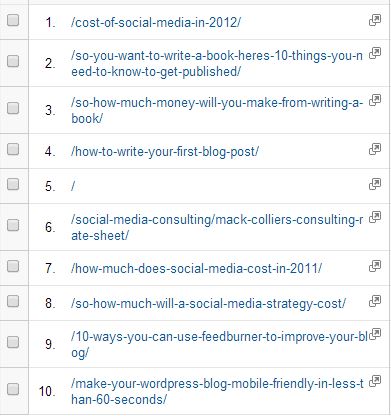
Here’s a list of the Top 10 most popular blog posts here last year:

BlogStatsNote the #2 and #3 blog posts are about book publishing.  I wrote these last year while I was launching my book.  I wanted to share what I had learned so that the information could benefit other consultants, marketers or really anyone that wanted to be a writer or was considering writing a book.  And the top search term that people used to find this blog last year was ‘I want to write a book’.  By a 10 to 1 margin over the #2 search term.

There’s just one (big) problem.  Current or potential writers that want to make money off writing a book is not my target audience.  Not even close.  So while these two posts were very popular, they helped connect me with an audience that I had no services for.  But I forgot this because I was focused on how these posts could be valuable to readers.  I just lost sight of the fact that they wouldn’t really create value for a big portion of my target audience.

This is one of the lessons I am always preaching here, to keep in mind the audience you are writing for.  I want to create helpful content for my desired audience.  The two posts on book publishing were very helpful, just not for the people I am trying to connect with.

Here’s a simple way to keep your content focused in 2014:

Create three content areas or buckets.  These will be the three areas of your business that you want to focus on with your content.

For example, if your blog is for your lawn care business, your three buckets could be:

1 – Killing insects in your lawn

2 – Growing healthier flowers for your yard

3 – Proper maintenance of your lawn

So for every post you write, you need to make sure it fits into one of these three buckets.  If it does not, you need to justify why you should publish the post.  This is a great way to keep your content on track and to make sure that you are only creating content that’s focused on your business.  An added benefit of this is that as you are creating content around the relevant areas of your business, you will be helping Google identify your blog with certain relevant keywords.  For example, I would rather people find my blog via a search term like ‘building a brand ambassador program for my company’ versus ‘i want to write a book’.

Additionally, you need to always consider who you are writing for.  For example, this blog is a business development tool for me.  Which means if I am creating content, I need to create content that is useful to the people that can give me business.  In evaluating my content here from last year, I noticed that too often I was creating content that was useful to solo bloggers.  I love helping solo bloggers (a big reason why I launched #Blogchat) but solo bloggers aren’t the audience I want to be getting business from.  So that’s why the majority of my content this year will be focused on how brands can market more efficiently, because brands and companies are the audience that I want to do business with.

It pays to go back every month or maybe every quarter and self-evaluate your content and your content strategy for your blog.  Look at what type of progress you are making on reaching your goals, and then make sure that you are still creating the type of content that you need to in order to reach those goals.

Share this:

  • Share on X (Opens in new window) X
  • Share on Facebook (Opens in new window) Facebook
  • Share on LinkedIn (Opens in new window) LinkedIn
  • Email a link to a friend (Opens in new window) Email
  • Share on Reddit (Opens in new window) Reddit

Like this:

Like Loading...

Filed Under: Blogging, Content Marketing, Social Media

January 7, 2014 by Mack Collier

Reaching a More Connected Customer Requires a More Connected Company

Over the Holidays I was reading an issue of the Wall-Street Journal about how companies are leveraging Twitter to improve its marketing.  Companies that sell cold medicines and items, especially those related to treating the flu, are closely monitoring Twitter.  They are tracking instances of people complaining on Twitter about having flu symptoms such as body aches, coughing and colds.  Then they will track where these people live, and make sure that local retailers are have sufficient inventory of any cold treatment products or medicines that the company sells.  Clorox and Kimberly-Clark (makers of Kleenex brand tissues) both reported double-digit sales growth by utilizing Twitter and online chatter to drive shipments of cold products during the previous flu season.

While this type of conversation-mining might seem revolutionary to many companies, it can seem a bit underwhelming to the customers these companies are trying to reach.  This type of functionality has long been available even in basic and free versions.  The now-defunct site Monitter.com provided users location-based searching based on zip code.  Even Twitter now provides this functionality, and you can even factor in user sentiment.

community building, online community

We’ve been chattering on Twitter for several years now.  When companies first arrived their goal was to market and promote.  As the above examples illustrate, now they are beginning to understand the value of listening.  One of the great marketing benefits of social media for companies is word of mouth in digital form.  Before social media and the internet, if customers in Nashville began complaining about flu-like symptoms in December, they did so via analog tools that were largely inaccessible to companies that sold products that could have helped them relieve their flu symptoms.  Today, we are increasingly using digital and social media tools, and as such, our word of mouth is now in digital form so companies can access it and act on it.

But the key is that companies must make the effort to access that customer feedback.  If your company is consistently tracking and analyzing this digital word of mouth from your customers, you will begin to notice trends and patterns.  You will begin to develop a deeper understanding of your customers.

Which means you can market more efficiently to them.  By 2014, most companies that do any business online are at least experimenting with social media.  But few companies are truly utilizing social media efficiently to drive real business growth.

If you want to be in the minority of companies that are using social media marketing correctly, start by leveraging these tools to better understand your customers.  Too many companies start using social media to better sell to customers.  That should come later.  Use this simple format:

1 – Listen first, then take what you learn and apply it to…

2 – Engaging with your customers.  Interact with them, help them, and create value for them.  That leads to…

3 – Sales

Instead, too many companies put the cart before the horse and jump in immediately trying to sell to people they don’t understand via tools they don’t understand.

Don’t put the digital cart before the digital horse.  It’s not about understanding the tools, it’s about understanding how and why your customers are using the tools.  Then you can move forward.


Share this:

  • Share on X (Opens in new window) X
  • Share on Facebook (Opens in new window) Facebook
  • Share on LinkedIn (Opens in new window) LinkedIn
  • Email a link to a friend (Opens in new window) Email
  • Share on Reddit (Opens in new window) Reddit

Like this:

Like Loading...

Filed Under: Social Media, Social Media Monitoring, Twitter

January 3, 2014 by Mack Collier

Behaving Badly Online and the Power of Eating Your Own Dog Food

A few months ago a well known ‘social media guru’ on Facebook said I was a hateful and fearful person, just because I disagreed with them on a particular social issue.  Actually, they didn’t single me out, they said that anyone that disagreed with them was hateful and fearful and intolerant (the irony of their intolerance was blissfully lost on them).  Then for good measure, another gooroo took the opposite stance on this same issue, and said that anyone that disagreed with them was hateful and fearful.  So we were screwed either way.

Over the last year or so, I’ve noticed an increase in people behaving badly online.  What’s most troubling to me is, a lot of this bad behavior is coming from ‘social media experts’ that advise companies on how to deal with customers online.  Consultants and agencies that train companies on how to respond appropriately online, then turn around and break their own rules when they get on their personal social media accounts.

Case in point, the recent episode with Justine Sacco’s tweet about her trip to Africa.  It was an incredibly bone-headed and immature tweet to leave, and it was pretty obvious as soon as she did that she was going to get canned, and she did.

What wasn’t expected was the near mob-mentality that erupted on Twitter especially.  It was as if her detractors on Twitter (and at this point there were many, mostly due to her own words) were waiting for a sense of closure that would only come from her being fired.  The longer it went without seeing her termination, the louder and angrier the mob got.  As my friend Ann Handley said:

I’m not trying to be sanctimonious here – I understand it’s human nature to grab a pitchfork and a club and join the march.

Or is it? Can’t we expect more from an evolved, networked, smarter world? Aren’t we better than that?

The challenge for companies is to treat content publishing as a privilege—to respect your audience and deliver what they want in a way that’s useful, enjoyable, and inspired. But the larger challenge for humans is to treat publishing with a similar respect—understanding the responsibility and power than comes with the ability to communicate with a global audience.

Additionally, I think that those of us that want to instruct companies on how to properly engage customers online should be held to a higher standard.  That means if you want to be noted as an expert in helping companies engage customers online, you lose the right to then go on Facebook and call Obama/Romney an asshole just because you’re a Republican/Democrat.

It means you have to eat your own dog food.

I’ll be the first to admit that I have slipped up a time or two and have discussed politics online.  I think most of us have, and there’s nothing wrong with that.  But if I start attacking people online simply because they support a different political party, I really do forfeit the right to call out brands for behaving badly.  We cannot hold brands to a higher standard than we hold ourselves.

We always talk about how brands need to be ‘more human.’ Sometimes we ‘humans’ do too.

Share this:

  • Share on X (Opens in new window) X
  • Share on Facebook (Opens in new window) Facebook
  • Share on LinkedIn (Opens in new window) LinkedIn
  • Email a link to a friend (Opens in new window) Email
  • Share on Reddit (Opens in new window) Reddit

Like this:

Like Loading...

Filed Under: Being Alive, Social Media

January 2, 2014 by Mack Collier

It’s 2014, Let’s Stop Talking About Social Media

5367598942_50a442693e_z

Happy New Year, y’all!  2014 begins my 10th year of being immersed in the world of social media.  I can remember when social media was simply blogs and MySpace.  Then Facebook and Twitter came along, and we all began to wonder when companies would begin to notice these amazing tools and what they could help them accomplish.

Finally, around 2008 0r 2009, companies start to pay attention to social media.  But in the five or so years since then, the conversation has largely remained focused on the tools themselves.  It’s long-overdue that we stop focusing on the tools and start focusing on understanding how and why people are using these tools.

Let’s stop focusing on social media and instead focus on how social media usage by our brand can relate to larger and far more valuable business objectives:

1 – Customer satisfaction

2 – Customer loyalty

3 – Sales

It’s time to elevate the conversation.  Actually it’s about 5 years past time to elevate the conversation.  We need to stop talking about the tools, and instead focus on the larger business goals that the tools help us reach.  For too long social media strategists/agencies and firms have been trying to sell companies on using social media with a tools-oriented argument.  Key executives that work within companies that approve marketing budgets don’t speak in terms of tools, they speak in terms of results.  A 15% increase in sales in Q3, a 10% reduction in product returns for the year or a 20% reduction in staff turnover.

When we change our conversation to stop focusing on the tools and instead focus on how the tools impact the bottom line, we earn the attention of companies.  It sends a completely mixed message to companies when we strategists say that companies need to invest in social media, but we talk about how that investment will lead to increased social media engagement, brand awareness, Likes and comments.  We tell companies that social media is important, then speak about that importance in metrics that are totally unimportant to the average company.  

So there’s no wonder they aren’t listening.  Neither are customers, because we are focused on ways to use social media to turn customers into digital billboards for our brands.

Stop the insanity!

If it’s 2014 and you are just now considering using social media to connect with your customers, I have good and bad news for you:

The bad news is: You’re way behind.

The good news is: Most companies that are using social media suck at it, so you can catch up quickly if you are smart.

It’s not about understanding the tools, it’s about understanding the people that use the tools.  That should be your focus in 2014.  Tools change but it’s always a good idea to understand who your customers are and how you can create value for them, regardless of the tools they (and you) use.

Pic via Flickr user DigitalLeica

Share this:

  • Share on X (Opens in new window) X
  • Share on Facebook (Opens in new window) Facebook
  • Share on LinkedIn (Opens in new window) LinkedIn
  • Email a link to a friend (Opens in new window) Email
  • Share on Reddit (Opens in new window) Reddit

Like this:

Like Loading...

Filed Under: Marketing, Social Media

December 19, 2013 by Mack Collier

Amazing #Blogchat Stats From 2013

Thanks to Hashtracking I was able to track the #Blogchat stats for 2013, and came up with some pretty interesting results that I wanted to share with you.

First, a caveat: Hashtracking switched me over from their account to an account just for me in February, so there’s a gap of 9 days where we didn’t have stats for #Blogchat.  So all stats associated with the chat are approximate.

#blogchatStats2Actually the number I currently have is right over 116,000, so if you add in the gap in February and the final 12 days of this year, we’ll end up with right at 125,000 #Blogchat tweets generated this year.  Yes, we are a chatty bunch!

Here’s how those tweets break down (Feb-now):

#blogchatStats3As you can see, 39% of the #Blogchat tweets are someone replying to someone else.  It’s a conversation, which is why #Blogchat has been so successful and what I love about the chat.  Smart people sharing what they know and learning from each other.

#blogchatStats4

Amazing number, isn’t it?  That’s the size of many small towns!  It also speaks to the diversity of the #Blogchat community.

#blogchatStats5I think this is really interesting.  26% of the tweets come from the 20 most active contributors, and 48%, almost half, of the tweets come from the 100 most active contributors.  So half the tweets are coming from 0.5% of the members!   

#blogchatStats6Thanks to Patrick, Linda, Bruce, Georganna and Janice for being the 5 most active members of the #Blogchat community this year.  If you are new to #Blogchat, these guys are a must-follow!

Of course, one of the things that makes #Blogchat so valuable is all the amazing co-hosts we get to learn from.  2013 was certainly no exception…

#blogchatStats7

 We were extremely lucky to learn from Kerry, Chris, Mitch, Jay, Carrie, Dave and Sheila this year.  As an added bonus, here’s the transcript from each co-host’s #Blogchat:

Kerry – Legal aspects of blogging

Chris – Incorporating video into your blogging

Jay – How to create Youtility in your blogging

Dave – Leveraging your blog as a networking tool

Sheila – Blogger outreach

Carrie – How a small biz can make money from blogging

Mitch – Lessons learned from a decade of blogging

Biggest #Blogchat of the year?  That came on the Sunday of March the 10th, when 3,038 tweets were generated!

Oh and who was the person with the most followers that used the #Blogchat hashtag in 2013?  That would be this guy:

#blogchatStats8Ok granted he only tweeted twice about #Blogchat and they were both RTs but hey, it’s MC Hammer!

And the biggie:

#blogchatStats10Isn’t that amazing?  And no, ‘Reach’ and ‘Impressions’ aren’t always the most accurate measurements around, but still, the number of people exposed to the #Blogchat hashtag this year cannot be denied. It’s a staggeringly large number.

Finally, thank you to everyone that has helped make #Blogchat the amazingly valuable and helpful community that it is.  Here’s to an even better 2014, which will be #Blogchat’s FIFTH year!

PS: Want to sponsor #Blogchat in 2014?  Here’s price and details.


Share this:

  • Share on X (Opens in new window) X
  • Share on Facebook (Opens in new window) Facebook
  • Share on LinkedIn (Opens in new window) LinkedIn
  • Email a link to a friend (Opens in new window) Email
  • Share on Reddit (Opens in new window) Reddit

Like this:

Like Loading...

Filed Under: #Blogchat, #Blogchat Transcripts

December 18, 2013 by Mack Collier

I Quit

54389823_88dbffdf7d_z

One of my goals for this year was to launch a newsletter.  Consistently, I had heard from marketers I trust that they were seeing great traction from their newsletters.  Then Chris Brogan said that the engagement level he was seeing from his newsletter was far better than what he was seeing on his blog.

That clinched it for me, and I launched the Think Like a Rock Star newsletter in February.  The goal was simple, I wanted to leverage the newsletter as a way to get new work leads.  My plan was to publish the newsletter once a week, all original content.  The format was that I would create original content for the newsletter, focused on how companies can better create and cultivate fans.  And I would end each newsletter issue with a reminder of one or two relevant ways that subscribers can work with me.  My thinking was that I would give subscribers valuable and original content, and then a sales pitch at the end.

The results?  They stink.  So far after 10 months I have gotten a grand total of zero dollars of business from my newsletter.

What’s worse, both the open rates and click rates for the newsletter have consistently fallen.  After the first few weeks the open rate was 50%.  Then it fell to 40%, then over the next few months down to 35%, 30%, 25% and lately it’s been barely above 20%.  The click rate was even worse, rarely getting above 3%.

After 10 months, the newsletter was averaging a 24% click rate, and a 1.9% click rate.  Honestly over the last few weeks I’ve seriously considered pulling the plug on the newsletter.  I’m putting 5-10 hours a month into it and literally getting nothing from it.  No emails, no contact, no clicks, nothing.

I was ready to say ‘I Quit’.

But…it kept nagging at me that I must be doing something wrong.  The newsletter is a tool that’s proven to work for others.  So far my newsletter was a failure, but I wasn’t ready to quit on it.

So I decided to re-evaluate everything about the newsletter.  I started subscribing to the newsletters of marketers that were seeing success with their newsletters.  I immediately noticed that their format was different from mine.  They weren’t publishing original content with their newsletter, in fact they typically were using their newsletter as a tool to drive subscribers back to their blog.  Often they would give a short summary of their latest post, then a link.

So on Monday I sent out my latest issue of my newsletter and tried a different approach.  I gave subscribers a recap of the recent changes that Facebook had made to its News Feed algorithm, and how it was likely impacting the reach of its brand page.  After telling subscribers what was happening, I added that if they wanted to see my two suggestions for handling this change, that they should click over to my blog to read my thoughts.

So my goal for this particular issue was two-fold:

1 – I wanted to see if I could significantly increase the open rate.  I wrote what I thought was a pretty good headline for the email: “The One Change Facebook Made That Could Kill Your Brand Page”

2 – I wanted to see if giving subscribers a lead-in to the post, then asking them to click here to read ‘the rest of the story’ would significantly increase the click rate.

The results?

The list’s average open rate is 24%, after two days the open rate for this issue is at 30%.  That’s a 25% increase over the list average.

The list’s average open rate is 1.9%, after two days the click rate for this issue is at 12.4%.  That’s an increase of over 500% above the list average.

There’s a couple of lessons here:

1 – Quitting is worse than failure.  When you fail you can still learn how to improve, but you can only realize that potential improvement if you keep trying to get better.

2 – It’s ok to change your path if you are lost.  I started out with a set of goals for my newsletter and certain tactics I was using to try to reach those goals.  After 10 months, it clearly wasn’t working, so I decided to try something new.

Now to clarify, simply getting people to click over to my site/content still isn’t the ultimate goal.  The ultimate goal is to get actual work from the newsletter.  But at least now, I have something I can tinker with.  Before, I wasn’t getting emails from subscribers, I wasn’t getting clicks, and the open rate was falling like a rock.  Now at least I have a way to generate more clicks, so that’s something.  I’ll still need to keep tweaking the format and content in order to see those clicks convert into leads, but today I feel much better about the newsletter than I did just a week ago.

The point is to keep trying.  It’s the same with your blogging strategy, your mobile strategy, etc.  It really does pay to experiment sometimes, for example, the headline to this post is an experiment.  I wanted to see if a very short and provocative headline would draw interest in the post.  Maybe it will, or maybe it won’t.

But if it fails, I’ll try something else.  I won’t quit.

Pic via Flickr

Share this:

  • Share on X (Opens in new window) X
  • Share on Facebook (Opens in new window) Facebook
  • Share on LinkedIn (Opens in new window) LinkedIn
  • Email a link to a friend (Opens in new window) Email
  • Share on Reddit (Opens in new window) Reddit

Like this:

Like Loading...

Filed Under: Social Media

December 16, 2013 by Mack Collier

The Simple Change Facebook Made That’s Screwing Up Brand Pages Everywhere

RedBullFB

A couple of weeks ago, Facebook altered the algorithm that determines what content you see in your News Feed (and no, you’re not seeing everything from your friends or the pages you Like).  Previously, content from friends/Pages that you had Liked or interacted with previously were more likely to show up in your News Feed in the future.

But earlier this month, Facebook again tweaked what content is shown in your News Feed.  When it did, the company said that ‘high quality articles’ would be given credence moving forward, and ‘the latest meme’ would get buried.

Instead, it appears that content from many company Brand Pages took a big hit.  Ignite Social Media, a social media marketing agency, analyzed almost 700 posts on 21 brand pages and had some pretty interesting/disturbing findings.  The biggest takeaway was that both organic reach and organic reach percentage fell by an average of 44% since the first week in December.  Five of the brands studied saw a decrease of over 60% and only one brand page in the study actually increased reach and reach percentage.  Since these results were revealed last week brand page managers everywhere have been lamenting similar findings on the pages they manage.

So what should your brand do now?

There are two things that I have consistently advised brands to do when it comes to social media:

1 – Plant seeds in the garden you own

2 – Focus on the people using the tools, not the tools themselves

Plant Seeds in the Garden You Own

The allure of Facebook for brands is obvious, there’s over a billion reasons why brands want to set up shop on Facebook.  Set up a brand page and suddenly you’ve got a free advertising tool on the biggest social networking site on the planet!  Why would anyone NOT want to do this?

Facebook knows that too.  Facebook is also now a publicly-traded company, and as such, revenue streams are of primary importance.  Which means if you want to keep having access to those users, increasingly Facebook will make it so you have to pay for that access.  Google does the same thing with its search engine, yes it says it is constantly tweaking its search ranking algorithm to give you better and more relevant results, but part of that is because Google wants you to pay for exposure.  It wants you to buy ads versus organically having your content rank highly.

Setting up shop on sites like Facebook and Twitter comes at a price for brands.  Yes, you have potential access to millions of potential customers, but ultimately, the sites control how and even if you get that access.  Facebook in particular is constantly changing the rules for how brands can use the site and distribute content.  Now that Twitter is  publicly-traded company, don’t be surprised if they don’t look for similar ways to monetize the efforts of brands.

This is why its better to put your eggs in baskets that you own.  Whereas you are at the whims of Facebook and Twitter when it comes to your content and engagement strategies, you have far more control over channels you own, such as your website, blog or email list.  Channels that your brand does not own can be used to compliment your social media efforts, but it should never be at the heart of what you do.  You want the heart of your social media strategy to be centered on channels you own, not ones that Mark Zuckerberg does.

Tools

Forget the Tools, Focus on the People

Who moved my ROI?  As Business Insider noted, this change could have a devastating impact for ‘social media marketers’ that are focused on helping brands get exposure for their content on Facebook.  Which is exactly the problem.  Too many brands and the agencies that service them are focused on gaming the system/tool versus trying to actually understand their customers.

What’s more important:

1 – Understanding how EdgeRank works to show your brand’s content higher in the News Feed of people that Liked your page

2 – Understanding why your audience is on Facebook

Understanding the people will always trump understanding the tools.  Your goal isn’t to understand how to game EdgeRank so that the picture you just posted will show up high on Sarah’s News Feed, your goal is to understand why Sarah is on Facebook.  What activities is she engaging in, and why?  What experience does she expect on Facebook, and why does she spend 3 hours a day on Facebook and has spent a grand total of 3 hours on Twitter this year?

Facebook is going to keep changing the rules.  You can either keep chasing the changes and wondering why you’re not seeing the social media riches your agency promised you, or you can stop chasing unicorns peeing rainbows and get to work creating something of value for your customers.

You cannot create that value for your customers until you understand them.  If you understand your customers and create value for them, then you win.  And nothing Facebook or Twitter or Pinterest does will change that.

Share this:

  • Share on X (Opens in new window) X
  • Share on Facebook (Opens in new window) Facebook
  • Share on LinkedIn (Opens in new window) LinkedIn
  • Email a link to a friend (Opens in new window) Email
  • Share on Reddit (Opens in new window) Reddit

Like this:

Like Loading...

Filed Under: Content Marketing, Facebook, Search Engine Optimization, Social Media

December 12, 2013 by Mack Collier

Your 2,000 Word Guide to Building a Better Blog

MP900433074

First, start with where you are now.   

Before you can move forward with your blog, you need to assess where you are now.  Let’s start by looking at your blog’s stats.

First, are you tracking your blog’s stats?  Hopefully you are, if not, start by adding Google Analytics to your blog today.

Assuming you have access to your blog’s stats, look at your stats for this year.  Start broadly by looking at the entire year.  Look for trends.  How is traffic doing?  How is search traffic doing?  Pageviews?  You want to see if you can find movement up or down and then try to figure out what triggered that movement.

But the main point is, you want to baseline where your blog is now so you’ll know if you are improving on your efforts as the year progresses.

What were you blogging goals for the previous year?  Did you reach them?  Look at how successful you were at reaching your goals and then decide if you need to alter anything for the year ahead.

Creating a Blogging Strategy 

Let’s assume that you either need to create a strategy for your blog, or you need to totally revamp your existing efforts.  How do you get started?

First, you need to decide what you want to accomplish with your blog.  Here’s some examples:

Increase sales

Increase brand awareness

Establish thought leadership

And those are examples for a business blog, but the same principle applies for a personal blog.  Basically ask yourself “What needs to happen in order for my blog to be a success?”  Answering this question is imperative because it’s the foundation for your blogging strategy.  

Defining Your Audience

This is critical.  You have to understand who it is you are writing for and what actions you want that audience to take.  If you’re trying to use your blog to build brand awareness, then it’s probably not a good idea to post your political rants there!

Here’s an example.  My desired audience for this blog is marketers that are interested in either working with me to help them build programs to better connect with their most passionate customers, or who want to hire me to speak or lead a workshop at their event.  In order words, my desired audience is primarily marketers at mid-sized and larger companies.  A couple of months ago a friend of mine pointed out that my content focus had gotten off center.  She helped me realize that a lot of the content I was creating at the time was actually focused on helping small businesses and solopreneurs.  maybe even personal bloggers.  I went back and checked and she was right!  I was focusing so much on creating helpful content that I lost track of the fact that the content wasn’t as helpful to my desired audience.  So you need to not only define your audience, but keep who it is you’re writing for in mind at all times, so you can create content that’s useful to them.

What Actions Do You Want Your Audience to Take?

Let’s go back to your goals for your blog:

Increase sales

Increase brand awareness

Establish thought leadership

Once you’ve figured out what your blogging goal is and who your desired audience is, you need to decide what actions you want that audience to take.  And those actions should tie back to your goals for your blog.

I’ll use this blog again as an example.  I want to connect with companies that can either hire me as a speaker, or that can hire me to help them build smarter marketing programs to connect with their most passionate customers.  So keeping this in mind, note what you see at the top of the blog on the nav bar.  The options are to learn more about me, to buy my book, to learn about hiring me to speak, and to learn about my consulting.  Then look at the top of the sidebars on the right.  At the top of the first sidebar is a form to signup for my email newsletter.  At the top of the other sidebar is my brand advocacy posts.  All of this is set up to give you information on how we can work together, or give you valuable content that can help you improve your marketing, but that also helps establish my expertise.  So either way, I am trying to move the reader closer to hiring me to either speak for or work with them.

Keep in mind that your most important real estate on your blog is Above the Fold.  This refers to the area you see when you first arrive on a blog without scrolling down.  The content at the top of your blog is always seen, so make sure that you use this space wisely.  For example if you want to drive email newsletter signups, simply moving your signup form from the bottom of your blog to the top will greatly increase your signup rate.

KatyFirework

What’s Your Content Strategy?

Remember earlier when we talked about defining our audience?  A big reason why was so we could craft a content strategy to connect with that audience.  Essentially, you want to think about how you can create content for your audience that is valuable to them, but that also helps them move closer to engaging in the types of actions you want them to take.  Your content needs to ultimately help you reach your larger goals for your blog.

An important distinction to keep in mind is that they type of content that you feel is valuable for your brand might not be valuable to your audience.  For example, if your goal is to increase sales, then you want to create content that moves your audience closer to buying from you.  But that doesn’t necessarily mean that you should create content that directly promotes your brand.  Often, content that teaches your audience a skill and that empowers them will make it easier for them to buy from you.  Sometimes pointing out what your competitors are doing can work because it can help your audience trust you.  Keep in mind that blogging is a great way to facilitate selling INdirectly.  Create valuable content for your audience, and that makes it easier for them to trust you, and easier for them to trust buying FROM you.

Developing a Posting Schedule

In many ways, your posting schedule will be a function of who you are writing for and what you are trying to accomplish (see how we are building the strategy as we add each layer?).  This post goes into creating a posting schedule a bit deeper, but we’ll talk about it here as well.  Think about who your audience is and when they are most receptive to your content.  In general (and please pay attention to the end of the post), posts seem to do better in the middle of the week.  For myself and most bloggers I have talked to since 2005 (whether personal or writing for a company blog), Tuesday, Wednesday and Thursday are the best days for traffic.  After that Monday, Friday, then the weekends.  So if you can only write one post a week, start running it on Tuesday or Thursday and see how it does.

Also keep in mind that certain goals will be dependent on creating more content.  For example, none of your goals for blogging will be easily reached if you can only write 1 post a month.  You need to create as much valuable content as possible.  Now ‘valuable’ is a very subjective term, but in general a good goal to shoot for is writing a minimum of one new post a week on your blog.  If you go below that it really becomes difficult to build readership.  A lot of people don’t like to talk about this, but there are several advantages to creating more content.  First, it trains you to become a better writer, quicker.  Second, search engines love sites that update their content frequently.  So new content helps your search rankings, and search traffic.  Third, new content helps build readership quicker.

So as a minimum baseline for your posting schedule, shoot for at least one post a week, ideally either on Tuesday or Thursday.  Another point to focus on is consistency of posting.  If you can only write 1 new post a week, then publish it the same day every week so your readers know when to expect it.  Not everyone will subscribe to your blog.

Tracking Your Blog’s Progress  

Did you take care of your blog stats as we discussed at the start of this post?  Good, because you’re going to need to have access to this information throughout the year.  Now comes the fun part, where we start tracking if this stuff is actually working.

First, read this post I wrote on blog analytics.  It will help you understand what you are looking for.  Go back and look at your goals for your goal.  What we want to do now is track metrics that relate to those goals.  Here’s some examples:

Stats1 These are metrics you can track to tell you that your content is helping you reach your goal of building brand awareness.  These metrics are all signals that your content is resonating with other people, and as such, that content is building a tool to help you or your brand build its reputation and awareness.

So when you start tracking metrics, pick metrics that tie back to your goal.  Don’t simply settle on the metrics that are the easiest to track, you want to make sure that you are focused only on tracking what makes sense for your blogging strategy.

Additionally, you will want to drill down and analyze your content to see which posts/topics are generating attention with your readers.  It’s a good idea every month or at least every quarter to look at your most popular posts for the last 30/60/90 days.  What you’re trying to figure out is which posts were more popular with readers and why were they more popular?  For example, if you look at your blogs stats for the last 90 days, you might find that 3 of your 5 most popular posts were posts that included industry news and links to stories within your industry.  That’s a key insight, and it could prompt you to start writing a post recapping industry news every Friday on your blog.  That one change could result in a 15-25% increase in blog traffic over the rest of the year.

Also, look at the keywords that people are using to find your content.  This will also help you learn how to change your content to make it more accessible to search engines.  When you look at your keywords, you will probably find that a lot of the phrases used are something like this: ‘How do I….’ or ‘What’s the best way to….’  So if you start writing your post headlines as a question, that can really help your search results because your post’s headline will closely resemble the actual search phrases that people are using.  One of my most popular posts here is How To Write Your First Blog Post.  A big reason that post is so popular is because the headline closely resembles common search terms such as ‘how do I write my first blog post?’ or ‘how to write my first blog post’.  So factor in how people will search for content when you write your posts and especially your post headline.

Finally, Remember This is All a Guide, Not An Absolute

I want to close with a word of caution: None of this is absolute and it shouldn’t be taken as such.  The purpose of this post is to get you started.  But as you start fleshing out your blog in the coming year, you may find that some of the advice I’ve shared with you here doesn’t seem to be working on your blog.  That could be because you are doing something wrong, or it could be because your blog is different.  For example, it may be that your particular audience wants new content on Saturdays and Sundays, instead of during the middle of the week.  If you truly want to build an awesome blog then you need to experiment and be willing to try new things.  You need to tinker, and see what works and what does not.  I have been blogging now for over 9 years, and I am constantly trying new things.  The reason why I do this is because I want to get better.  Like you, I will read what others tell me I should be doing.  I look for best practices, but I also understand that just because something works for every other blogger doesn’t guarantee that it will work for me.

This post will get you started on your journey to have an amazing blog.  But if you hit a pothole along the way, don’t be afraid to step back, and try something different.  It might not work, but even if it doesn’t, you will still learn something in the process.   As long as you are constantly learning, you are constantly improving.

Share this:

  • Share on X (Opens in new window) X
  • Share on Facebook (Opens in new window) Facebook
  • Share on LinkedIn (Opens in new window) LinkedIn
  • Email a link to a friend (Opens in new window) Email
  • Share on Reddit (Opens in new window) Reddit

Like this:

Like Loading...

Filed Under: #Blogchat, Blog Analytics, Blogging, Content Marketing

December 9, 2013 by Mack Collier

You Don’t Look Smarter By Making Other People Feel Stupid

7512001702_88b129c8f9_o

One of the things I love about Marcus Sheridan is that he’s always sensitive to the point of view of someone that’s new to whatever topic he’s discussing, whether it’s social media, content marketing, etc.  I loved this post of his, especially this part:

So let’s be willing to embrace imperfection, shall we? Let’s allow the artist to learn as he or she goes. Let’s applaud what appears to be “mediocrity” when in reality the piece of art that was created may just have been the start of something very, very special for the creator.

This also dovetails with something Kathy Sierra talked to me about when I was writing Think Like a Rock Star, (paraphrasing) “A lot of the things that the writer adds to make themselves look like an expert, actually makes the reader feel dumb”.

We all start at zero.  The majority of people that are today considered ‘thought leaders’ when it comes to social media weren’t even using these tools 6-7 years ago.  The ‘A-List’ was completely different in 2005 when I started blogging than it is today.

Yet the best of these teachers are the ones that gained knowledge and expertise, without losing the ability to share those ideas in terms that could be easily understood.  If you are writing for others and using social media as a channel to build thought leadership you have to remember where your audience is along their path to understanding.  You cannot talk over them, you have to lead them at a pace that is comfortable to them.

Make your ideas more accessible and empower your audience to learn at a pace that’s comfortable to them.  Remember that if your words make the reader feel dumb then the reader might decide that you’re not an ‘expert’ after all.

Pic via Flickr

Share this:

  • Share on X (Opens in new window) X
  • Share on Facebook (Opens in new window) Facebook
  • Share on LinkedIn (Opens in new window) LinkedIn
  • Email a link to a friend (Opens in new window) Email
  • Share on Reddit (Opens in new window) Reddit

Like this:

Like Loading...

Filed Under: Content Marketing, Social Media 101

  • « Previous Page
  • 1
  • …
  • 59
  • 60
  • 61
  • 62
  • 63
  • …
  • 119
  • Next Page »

Recent Posts

  • My Substack Conversion Rate Went From 0.5% to 13% in Six Months, Here’s How
  • A Solid Conversion Strategy is Vital on Substack, Here’s the Proof
  • Empathy is Your Customer Service Secret Weapon
  • Understanding Substack’s Three Growth Stages
  • Blogging Isn’t Dead, it’s Morphed Into Substack

Categories

Archives

Comment Policy

Be nice, be considerate, be friendly. Any comment that I feel doesn't meet these simple rules can and probably will be deleted.

Top Posts & Pages

  • The Real Reason Why the Mona Lisa is So Popular Will Surprise You
  • Why Did Jesus Send His Apostles Out With Nothing?
  • Let's Take a Closer Look at Patagonia's Worn Wear Road Tour
  • Understanding Substack's Three Growth Stages
  • Case Study: Patagonia’s Brand Ambassador Program Focuses on Product Design and Development Over Sales
  • The Difference Between a Brand Ambassador and a Brand 'Spokesperson'
  • How Much Does a Brand Ambassador Program Cost?
  • Case Study: Why GE Started an Employee Brand Ambassador Program to Solve One Specific Business Problem
  • #Blogchat LIVE is coming to Content Marketing World!
  • Why introverts love Social Media

  • Blog
  • Mack’s Bio
  • Work With Mack
  • Buy Think Like a Rock Star
  • Book Mack to Speak

Copyright © 2026 · Executive Pro Theme on Genesis Framework · WordPress · Log in

%d