MackCollier.com

  • Blog
  • Mack’s Bio
  • Work With Mack
    • See Mack’s Work
  • Buy Think Like a Rock Star
  • Book Mack to Speak

March 3, 2015 by Mack Collier

My Blog Traffic and Podcast Audience Results For February

For every month in 2015, I’ve set specific goals for growing my blog readership, and podcast audience.  The end goal is that by December this blog will have at least 100,000 visitors for that month, and the podcast will be downloaded at least 10,000 times for December.  Every month I am going to write a post like this recapping how I did in the previous month, and share any lessons I have learned.  The goal is to help you learn how to build a blog readership and podcast audience as I do.

First, here were my goals for February:

Blog – At least 54,000 visitors

Podcast – At least 850 downloads

Now right off the bat I have to admit that I forgot when setting both goal amounts that there were only 28 days in February.  Oops!  My goals for last month should have been about the same as January.

Which is part of the reason why I didn’t hit either goal.

Let’s start by looking at how the blog did in February:

My total blog traffic for February was 50,225 visitors, averaging 1,794 visitors a day.  My average daily traffic in January was 1,735 visitors a day, so traffic increased slightly last month.

Here’s where my traffic came from in February:

Organic Search – 81.3%

Direct – 11.3%

Referral – 4.1%

Social – 3%

Email – 0.3%


Organic Search traffic went down slightly, and everything else went up slightly.  I am hoping that trend continues in March.

Posts written in February – 10.  My goal was to have at least 2 posts a week, so I hit that goal.  For March, I’m going to bump that goal up to at least 12 posts and 3 a week.

One of the things I’ve noticed about having goals for the blog for this year is that it’s forcing me to pay more attention to all the details.  Also, it’s prompting me to always look for ways to improve the experience here, which will improve the numbers.  One of the nagging issues on this blog has been slow load times. Up until a couple of weeks ago, it typically took over 6 seconds to load a page on this blog.  I’ve known for a long time that such a high load time was creating a subpar experience for many visitors, and a lot of people were probably leaving before the blog even loaded.

There were two main reasons for the slow load times:

1 – I was using Godaddy’s ‘Economy’ hosting.  The economy hosting is shared, meaning that it’s stuck on a server with hundreds if not thousands of other sites, which creates longer load times for all those sites.  A big reason why I never switched to a faster hosting method was because I was scared to death of the migration process.  I was afraid it would break my blog.

2 – The 2nd reason for the long load times were all the plugins I had.  Plugins do two things for your blog: They add functionality, and add load time.  So every plugin is a tradeoff between increased functionality for you and your readers, and increased load time.  I had always focused on the increased functionality, and ignored the increased load times.


So a couple of weeks ago I put my foot down and decided that it was time to get the load times for this blog down drastically.  When I started checking with a site called Pingdom, the blog was loading in a range of 5.5 to 6.5 seconds.  So an average of about 6 seconds to load.  Insanely high.  Here’s what I did to lower load times:

1 – I switched from Godaddy’s Economy Hosting to Managed WordPress Hosting.  This immediately shaved 1 to 1.5 seconds off the load times.

2 – I disabled any unnecessary or redundant plugins.  This saved 0.5 to 1 second of load time.

3 – I added the WP Smush.It plugin.  This plugin optimizes the images used on your blog.  More images means more time to load, and this plugin strips out any uncessary bits and bytes to make the images smaller and quicker to load.  This lowered the load time by about half a second.

4 – I turned off pingbacks.  This saved another 0.5 to 1 second off load times.

5 – I disabled the Jetpack plugin.  This saved another 0.5 to 1 second off load times.  This one was a big tradeoff.  The Jetpack plugin had a lot of functionality I needed, but that load time of an extra second or so was a lot.

6 – I changed the frontpage option to only display 3 posts instead of 7.  7 posts means more stuff to load, and longer load times.  This saved 0.5 to 1 second.


So at this point when the smoke had cleared, here’s how fast my blog was loading:

SIteSpeed4My blog had gone from loading in over 6 seconds, to loading in 3 tenths of a second!  That is freaking FAST.  Now that was with almost no plugins other than the bare essentials activated.  I wanted to strip out all of the fat, and get the blog loading as fast as possible.  I also wanted to give myself some leeway, because I would need to add a few plugins back, and those would bump the load times back up a bit.

The first problem I noticed was, I had no sharing buttons here.  Gotta have sharing buttons.  So I started researching sharing plugins, I specifically wanted a plugin that would add sharing buttons before the post, but also I wanted a plugin that wouldn’t add much load time.  I quickly discovered the Premium plugin Social Warfare.  The plugin got very good reviews, and I noticed that the developers promised ‘virtually instant load times’.  So I went with it and am using it on the blog now.  I really like it so far, and I’ve noticed it added about 3 to 7 tenths of a second of load time to my blog.  Which is pretty low.

So at this point, my blog is consistently loading in 0.7 to 1 second.  Very fast.  So what’s an ideal load time?  It really depends and you’ll hear a lot of different answers.  Personally, I think your goal should be to get your load time down to 2 seconds.  If it only takes 2 seconds to load your blog, most visitors probably won’t even notice that.  But if it takes you 3 seconds or longer, that can quickly become an irritant.  You can use Pingdom to check your site’s load time.  Don’t fret if your load time is over 3 seconds, the odds are you can make some very simple and quick changes to your blog to get that load time down by at least a second.

Podcast Numbers and Overview for February      

I made the same mistake in setting my podcast goal for February as I did with my blog: I forgot that there were only 28 days in February.

Goal for February – At least 850 downloads.

Actual number of downloads for February – 574

Oops.  This wasn’t even close.

Here’s the podcast daily downloads over the last 6 months:
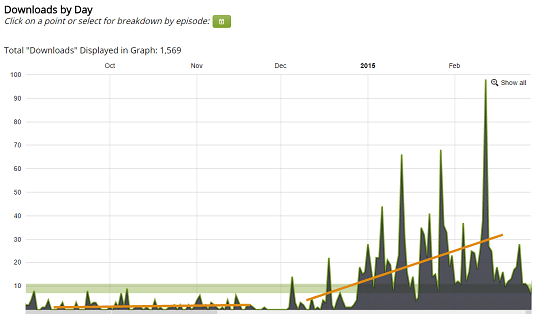
PodcastNumbersFeb

Now, there’s an explanation for why the numbers were down in February for podcast downloads.  In January I started to notice that my laptop’s keyboard was acting funky.  By early February it had gotten really bad, so I decided it was time to get a new laptop.  I found a Dell laptop that had all the bells and whistles I needed, but the problem is that it was a brand new model, and as such it wasn’t available at retailers yet.  The only option was to have Dell build me one, which would take 2-3 weeks to build and ship to me.  Ok fine, I ordered it.  And sure enough, a couple of days after I ordered it, my old Dell laptop officially kicked the bucket.  Which meant I couldn’t publish new podcast episodes until I got the new laptop.  So I was only able to publish two new podcast episodes in February.  I have the new laptop now so starting this week I’ll have regular episodes up again.  But this taught me a valuable lesson: Have a few episodes of the podcast recorded ahead of time to avoid a problem like this in the future.

So that’s how my February went here on the blog and with my podcast, The Fan-Damn-Tastic Marketing Show. My goals for March are:

Blog – At least 58,000 visitors

Podcast – At least 1,100 downloads.

I’ll share my results with you in one month!

Share this:

  • Share on X (Opens in new window) X
  • Share on Facebook (Opens in new window) Facebook
  • Share on LinkedIn (Opens in new window) LinkedIn
  • Email a link to a friend (Opens in new window) Email
  • Share on Reddit (Opens in new window) Reddit

Like this:

Like Loading…

Filed Under: Blogging, Fan-Damn-Tastic Marketing Show

February 24, 2015 by Mack Collier

It’s Not About Social Media ROI, It’s About Marketing ROI

SocialMEdiaSmallLet’s say you are the CMO at your company, and the CEO is demanding that sales for Product A increase by 10% above your projections for the next fiscal year.  He also says that you can only make one change to the marketing mix.


Would you:

A – Move billboard placements in Product A’s Top 10 markets from the interstate to downtown locations?

B – Launch a company blog designed to better explain the features, qualities and benefits of Product A?

C – Divert budget to more television ads designed to show why Product A is a better fit for customers than the competitor’s Product B?

D – Move all grocery end-cap displays in Wal-Mart up to the front registers?


In Marketing 101 class we learned about the AIDA model of consumer behavior.

A = Awareness

I = Interest

D = Desire

A = Action


Awareness leads to Interest leads to Desire leads to Action.  Note that the purchasing happens at the Action portion of this model.  So if we are looking at the individual components of a marketing plan, how do you define the ROI of tactics that comprise the Awareness portion of your plan?  In theory, you cannot, because customers aren’t ready to buy at this stage of their purchase journey.  This is why you create a comprehensive marketing plan that makes customers Aware of your product, that builds Interest in the product, then a Desire to Act.

When the smoke clears, you have a marketing plan that you can judge the ROI of.  But it doesn’t make sense to judge the individual tactics of a comprehensive plan from a ROI perspective.  No matter how much it wants to, your billboard on Highway 23 can’t close a sale for you.  At best, it can make your customers Aware of your product and make them Interested and increase their Desire to buy, but it can’t convert on the Action of buying.

So what does that mean for you, the social media manager at your company that is trying to explain and perhaps even defend why your company should be using social media to connect with customers?

It starts with having an honest discussion about what social media can and cannot do for your business.  First, social media has never worked well as a channel to facilitate direct sales.  Social media works best as an interaction channel, as a way for people to engage each other and be social.  Direct sales isn’t an activity that functions well in the middle of social conversations online anymore than pitching strangers chatting on the front porch on Sunday afternoon does.

So if social media works well as a channel for people to have interactions and discussions and to share content, then your business needs to find its value within those functions of the channel.  You want to be aware of how your current and potential customers prefer to use these tools, and work within those constraints.

What type of interactions do they prefer?  And with who?  With your brand, or with fellow customers?

What type of content are they creating?

What type of content are they sharing?

The idea is that you want to use social media in a way to connect with your customers and create value for them.  You create value for your customers by enhancing their experience via social media tools.  By giving them the type of high-quality content they are looking for and need.  By helping to facilitate the type of interactions they want and need (Hint: They don’t want to be sold to, they do want help dealing with a problem setting up your new laptop they just bought).

The best way to achieve your goals for social media is to help customers achieve their goals for social media.  Understand why your customers are on social and you will understand how you can create value for them via these channels.  That value will enhance your overall marketing results, which will lead to an increase in marketing ROI.

Share this:

  • Share on X (Opens in new window) X
  • Share on Facebook (Opens in new window) Facebook
  • Share on LinkedIn (Opens in new window) LinkedIn
  • Email a link to a friend (Opens in new window) Email
  • Share on Reddit (Opens in new window) Reddit

Like this:

Like Loading…

Filed Under: Marketing, Social Media

February 23, 2015 by Mack Collier

‘Badass: Making Users Awesome’ is the Best Business Book You Can Buy in 2015

I could not be more excited to be holding this book!  Badass: Making Users Awesome is the best business book you can buy in 2015.

Period.

Badass starts with a simple challenge: Create a bestselling product.  Without marketing, without competing on price.  The book challenges you to think about what makes a successful product?  Why did this social media book become a New York Times Bestseller and this one did not?  Why did this software suite from Adobe sell a million copies while this one from Roxio was a bomb?  What makes Product A successful while Product B (that has the same or very similar features, and pricing) is not?

“The key attributes of sustained success don’t live in the product.  The key attributes live in the user.” (page 21)

Bam! It’s not about making a better product, it’s about making a better user of your product!  It’s about making your users and customers be Badass, and Kathy teaches you exactly how.  Not only does she teach you how to create badass users, she shows you why so many companies fail to create badass users.  She shows you how the new user becomes the badass user.  How they change along the way, how the way they use your product changes, and how they view that product and your brand changes.

Perhaps the biggest marketing takeaway from this book is the difference between how most companies market their product versus how most customers want to use your product.  Most marketing is focused on the product, or tool.  But most customers are more interested in what the tool allows them to do.  It’s not about the DSLR camera, it’s about me being able to take amazing pictures.  It’s not about the chemical composition of the carnauba wax, it’s about me being able to give my red car that gorgeous ‘wet’ wax look.  The best marketing isn’t about your products, it’s about the larger context that your products lives in, that I am passionate about.

That passion is what can drive me to be Badass.  And if your company is creating Badass users, it’s ensuring its long-term success.

Now, a word about the actually book itself: This is a simply gorgeous book.  First, it’s printed on very slick and high-quality paper, which feels far superior to the standard newsprint-y paper stock that most business books use.  Second, the book has literally hundreds of visuals, graphs and charts that enhance learning, and add to the value of the book.  Here’s an example:

DSCN1686-1024x768
So colorful and a very welcome break from the walls of text you see in too many books.  And for fans of Kathy’s Creating Passionate Users blog, these graphs and visuals are right in line with what we’ve come to expect from Kathy.

As you know from reading this blog, I was thrilled to have Kathy agree to write the foreword for my first book, Think Like a Rock Star.  What you may not know is that Kathy co-created the Head First series of programming books, published by O’Reilly.  This series has been so successful that Kathy’s books have sold over one million copies.  Yeah.  A big reason why these books have been so successful is because of how Kathy organizes the information in her books to help facilitate learning.  It even includes worksheets and spaces for you to create your own formula for who your ideal Badass user would be, what they would be able to accomplish if they were Badass, etc. She was kind enough to help me greatly with the structure of Think Like a Rock Star in this regard, but of course she did a much better job with her own book 🙂  Which is one reason why Badass is going to be a hit.  The bottom line is if you bought and enjoyed Think Like a Rock Star, you absolutely will love Badass, probably moreso.

“You have the chance to help people become more badass not only at using your tool within a meaningful context, but badass at life.” (page 282)

Word. Badass:Making Users Awesome is the best $20 you can invest in your business this year.  Buy it right now at Amazon.

(Disclosure: Kathy is a friend and so are you.  I believe in helping my friends be awesome so that’s why I want you to buy this book.  Now, go!)

Share this:

  • Share on X (Opens in new window) X
  • Share on Facebook (Opens in new window) Facebook
  • Share on LinkedIn (Opens in new window) LinkedIn
  • Email a link to a friend (Opens in new window) Email
  • Share on Reddit (Opens in new window) Reddit

Like this:

Like Loading…

Filed Under: Brand Advocacy, Marketing

February 19, 2015 by Mack Collier

What You Can Learn From My Record Blog Traffic Yesterday

I am constantly preaching the need for bloggers to have Google Analytics on their blog during #Blogchat.  A big reason why is so you can track changes in your blog, good and bad, so that you can understand why the change happened.

Yesterday this blog had 2,235 visitors, which is about 90 more than the previous high for one day.  What I want to do is walk you through the stats in Google Analytics to figure out why this happened, and also give you some insights into how you can do the same for your posts.

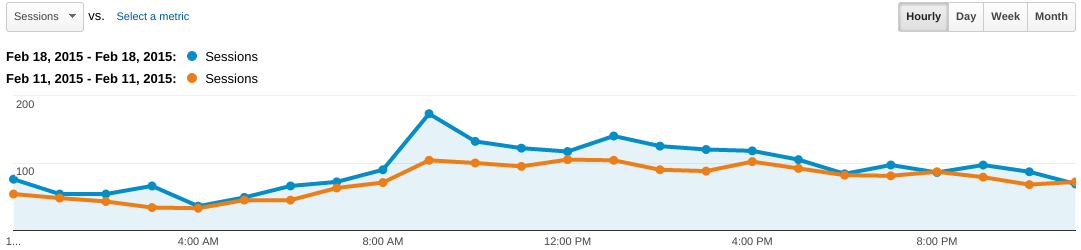
One thing I do every day is a comparison between the current day’s traffic and the traffic from one week ago.  For example, today I’ll track the current day’s traffic (Thursday) and also compare the hourly traffic against last Thursday’s traffic.  This gives me an easy way to see if traffic is doing better or worse than it was a week ago.  Here’s what that comparison looked like for yesterday compared to a week earlier:

HourlyGAtraffic
 That’s a really strong graph as it shows that traffic for yesterday (blue) was higher than the previous Wednesday during every hour yesterday except for the final one of the day.  This is what you want to see, because it indicates that traffic is growing week to week.

But the traffic last Wednesday was 1,785, whereas yesterday it was 2,235.  That’s a 25% increase, and while I’m thrilled with that jump, I want to figure out why it happened.

So let’s put on our cyber detective hats and dive deeper into the blog’s stats.  The first place I’ll start is by taking the above data (yesterday’s traffic vs the previous Wednesday’s) and segment that traffic into channels.  You can find this in Google Analytics by clicking Acquisition>All Traffic>Channels:

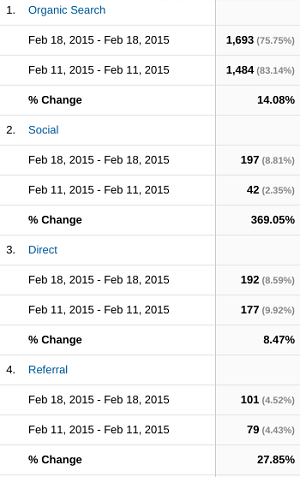
ChannelTraffic1

Three things immediately jump off this graph to me:

1 – Note that there was a BIG jump in search traffic.

2 – While the number of visitors that arrived at the blog from an organic search increased, the percentage of overall traffic that came from search actually went DOWN.

3 – There was a BIG jump in traffic from Social.


Now, the big jump in search along with the big jump in social is interesting to me.  It increased by 14% week to week, which is much higher than it normally does.  I want to play a hunch and check out the sources of the Social traffic.  So I click on Social and it will show me which social sites drove traffic to my blog yesterday and a week ago yesterday:

SocialTrafficA-ha! So almost all of the surge in Social traffic yesterday vs a week ago was actually coming from just Twitter.  This is my suspicion: As people were sharing my content yesterday on Twitter, it was leading to more links to my content being seeded higher in search results on Google. So the better my content did on Twitter yesterday, it resulted in it also doing better in search results on Google.  That would explain why search traffic spiked because overall the two traffic sources that accounted for almost all of the overall traffic bump yesterday were Google and Twitter.  Perhaps this is a result of Google indexing tweets into search results?

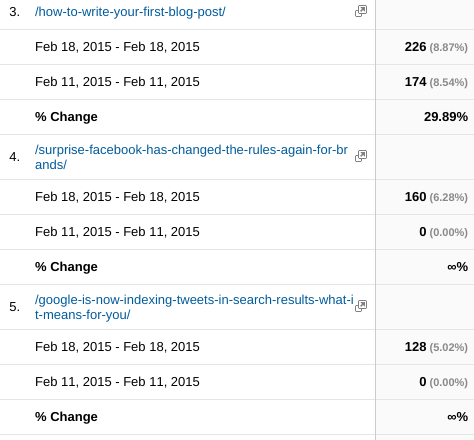
But I still don’t know if any content in particular was driving the increase in traffic.  That’s what I really want to know.  So back to Google Analytics, I click Behavior>Site Content>All Pages:

PostsGA
Double A-Ha! The 4th and 5th most viewed posts yesterday were both new posts I wrote this week.  And a big chunk of the overall growth in traffic can be tied back to these 2 posts (288 new visitors).

This also gives me important insights into the type of content that resonates with my readers.  And since I’ve already looked at the channel data, I know that most of the increase probably came from Twitter, so really I know that these two topics likely resonate with my followers on Twitter.

And the beauty of this is I can come back tomorrow and do the same analysis on this post, and compare how it does today vs how the above two posts from earlier this week did.  BTW, a big reason why I wanted to write this post is because I have been doing these type of analysis for a while now, and I know that posts that do a deep-dive into actual numbers are popular with readers here.  Another advantage to knowing your blog’s stats!

The point in all this is to invest time in understanding your blog’s stats so you can improve your blogging efforts and efficiency.  If I hadn’t looked at my blog’s stats I would have little idea that yesterday was a record-setting traffic day or more importantly why it was a record-setting traffic day.  Now I know, and that knowledge will help me improve my blogging efforts moving forward.  Just as it will for you if in you invest the time in understanding your blog’s stats.

Share this:

  • Share on X (Opens in new window) X
  • Share on Facebook (Opens in new window) Facebook
  • Share on LinkedIn (Opens in new window) LinkedIn
  • Email a link to a friend (Opens in new window) Email
  • Share on Reddit (Opens in new window) Reddit

Like this:

Like Loading…

Filed Under: Blog Analytics, Twitter

February 18, 2015 by Mack Collier

Surprise! Facebook Has Changed the Rules Again For Brands

Facebook has once again tweaked its News Feed algorithm and the change will alter how often content from brands appears in News Feeds from people that have Liked that brand’s page.  This post seems to write itself 2-3 times a year, doesn’t it?

The newest changes, which rolled out last month and were announced last November, flip the script on brands.  Previously, brands were told that they needed to add photos to their updates to increase engagement and visibility in Facebook’s News Feed.

Now?  It’s the opposite, content with photos has the lowest reach.

Yeah.  This is a big reason why I am always telling you to first plant seeds in the gardens you own.  Invest in your website and blog first, not social media sites like Twitter, Facebook and Pinterest.  Because those sites can change the rules on you whenever they want, and Facebook is the worst offender here.  What irks me most about this latest change is that it flies in the face of the advice that companies are hearing about social media.  Companies have been taught for years that pictures drive engagement.  That adding a relevant image to your content will enhance its value and the engagement around it.  Now, Facebook is saying that pictures are penalized, if anything.  This becomes a big problem for the companies that focus most of their social media efforts on Facebook because they will be learning what Facebook wants them to know about improving engagement on Facebook versus about what actually drives the engagement of social media content.

Facebook can be a wonderful complement to your existing online marketing efforts.  Unfortunately, many companies use its Facebook page as a replacement for having a blog or even a website.  And if they later decide to launch a blog or website, they can take the bad lessons learned on Facebook, and apply it to their blog.  Like writing posts without images.  Or only publishing ‘cute’ videos of kids falling in the snow and wondering why that’s not driving engagement on the company blog for an industrial lubricant supplier.

In a perfect world, Facebook’s goals would be aligned with your company’s goals.  Facebook would want to show and teach you how to create content that is more engaging and valuable to your customers.  But Facebook is now a publicly-traded company.  Facebook’s goals are increasing revenue and profits.  That’s likely a big reason why it’s moving toward putting more value on videos.  Because watching videos means you stay on Facebook even longer.  And as time spent on site goes up, Facebook can report that to shareholders as a sign of growth and to advertisers as leverage to raise ad rates.

Facebook’s goals are to make Facebook better for Facebook, not for your company.  Your company is on its own, so plan accordingly.

Share this:

  • Share on X (Opens in new window) X
  • Share on Facebook (Opens in new window) Facebook
  • Share on LinkedIn (Opens in new window) LinkedIn
  • Email a link to a friend (Opens in new window) Email
  • Share on Reddit (Opens in new window) Reddit

Like this:

Like Loading…

Filed Under: Facebook

February 17, 2015 by Mack Collier

Google is Now Indexing Tweets in Search Results, What it Means For You

Google’s love affair with Twitter is back on.  Previously, Google had indexed tweets from Twitter in its search results, but that deal ended in 2011.  Here’s a post I wrote back in 2011 that examined how this process worked.  Earlier this month it was reported that Google would begin adding tweets back to search results sometime in the first half of 2015, but it looks like it’s already underway.

Here’s a screenshot from a google search I did for the name of my marketing podcast.  Note the 6th and 7th results on the first page are tweets I left:

FanDamnTweetsGoogleThis means that content you create on Twitter (tweets) is now being indexed into search results alongside posts that appear on your blog or white papers on your website.

It also means that you now have another channel to seed your content into Google search results.  One of the issues that many blogging businesses face is a difficulty in getting content to rank high in Google results.  It typically can take years to build a business blog to the point where content ranks well in search results.

But if you have a large following on Twitter, that could mean that your tweets rank higher in search results than blog posts you write on the same topics.  You can leverage your following on Twitter to help build your audience for your blog.

Another way to use Twitter to help your blog (and this has nothing to do with Google indexing tweets) is to leverage your business discussions on Twitter as potential topics for your business blog.  I am constantly doing this, I will use Twitter as sort of a ‘sounding board’ to see which topics are important and interesting to others.  Participating and even lurking in Twitter chats is a great way to do this.  By following a Twitter chat that’s focused on topics that are relevant to your blog, you can get a better sense for which topics interest potential readers of your blog.  Which can lead to more content ideas for your blog, which will make it easier to hit your content creation goals.

Have you noticed that tweets are showing up in Google results?  Has it impacted any search terms your blog has ranked for in the past?


Share this:

  • Share on X (Opens in new window) X
  • Share on Facebook (Opens in new window) Facebook
  • Share on LinkedIn (Opens in new window) LinkedIn
  • Email a link to a friend (Opens in new window) Email
  • Share on Reddit (Opens in new window) Reddit

Like this:

Like Loading…

Filed Under: Fan-Damn-Tastic Marketing Show, Search Engine Optimization, Twitter

February 11, 2015 by Mack Collier

The Fan-Damn-Tastic Marketing Show Episode 15: Sometimes the Customer is Wrong

Hey y’all!  Welcome to the 15th episode of The Fan-Damn-Tastic Marketing Show! In this episode we will delve into the idea that ‘The Customer is Always Right’, and look at two examples when this might not be the case.    If you enjoy this episode then please subscribe on iTunes!

Show Notes:

1:00 – Why we say ‘The Customer is Always Right’

1:45 – There are certain cases where the individual customer can be wrong

2:05 – Sometimes a customer may demand a free product or service and threatens to complain online if you don’t give them what they are asking for

3:00 – How to handle this situation correctly

6:30 – Your fans view themselves as owners of your company and brand

7:15 – Some fans demand that you not only listen to them but act on their suggestions, even if they aren’t feasible or possible

10:00 – How to respond to fans that believe you have to do what they are suggesting, ‘my way or the highway’


Here’s where you can download this episode directly.

[smart_track_player url=”http://traffic.libsyn.com/fandamnshow/Sometimes-The-Customer-Is-WrongFINAL.mp3″ title=”Sometimes the Customer is Wrong” ]

[smart_podcast_player]


Share this:

  • Share on X (Opens in new window) X
  • Share on Facebook (Opens in new window) Facebook
  • Share on LinkedIn (Opens in new window) LinkedIn
  • Email a link to a friend (Opens in new window) Email
  • Share on Reddit (Opens in new window) Reddit

Like this:

Like Loading…

Filed Under: Brand Advocacy, Customer Service, Fan-Damn-Tastic Marketing Show, Marketing

February 10, 2015 by Mack Collier

The Best Marketing Isn’t Focused on Your Product, its Focused on My Passions

Did you notice something about the commercials for this year’s Super Bowl?  Besides the fact that this was a pretty weak crop of ads, the few that did stand out had something in common.  These spots weren’t really about a product as much as they were about passions and beliefs.

Self-image, especially among young girls.

Online bullying.

Caring and loving others.

Think about your passions.  The things, ideas, people and beliefs that you care about. These are the things that move you, that don’t just hold, but arrest your attention.

The vast majority of the marketing in this country is aimed at promoting products.  But the small percentage of marketing that breaks through the clutter and grabs your attention typically has one common trait:  The best marketing isn’t focused on a product, it’s focused on the passions of its customers.

Watch this Red Bull commercial and ask yourself “What product is Red Bull selling here?”

I would argue that this spot isn’t designed to sell Red Bull’s energy drink.  It’s designed to sell what happens after you drink it.  Freedom.  Individual accomplishment.  Pushing your personal boundaries and reaching goals that you thought were out of reach.

These are themes that many of us are passionate about.  Very few of us are passionate about an energy drink, and Red Bull knows that.  So instead, the company focuses its marketing on the ideas, themes and beliefs that its customers are passionate about.

And in turn, that helps Red Bull’s customers become more passionate about Red Bull.  The key to successful marketing isn’t to promote your product, the key to successful marketing is to promote the passions and beliefs of your customers that your product fits into.

Patagonia is another company that markets its passions moreso than its products.  In 2011, Patagonia launched a ‘Don’t Buy This’ campaign encouraging customers to think twice about whether or not they really needed a new coat or jacket.  Or if they decided to buy one, buy used versus new.  The campaign from Patagonia was at attempt to combat materialism and consumerism.

And it didn’t work.  Patagonia’s sales spiked 30% as a result.  Why did this happen?  Because customers felt that Patagonia’s beliefs and passions were in line with their own, and as a result they felt that Patagonia was trustworthy, so they bought from the brand.  Patagonia’s marketing resonates with customers because it’s clearly focused on the company’s beliefs, not the company’s products.  Customers that share those beliefs, are drawn to the company’s marketing as a result.

If you want to grab my attention, stop focusing on marketing your products and instead focus on my beliefs.  More specifically, craft your marketing messages so that you explain to me how your products relates to the ideas, beliefs and themes that I am already passionate about.

Do that, and you’ll win my business.

Share this:

  • Share on X (Opens in new window) X
  • Share on Facebook (Opens in new window) Facebook
  • Share on LinkedIn (Opens in new window) LinkedIn
  • Email a link to a friend (Opens in new window) Email
  • Share on Reddit (Opens in new window) Reddit

Like this:

Like Loading…

Filed Under: Brand Advocacy, Content Marketing, Marketing, Think Like a Rockstar

February 5, 2015 by Mack Collier

My Blog Traffic and Podcast Audience Results For January

Hey y’all!  So last month I mentioned that I had set specific monthly goals for growing both my traffic here, and the number of downloads to my podcast.  What I’m going to do is every month this year I will give you an update letting you know if I hit my goals for the previous month, and also letting you know what my goals are for the current month.  I’ll also share with you the most important lessons I learned over the past month. I want to do this to hold myself accountable to the goals I’ve set, but to also give you a way to learn from I’m doing.  So many people and companies want to know how to grow its blog readership, and podcast audience.  This year we’ll look at my efforts to do both.

First, here were my goals for January:

Blog – Traffic of at least 50,000 visitors.

Podcast – At least 750 downloads.


Breakdown of My Blog Traffic

My blog traffic for January was 53,783!  So I comfortably hit my blogging goal for January!  Pretty excited about that.

Posts written – 12 (At least 2 every week, which was my goal)

Most popular post written in January (based on views) – The Most Boring Answer to the ‘How Do I Build More Traffic to My Blog?’ Question

Detailed Analysis of Traffic Sources

Here’s where my traffic came from in January:

Organic Search – 83.46%

Direct – 9.15%

Referral – 4.19%

Social – 2.93%

Email – 0.19%

Other – 0.08%

Two things jump out to me from these numbers:  For me, organic search is way too high, and social is way too low.  I would like to see search fall to around 70% and Social rise to 10-15%.  I just worry when my traffic is that dependent on one source.

Something else that’s interesting, check out the numbers for time spent on site:

Average time a visitor spends on this blog – 47 seconds

Average time a visitor coming from search spends on this blog – 41 seconds

Average time a visitor coming from social spends on this blog – 71 seconds

Average time a visitor coming from Twitter spends on this blog – 74 seconds

Average time a visitor coming from Facebook spends on this blog – 73 seconds

Interesting, huh?  A visitor coming from a social media site spends about 80% more time on the site versus a visitor coming from search.  This suggests that the search visitor is just coming to get something and leave, while the social visitor is more likely to look around a bit.

Also, I’m noticing that the engagement numbers I am seeing on Twitter are surprisingly low.  According to Twitter, even though I have over 50,000 followers, most of my tweets are seen by less than 1,000 people.  Yikes!  I’ll probably be spending a bit more time on Google Plus to see if I can raise social traffic and engagement there, since I have a much larger network there versus Facebook or LinkedIn.

Now my goal for February is to hit 54,000 visitors.  This looks like it should be easy since I almost did that in January, but don’t forget that this month only has 28 days.  In fact I am currently on pace to only hit 50,000 visitors for the month.  So even if I miss my goal for this month I’m not too worried due to it being a short month.  However,  I am going to try to get back to writing 3 posts a week starting next week.  Just in case!

Podcast Numbers and Overview 

If you listened to this week’s episode of #FanDamnShow you know I already did a breakdown of how the podcast did in Jan, and my key takeaways.  Please check out that episode if the podcast stuff is what you are interested in.

Goal for January – At least 750 downloads

Actual number of downloads for January – 737

I missed my goal by 13 freaking downloads!  Ugh!  But still very close and my goals for the podcast growth was really aggressive.  For reference, the podcast had 133 downloads for all of December, and 737 in January.  Still, a massive jump.

Here’s daily downloads for August 1st, 2014 through January 31st, 2015:

PodcastTraffic

As you can see, very low daily downloads, typically less than 10 a day, until the end of December and through January on the right.  That’s when I started putting out new episodes on a weekly basis.  From August 1st through December 29th, I put out 3 new episodes of the podcast.  From December 30th through January 31st, I put out five new episodes of the podcast, one every week.  If you are wanting to build an audience for your podcast, consistency is key.  Putting up a new episode on a regular schedule is vital to your show’s success, as this graph proves.

Two important lessons I learned from doing the podcast in January:

1 – It’s very important to script out the flow of each episode before recording it.  I didn’t do this for the first couple of episodes in January, and I noticed my thoughts were kinda all over the map.  When I started writing down a script, just the key points I wanted to talk about and in the order I wanted to talk about them, it really helped the flow of the episodes, and it made it much easier for me to keep my thoughts organized.

2 – It’s very important to thank the people that are promoting your show.  What I noticed was that each week people were promoting the show for me, especially on Twitter and Facebook.  So I made a point of doing a shoutout to them on each show, then I let them know I did so after the episode went up.  Just a small way to say ‘Thank You’, but everyone loves to be appreciated, right?

So that’s how my January went, and what I learned.  Again my goals for February are:

Blog – At least 54,000 visitors.

Podcast – At least 850 downloads.

I’ll be back here in a month to let you know how I did!

Share this:

  • Share on X (Opens in new window) X
  • Share on Facebook (Opens in new window) Facebook
  • Share on LinkedIn (Opens in new window) LinkedIn
  • Email a link to a friend (Opens in new window) Email
  • Share on Reddit (Opens in new window) Reddit

Like this:

Like Loading…

Filed Under: Blog Analytics, Fan-Damn-Tastic Marketing Show

February 4, 2015 by Mack Collier

The Fan-Damn-Tastic Marketing Show Episode 14: Segmenting Your Fans to Better Engage Them

Welcome to the 14th episode of #FanDamnShow! Today’s episode is how to stabilize or build your social media engagement by segmenting your fans online to better engage with them. If you enjoy this episode then please subscribe on iTunes!

Show Notes

0:50 How engagement around social media content seems to be falling

3:00 Our behavior has shifted from engaging with content to simply creating and sharing content

3:50 If your engagement is falling, then most engagement will come from the people that know you and have an existing relationship with you

6:00 How to segment your fans and easily stay engaged with them on Twitter and Google Plus

12:45 Results of my January goal for total downloads and whether I hit that number

14:05 The two things I learned from doing #FanDamnShow in January


Here’s where you can download this episode directly.

[smart_track_player url=”http://traffic.libsyn.com/fandamnshow/Episode_14_-_Segmenting_FansFINAL.mp3″ title=”How to Segment Your Fans to Better Connect With Them” ]

[smart_podcast_player]

Share this:

  • Share on X (Opens in new window) X
  • Share on Facebook (Opens in new window) Facebook
  • Share on LinkedIn (Opens in new window) LinkedIn
  • Email a link to a friend (Opens in new window) Email
  • Share on Reddit (Opens in new window) Reddit

Like this:

Like Loading…

Filed Under: Brand Advocacy, Fan-Damn-Tastic Marketing Show, Google+, Social Media, Twitter

  • « Previous Page
  • 1
  • …
  • 50
  • 51
  • 52
  • 53
  • 54
  • …
  • 119
  • Next Page »

Recent Posts

  • My Substack Conversion Rate Went From 0.5% to 13% in Six Months, Here’s How
  • A Solid Conversion Strategy is Vital on Substack, Here’s the Proof
  • Empathy is Your Customer Service Secret Weapon
  • Understanding Substack’s Three Growth Stages
  • Blogging Isn’t Dead, it’s Morphed Into Substack

Categories

Archives

Comment Policy

Be nice, be considerate, be friendly. Any comment that I feel doesn't meet these simple rules can and probably will be deleted.

Top Posts & Pages

  • Why Did Jesus Send His Apostles Out With Nothing?
  • Understanding Substack's Three Growth Stages
  • A Solid Conversion Strategy is Vital on Substack, Here's the Proof
  • My Substack Conversion Rate Went From 0.5% to 13% in Six Months, Here's How
  • The Real Reason Why the Mona Lisa is So Popular Will Surprise You
  • The introvert's guide to speaking
  • I Do Not Deserve to Suffer Like This...
  • Let's Take a Closer Look at Patagonia's Worn Wear Road Tour
  • How Is Twitter Impacting Search and SEO? Here's the (Visual) Proof
  • An Open Letter to Cathryn Sloane From Someone Over the Age of 25

  • Blog
  • Mack’s Bio
  • Work With Mack
  • Buy Think Like a Rock Star
  • Book Mack to Speak

Copyright © 2026 · Executive Pro Theme on Genesis Framework · WordPress · Log in

%d