MackCollier.com

  • Blog
  • Mack’s Bio
  • Work With Mack
    • See Mack’s Work
  • Buy Think Like a Rock Star
  • Book Mack to Speak

September 28, 2017 by Mack Collier

Extra Space Storage is #Blogchat’s Sponsor for October 1st!

UPDATE: Here’s the transcript from last night’s #Blogchat!

SECOND UPDATE: Extra Space has published this wonderful recap of this #Blogchat on their blog.  Check it out, it really gets into everything we covered, so awesome!

This Sunday (Oct 1, 2017), Extra Space Storage will be joining #Blogchat as its sponsor!  I’m thrilled they are on board and love their topic selection!  We’ll be discussing “How to Be a Better Blogger By Creating a Better Blogging Workspace”.  I love this topic because in all the 9 years of doing #Blogchat, we’ve somehow never discussed the physical organization of the space we each write and blog in.

#Blogchat begins at 8pm Central, this Sunday.  Here’s the questions we’ll cover:

8:00pm – 8:10pm – Q1: What does your primary blogging/writing workspace look like?

8:10pm – 8:20pm – Q2: Which spaces or areas in your home inspire your creativity when writing?

8:20pm – 8:30pm – Q3: What style elements make a blogging workspace more productive? Being organized? Lighting? Location? Quiet?

8:30pm – 8:40pm – Q4: What are your best tips for maximizing a small writing space?

8:40pm – 8:50pm – Q5: What has been the most important change you’ve made to your writing space that improved your productivity?

8:50pm – 9:00pm – Q6: What advice do you have for maximizing productivity while writing blog content from home?


I think this will be a wonderfully informative #Blogchat as how you organize your writing/blogging space is so important to improving your productivity as a blogger.  I’m sure we’ll all have plenty of tips and tricks to share on how to better organize our spaces, and I bet @ExtraSpace will have some ideas as well!

So please join us this Sunday at 8pm Central for #Blogchat, sponsored by Extra Space Storage!  And please follow @ExtraSpace on Twitter, and check out their blog, Spacewise!

Does your company want to sponsor #Blogchat on a weekly or monthly basis? Here’s all the details you need, email me at mack.collier@gmail.com to reserve!

Share this:

  • Share on X (Opens in new window) X
  • Share on Facebook (Opens in new window) Facebook
  • Share on LinkedIn (Opens in new window) LinkedIn
  • Email a link to a friend (Opens in new window) Email
  • Share on Reddit (Opens in new window) Reddit

Like this:

Like Loading...

Filed Under: #Blogchat, #Blogchat Transcripts

August 22, 2017 by Mack Collier

How Facebook Just Changed Influencer Marketing and What Needs to Happen Next

Last week without much fanfare, Facebook made a pretty big change to how brands work with influencers on its site.  Previously, a brand would have to share an influencer’s post before they could boost it. Now, brands can boost any influencer’s post as long as the influencer is authorized to tag the brand in their updates. The influencer tags the brand in their update, then the brand can boost the influencer’s update.

Why is Facebook making this change? The suspicion is that Facebook will begin suppressing influencer posts that are tagged for brands to boost in an effort to get brands to spend more on boosting those posts to achieve the reach they need to hit their campaign marks. Facebook has been doing this for years with brand content, and this would simply be an extension of that strategy.  If Facebook does start suppressing brand-related updates from influencers, that could also lead to influencers and brands not disclosing their working relationship in an effort to keep their organic reach. This would be an FTC violation, but with expensive influencers, some brands might risk the fines. Which would further erode consumer trust in such content.

And, of course, any moves Facebook makes in regards to dictating how brands can work with influencers will likely be mirrored on Instagram, since FB now owns IG. So these changes will have a big impact for any brands that leverage paid social in their influencer marketing plans.

What Will Happen Next

For agencies that are committed to influencer marketing, these moves will make their lives a bit easier as influencers can now do some of the back-work for them as agencies no longer have to add influencers and approve them for boosting, which will simplify their workflow. If Facebook does start suppressing the organic reach of influencer posts (in an effort to drive more paid support), then it will likely mean that budgets for paid support will have to increase. It could also mean that Facebook will crack down on influencers using fake followers and bots so advertisers will have a truer sense of the real size of an influencer’s network and reach.

That’s on the agency side. For companies that are working with influencers in-house, especially mid-size and smaller companies, these moves could dictate a re-assessment of its influencer marketing strategy, especially if most of that strategy is currently running through Facebook and Instagram.

From the company side, here’s two changes I would hope to see when it comes to influencer marketing:

1 – Companies need to start treating influencers as business partners. Kerry is spot-on here. Too many companies have the mentality that they want to ‘rent’ an influencer’s audience for the duration of a campaign. By working and even investing in influencers long-term, this allows the influencer to more effectively connect with their audience on the brand’s behalf, and the content they create for the brand will be more credible with the influencer’s audience. Plus, this commitment to working and growing together makes it easier for the influencer to become an actual advocate or fan of the brand, which further helps the authenticity of the influencer’s content that promotes that brand.

2 – Companies need to focus more on working with influencers who are also existing advocates and fans for their brand. Doesn’t it make sense to work with influencers who are already signing your brand’s praises? Of course it does. One of the problems that brands face when sponsoring content from influencers is that it often comes across as an obvious paid endorsement from the influencer. “They are just saying they like that product because the brand is paying them”, is often the knee-jerk response to such content. But your brand’s fans are already promoting your content for free, so why not invest in deepening that relationship?  And yes, many brands will read that and say “Well if they are already promoting us for free, why pay them?”.  Because these fans of your brand are also directly engaging every day with your customers. Not only are they selling for your brand, they are also collecting incredibly valuable product feedback from other customers.  Feedback that can be acted on and incorporated back into the business and marketing processes to further increase sales.  Whether I am working with a client on influencer marketing or brand advocacy/ambassador efforts, I always stress to them that it’s not just about the direct sales. Focus also on the indirect activities that the influencers or ambassadors can engage in on the brand’s behalf that will also lead to sales.


If your brand or agency uses Facebook for its current influencer marketing efforts, how will these changes impact you?

Share this:

  • Share on X (Opens in new window) X
  • Share on Facebook (Opens in new window) Facebook
  • Share on LinkedIn (Opens in new window) LinkedIn
  • Email a link to a friend (Opens in new window) Email
  • Share on Reddit (Opens in new window) Reddit

Like this:

Like Loading...

Filed Under: Brand Advocacy, Facebook, Influencer Marketing

August 14, 2017 by Mack Collier

How to Make Your Blog Relevant

When you start blogging, whether it’s for yourself or your employer, you want the blog to be relevant.  You want it to stand out and be recognized by readers as a valuable source of information.  Last night at #Blogchat we discussed this topic, and I wanted to share some thoughts here.  If I was starting a new blog in 2017 and wanted to make it relevant, these are the steps I would take:

1 – Define your desired audience.  Know who it is you want to reach, and why you are trying to reach them.

2 – Understand where this group is CURRENTLY getting its information from. What blogs and sites are they reading? What type of content are they looking for? In short, what is relevant to them?

3 – Start reading the sites they read, and start writing about the same content.  Once you know what is relevant to your audience, then you can create it for them.

4 – Start reading the sites your audience reads, and start commenting on those sites. This gets your readers familiar with seeing you and your thoughts on the sites they view as being credible. This not only drives traffic to your blog, it also helps make you credible and relevant in the eyes of your desired audience.  When I started blogging in 2005, I wrote every day. I figured the quickest way to get readers was to blog more. So I was a sponge, I wrote every day, and every day I read marketing and advertising blogs to get ideas for posts and to stay up to date on the space. As I would read these blogs, I would occasionally find an article I liked, and I would comment on it.

I kept writing every day on my blog, and nothing was happening. No traffic, no comments, nothing. Then one day, the floodgates opened.  My traffic started growing, and I started getting comments! On every post! I was thrilled, but at the same time, I was confused; Why was I suddenly getting traffic AND comments? I had no idea, till one day, someone left a comment and said “Hey Mack, coming here to leave you a comment since you left a comment on my blog!”  That’s when the light bulb went off…I went and checked and everyone that had started leaving comments on my blog were bloggers that *I* had commented on their blog first! It worked in 2005, it still works today, so get out there and be social!

5 – Take a stand, share your voice. Readers want to read blogs that are written in a passionate voice. We are drawn to passionate writing, it’s more interesting to us. Obviously, if you are writing for an employer, you want to be mindful of your company’s blogging or social media policy, but you can still share your opinions in a passionate and constructive way.

6 – Put in the work and don’t be afraid to ‘act’ bigger than you are. I started blogging in 2005, and one of the first posts I wrote as a series on how female rock stars were marketing themselves. I thought that a great companion piece to the posts would be if I could convince someone in marketing at a major record label to let me interview them.  Again, I was a new blogger so I thought what the hell. I emailed every record label I could find. None of them even answered me, except for Nettwerk, and eventually I got an interview with Terry McBride, who at the time was the manager for both Avril Lavigne and Sarah MacLachlan. Not bad, eh? But if I had thought ‘well I’m just a lowly blogger that no one knows, I can’t email record labels!’, I would have never gotten that interview. You never know till you ask.

7 – Ignore anyone that tells you that you can’t be a big-shot. One thing I learned the hard way is that social media can be just like high school. If you start doing well, you’ll start to draw criticism. Almost always, this criticism will come from people that are afraid you are getting ‘bigger’ than they are, and they are jealous. When I announced I was writing Think Like a Rock Star in 2013, a few people lashed out. They said I didn’t deserve a book, that it was a dumb topic, that I wasn’t an ‘expert’ on the topic. These few people had one thing in common: None of them had written a book yet, and all of them wanted to. Take criticism as a sign that you are being successful and growing. No one criticizes the unknown blogger!

8 – Act like your blog is relevant, because it is. Cover the space that’s interesting to your audience. Talk about where your industry is headed, don’t just react to existing opinions, share your own. This is also how you become a thought leader. The truth about thought leader is that it’s not about the people that walk the same road as everyone else, it’s about the people that clear a path for the rest of us.


So there’s some tips on how to make your blog relevant. If you want to review the transcript from last night’s #Blogchat, here it is.

Share this:

  • Share on X (Opens in new window) X
  • Share on Facebook (Opens in new window) Facebook
  • Share on LinkedIn (Opens in new window) LinkedIn
  • Email a link to a friend (Opens in new window) Email
  • Share on Reddit (Opens in new window) Reddit

Like this:

Like Loading...

Filed Under: #Blogchat, Blogging

July 27, 2017 by Mack Collier

You-Us-Me; The Only Formula You Need For Creating Content That Drives Sales

How to create content that drives sales

How do you create content that drives sales? It’s an often elusive goal for many businesses. Yet one of the incorrect assumptions that many blogging companies make is that their content isn’t ‘good enough’ to drive sales.  Often, the content is fine, it’s just aimed at an audience that either isn’t ready for it.

We see this with many companies that are creating content as a way to ‘build awareness’. Yet the content that they are creating is completely promotional in nature. A complete disconnect, based on their audience and goals.

So what type of content is right for your audience? It turns out that there’s a very simple process to follow in order to figure out what type of content is right for your audience.

You – Us – Me. It turns out, there’s only three types of content you need to focus on: You (Content written completely from the customer’s POV), Us (Content that focuses on a link between the customer and your brand), and Me (Content written that’s completely promotional in nature).

Let’s Talk About You 

This content is written completely from the customer’s POV. You focus your content on select areas that relate to your products, but that aren’t about your products. The idea is to focus on areas that are important to your audience, but from the audience’s point of view.

For example, let’s say your company sells cyber-security software. At this stage, your content would focus completely on helping your customer understand how to be more secure online. You don’t talk about how your software can help with this….YET.  At this stage you are only giving the customer content that helps them become more secure online.  This content helps build awareness, because it is completely focused on the needs of the customer.

Let’s Talk About Us

Here, you create content that focuses on a link between the customer and your software. You are still focusing on cyber-security, but here you will focus on specific areas of cyber-security that your product addresses. This helps the customer become more secure online, but it also helps them understand how your software will benefit them as well. At this stage the customer is beginning to understand how your software could benefit them.

Let’s Talk About Me

Now, the behavior of your customer has shifted again, so you also shift the focus of your content. By this stage, the customer is interested in purchasing cyber-security software. So you shift your content to focus exclusively on the benefits of owning your cyber-security software. You talk about the benefits of owning your software, and also give some insights into how the software works and what problems it solves. THIS is where you sell.  You sell here because the customer is finally READY TO BUY.  The customer is doing research so at this point they WANT content that’s focused on your software because they are considering a purchase.


You can use the You – Us – Me process to easily determine what type of content is best to create.

If you want to build awareness, then you always create content focused completely on your audience. The reason why is because the audience has no idea who you are (which is why you are trying to build awareness with them) so you focus completely on them, in order to win their attention.

If you want to create content that sells, then you need to understand if your audience is ready to be sold to.  If they aren’t aware of who you are, then you don’t sell to them.  If they are slightly aware of who you are, then you create content that helps them understand the connection between what’s important to them, and how your products/services relate (Let’s Talk About Us).  If your audience is researching a purchase, then you talk about yourself.  You give the audience more promotional and product/service-specific content, because that’s the information they are looking for.

Think about who you are trying to connect with, and where they are in their buyer’s journey.  That will determine if your content should be focused on You, Us or Me. Once you know where the customer is, then you can create the content they need currently, and give them Calls to Action that move them to the next level. Simply giving consideration to what content the customer currently needs will greatly increase the effectiveness of your content strategy.

Share this:

  • Share on X (Opens in new window) X
  • Share on Facebook (Opens in new window) Facebook
  • Share on LinkedIn (Opens in new window) LinkedIn
  • Email a link to a friend (Opens in new window) Email
  • Share on Reddit (Opens in new window) Reddit

Like this:

Like Loading...

Filed Under: Content Marketing, Content Strategy

July 26, 2017 by Mack Collier

How One Fan Made Marketo’s Bad Day a Little Less So

So Marketo had a bad day yesterday. They forgot to renew their domain, causing the site to be down, and plenty of frustration and panic for their customers. Believe it or not, this happens.  A few years ago here I briefly lost the mackcollier.com domain for the same reason, I thought it was set to auto-renew, and it wasn’t.

As you can imagine, twitter had a field day with the news….

Might be worth putting infrastructure first for a while… #Marketo pic.twitter.com/hoFSZIJEmm

— neverendum tremens (@rainfordhugh) July 25, 2017

By now, this is how both #Marketo staff and #Marketo users are resolving….#Domain #DNS @marketo pic.twitter.com/bklgn5qW3d

— David Quaid (@DavidGQuaid) July 25, 2017

But the news could have been a lot worse for Marketo, if it wasn’t for one of its customers stepping in to help out:

I renewed your domain @Marketo . Hopefully things will be back up soon. pic.twitter.com/GIJaK7dekW

— Travis Prebble (@TravisPrebble) July 25, 2017

Yep, Travis stepped in and helped out Marketo when he saw they were facing problems. Remember that your fans see your brand as being THEIR brand too. Fans have a sense of ownership over their favorite brands, and act in the brand’s best interests. Travis no doubt understood what a mess this would cause for both Marketo and its customers, and wanted to help a brand that he loved.

And to Marketo’s credit, they gave Travis his just recognition as their Superman…

That sounds like a great idea! Have you fly in wearing a cape.☺

— Marketo (@marketo) July 26, 2017

Lol! pic.twitter.com/xee4gLH9dO

— Marketo (@marketo) July 26, 2017

There are many lessons here and plenty of ‘how the hell did they let this happen?’ questions to answer. But one positive that may come from this episode is if Marketo explores ways to better engage its passionate fans like Travis.

Every company has passionate fans like Travis, and unfortunately, any day could see your company facing a crisis like the one Marketo faced yesterday.  When that happens, you’ll want to have as many fans like Travis helping you out as possible.  The time to start creating, cultivating and engaging with those fans is today.

When did Noah build the Ark? Before the rains came. Over the coming days and weeks, Marketo will be doing a lot of self-auditing and examining how they handled this crisis and how to avoid similar ones in the future. If the brand is smart, they will devote some of their reflection to how they can embrace and empower all the fans they have like Travis in the future.

What an interesting day it has been. Thanks to everybody I’ve talked to @Marketo for being gracious throughout this.

— Travis Prebble (@TravisPrebble) July 25, 2017

Share this:

  • Share on X (Opens in new window) X
  • Share on Facebook (Opens in new window) Facebook
  • Share on LinkedIn (Opens in new window) LinkedIn
  • Email a link to a friend (Opens in new window) Email
  • Share on Reddit (Opens in new window) Reddit

Like this:

Like Loading...

Filed Under: Brand Advocacy, Social Media Crisis Management

July 13, 2017 by Mack Collier

I’m Letting You Off the Hook; You Don’t Have to Blog As Much Anymore

UPDATE: Here’s the transcript from this #Blogchat.

If you’re a business and you’re blogging every day, then you’re doing it wrong. I know, I know, for years the conventional wisdom was that in order to build readership for a blog, especially if it’s a business blog, you needed to blog as often as possible.

And that advice worked well, 10 years ago. Unfortunately, now every social media site had become a content stream. The News or Home feed on most major sites like Facebook, Twitter and even LinkedIn, are a constant stream of links being shared.

Here’s the problem: If your writing team is hustling to write multiple posts a week, you’re probably creating a lot of mediocre content simply due to time constraints.  That mediocre content is then competing against a sea of equally mediocre content in a sea of link-sharing on those social sites.

Nothing gets lost on social media sites faster than mediocre content. What IS getting shared these days is long-form content. More specifically, long-form content that does a deep-dive on a particular topic.  And research shows that the longer your content is, the more social shares it generates:

Average Shares by Content Length

Yesterday, the goal was to get out 2-3 posts every week, each one fairly short, 300-500 words. Today, the goal is to get out 1-2 posts a month, each one 1,000-2,000 words.  Think about the time you spend each month writing 3-4 posts. What if you spent that time on writing one comprehensive post?  How much better would that content be if you had more time for research, editing and production? How many more pageviews and social shares would it get? Let me tell you, nothing is more frustrating for a blogger to write post after post and never see the needle move.

I’ve seen this with my own blog. A couple of years ago I started occasionally writing longer posts, and these posts almost always did better as far as traffic and social shares than the shorter posts I would sometimes write.  Now, if I write a post that isn’t at least 1,000 words, I wonder if there wasn’t something that I left out or additional information that I could have included.

Now this isn’t to say that you should stop writing multiple posts every week.  If that approach is working for you, then by all means stick with it.  NEVER change what you are doing if it is working for you. I don’t care how many ‘experts’ tell you otherwise.  It’s fine to experiment and be open to new ideas, but never change what’s working for you just because it’s ‘conventional wisdom’ of the moment. But if your current efforts to write 2-3 posts a week aren’t working, then I would suggest you consider spending that time on writing fewer, more comprehensive posts.

But wait, there’s more!

Now it’s not enough to simply write fewer posts, that are longer. What we’re talking about is shifting your content strategy. You want to transition from writing many posts that give a quick, superficial coverage of a general topic, to long-form deep dives of fewer topics that are the cornerstone of your business. I’ve written before about planting your content flag and finding the 2-3 things that you want to be known for. The great thing about longer content is that it helps you really drill down into topics that are core to your business. This helps you establish your expertise around these topics, and makes it easier for your readers to associate those topics with your business.

In addition to writing longer, more comprehensive posts, you also want to beef up your promotional efforts for those posts. You want to invest more time in custom graphics for those posts, or even custom videos. For example, I used Lumen5 to create a custom video for my last post on using millennials in your brand ambassador program. That allows me to also post the video on YouTube, and there link back to the post. Check out how UnBounce even created a custom pop-up graphic for one of its more popular posts.

But I don’t like promoting my posts, it feels so….icky!

Here’s the deal: If you are creating truly great content that is USEFUL to your readers than you OWE it to them to share that content. It’s not about helping you, it’s about helping THEM. Share the content and tell your network why it will help them. One of the great ironies of social media is that it seems like bad content gets promoted too much, and great content isn’t promoted enough.

Also, despite what social sites tell you, very few people actually ‘follow’ you. I have around 46k people currently ‘following’ me on Twitter, and each time I share this post, I will be lucky if 1% of that number actually sees each share. Which is why I don’t mind repeatedly sharing my best posts on social media, because I know that most people following my updates won’t see the post being shared more than once.

So if your current blogging strategy is to write multiple posts and week, and that approach is NOT working, then try this:

1 – Write fewer posts, that are longer, deeper dives into topics.

2 – Pick topics that are core to your business. What do you want to be known for? Blog about these topics, and related ones.

3 – Don’t think of it as writing blog posts, think of it as writing a comprehensive ‘guide’ to that topic.

4 – Work on custom graphics for the posts. In general, more visual elements equals more social shares.

5 – Feel free to promote your posts.  You’ve created amazing content, you will be doing your audience a dis-service if you aren’t sharing it with them.


Want more ideas? We’ll be discussing this very topic this Sunday night (7-16-2017) at #Blogchat on Twitter.  For now, here’s the custom infographic I created for this post on The Rock Star’s Guide to Content Creation, Content Marketing and Promotion.

Share this:

  • Share on X (Opens in new window) X
  • Share on Facebook (Opens in new window) Facebook
  • Share on LinkedIn (Opens in new window) LinkedIn
  • Email a link to a friend (Opens in new window) Email
  • Share on Reddit (Opens in new window) Reddit

Like this:

Like Loading...

Filed Under: #Blogchat, Blogging, Content Marketing

June 18, 2017 by Mack Collier

How to Write a B2B Blog That Gets Engagement and Results

How to Write a B2B Blog That Gets Engagement and Results

UPDATE: Here’s the transcript for this #Blogchat!

Tonight’s (6-18-2017) #Blogchat will focus on B2B blogging. From past surveys, I’ve found that about half the #Blogchat audience blogs for their employer, and that employer sells to other businesses. So this should be another very interesting #Blogchat for those of you blogging for a B2B!

Blogging for a business is much different from blogging as a hobby or for your personal enjoyment. The goals that an individual has for their personal blog are typically completely different from the goals that a business has for its blog.  Tonight we’re going to look at B2B blogging through two lenses: Getting engagement and getting results. To prep for tonight’s #Blogchat discussion, I wanted to take a closer look at how B2B blogs can and should do both.

What ‘Engagement’ Means for a B2B Blog

If you’re a personal blogger and you’re writing about your passions, probably the only engagement you care about or even want are comments on your posts, and social shares. This is because you are typically creating content as a way to create or expand a conversation. You want interaction with your readers, you want to share your thoughts and you want them to share their thoughts, with a larger conversation being one of the chief reasons why you blog.

Businesses that blog are using their blog as a tool to grow their business. This changes how they measure their efforts and how they blog.  So the types of engagement that matter for a personal blogger, may not to a business blog.

Here’s an example. When I started blogging back in 2005, I was focused on creating content that drove engagement in the form of comments.  Remember this was before Twitter and Facebook at the time wasn’t open to everyone, it was only available to college students. So the idea of ‘social shares’ wasn’t really a focus for engagement, it was all about driving comments.  So as a new blogger who was blogging to grow my consulting business, the type of engagement I pushed for was comments.

After blogging for a few months, I began to notice that the majority of my new clients weren’t readers that were leaving comments on my blog. Instead, they were people were finding my content from doing google searches. To this day, about 75% of my new clients have never left a comment on my blog.

So while comments are still important to me and most B2B bloggers, we often look at other forms of engagement.  B2B bloggers often use social media in conjunction with other marketing initiatives.  For example, a blog is often used by a B2B business to help drive newsletter subscribers, or to promote downloads of a whitepaper.  Then, the B2B will track engagement metrics associated with these.  Whereas a personal blogger might track how many comments per post they get or how many Likes on Facebook, a B2B blogger would likely track engagement metrics like the number of new email newsletter signups per week, or the number of white paper downloads per month.

In other words, B2B bloggers are trying to acquire customers, so they measure engagement metrics that tie to that goal.

What Type of Results Do B2B Blogs Measure?

Sales. That’s it. B2B blogs need to help generate sales for the business, and everything it does is measured through this lens. Notice above when discussing engagement, a B2B blog measures engagement metrics that more closely align with sales versus simple interactions with readers.

So if a B2B blog’s job is to generate sales, then it must create content that helps support that goal. However, there is an important caveat that B2B bloggers must understand; You can only sell what the reader is ready to buy.  What I mean by this is, if you are creating content that sells your product, it will only be receptive to readers that are READY to buy that product. This is where many business bloggers get in trouble, because they want to blog as a way to raise awareness for their business. But raising awareness often conflicts directly with the idea of generating sales IF you aren’t thoughtful about your content strategy.

If your content strategy is to create content that raises awareness of your business, that means by default, you are creating content for an audience that doesn’t know who you are (which is why you need to raise your awareness). If that audience doesn’t know who you are, they also don’t know why they should do business with you. So if you create content that directly sells to the same audience that doesn’t know who you are, it will most likely fail spectacularly.

Instead, your content should be focused more on the potential customer, in order to gain their attention and attraction for your content. After you’ve gained their attention (built awareness), then you can start creating content that more directly sells to them. Here’s an example: In doing a content audit of my blog, I realized that recently, I haven’t been creating enough content to support my consulting services that are focused on helping companies launch and build brand ambassador programs. So I’ve been building out a content calendar of future posts that will focus on connecting with readers that I want to hire me to help them build brand ambassador programs. But this audience is one that doesn’t know who I am, so my content doesn’t need to sell my services directly.  Instead, my content will be focused on the customer, it will be educational and instructional, with the goal of helping the customer so that the customer will be open to engaging more with my content and learning more about my consulting services around brand ambassador programs.

So for B2B blogs, the result they are seeking is more sales, but you need to understand your audience and craft a content strategy that moves the reader from unaware, to aware, to ready to buy.  Check out this post for a deeper dive on this issue from the content strategy side.

Whew, that’s a pretty meaty prep post for tonight’s #Blogchat on How to Write a B2B Blog That Gets Engagement And Results! Please do join us tonight on Twitter at 8pm Central. Also, #Blogchat is being sponsored this month by Marketing Profs, who was kind enough to offer #Blogchat a FREE writing toolkit, just click here to get yours, all for free!  See you tonight at #Blogchat, you can follow along here on Twitter.

Share this:

  • Share on X (Opens in new window) X
  • Share on Facebook (Opens in new window) Facebook
  • Share on LinkedIn (Opens in new window) LinkedIn
  • Email a link to a friend (Opens in new window) Email
  • Share on Reddit (Opens in new window) Reddit

Like this:

Like Loading...

Filed Under: #Blogchat, #Blogchat Transcripts

June 3, 2017 by Mack Collier

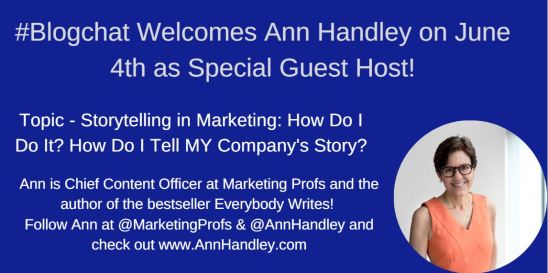
Ann Handley Joins #Blogchat to Discuss Storytelling in Marketing!

Ann Handley joins #Blogchat

UPDATE – Here’s the transcript from Ann’s #Blogchat!

I’m thrilled to announce that Ann Handley, the world’s first Chief Content Officer will join #Blogchat this Sunday (June 4th, 2017) to discuss Storytelling in Marketing!  Marketing Profs is June’s #Blogchat sponsor, and they have a great freebie for you!  Click here to get their FREE 37-page writing guide!

Here’s our topic: Storytelling in Marketing: how do I do it? How do I tell MY company’s story?

Here’s the questions we’ll be discussing:

Q1 – What does it mean to be a ‘storyteller’ when it comes to marketing, and which brands do this well?

Q2 – How does a company figure out what its story is? What should it share?

Q3 – Which social media tools are best for storytelling? Can it just be a blog?

Q4 – If a company only has 1-2 people that ‘do’ social media and marketing, how do they effectively use storytelling?


That’s what we’ll be discussing! All this fun starts at 8pm Central on Sunday! As an added bonus, Ann will be giving away 3 copies of her bestselling book Everybody Writes to participants in the #Blogchat!  Marketing Profs will randomly select 3 people that signup for the 37-page writing guide to win a copy of Everyone Writes.  Void where prohibited.

So by joining #Blogchat this Sunday, you’ll learn a ton about how to tell your company’s story with marketing, you can get this wonderful 37-page marketing guide AND you’ll have a chance to win a copy of Everybody Writes.  All this for the price of…..FREE!  Can’t beat that deal! Make sure you are following @MarketingProfs on Twitter and we’ll see you Sunday at 8pm Central!

Share this:

  • Share on X (Opens in new window) X
  • Share on Facebook (Opens in new window) Facebook
  • Share on LinkedIn (Opens in new window) LinkedIn
  • Email a link to a friend (Opens in new window) Email
  • Share on Reddit (Opens in new window) Reddit

Like this:

Like Loading...

Filed Under: #Blogchat, #Blogchat Transcripts

May 31, 2017 by Mack Collier

A Quick Overview of Lenny and Larry’s Brand Ambassador Program

Lenny and Larry's cookies brand ambassador programI am constantly looking for nutritional snacks and such for when I travel. I am an extremely picky eater, plus I had my gall bladder removed a few years ago, and if I don’t eat regularly, it can cause headaches and slight nausea. So having tasty and ideally nutritious snacks while traveling is a must for me.

About a year ago I discovered Lenny and Larry’s nutritional cookies. The problem with most ‘nutritional’ cookies or bars is that they taste terrible. Lenny and Larry’s cookies actually aren’t that bad, in fact they taste great when compared to similar products. Additionally, they are very easy to digest, with a great protein to fat ratio.  Each cookie (4 oz) is massive and enough for 2 servings, with 6 grams of fat per serving and 8 grams of protein.

Needless to say, The Complete Cookie is now my go-to snack when traveling. So the other day when I was on their site, I noticed they have a page that explains their brand ambassador program. I want to review their program because I know a lot of you are curious as to what a brand ambassador program looks like ‘in the wild’.

Before I discuss Lenny and Larry’s brand ambassador program, I wanted to review some of the key elements that a good brand ambassador program will have:

1 – A process for helping ambassadors better sell your products to the potential customers they will interact with regularly.  This could be coupon codes or samples that ambassadors can share with potential customers to encourage a purchase.

2 – A process for letting ambassadors collect and share product feedback from their interactions with potential customers, as well as their own product feedback. This is especially beneficial for letting ambassadors share feedback from potential customers on why they don’t currently buy your brand or its products.

3 – A way for ambassadors to directly communicate and connect with each other around shared ideas and beliefs that are core to them, that also relate to your brand and its products. For example, if your company makes cooking utensils, it might be a good idea to create a message board that unites ambassadors around the idea of cooking.


Based on what I see on this page, Lenny and Larry’s brand ambassador program is focused on having its members drive sales.  Period. There’s also a passing mention of driving digital WOM with the #TeamLL hashtag, but it’s obvious that the main focus of the program is additional sales.

From the page:

“Our Brand Ambassador program is our way of saying thank you.

Every ambassador gets a personalized landing page with a unique URL. Every time someone purchases after following your tracking link, you are handsomely rewarded. The more you promote, the more benefits you’ll receive.

Rewards:

Free cookies
Monthly discount codes
Official Lenny & Larry’s swag
$$ Commissions $$ (extra income)”

Which is a good start. A solid brand ambassador program should absolutely make it easier for its members to generate new sales from the potential customers they will interact with. However, if the main/only focus of the program is to encourage members to sell products, it can create problems. For one, the members will start to have sales-oriented interactions with potential customers, as you see here:

Stock up today!!! Use the link in my profile. #teamLL #lennyandlarrys #completecookie pic.twitter.com/OyoPg2hG4Z

— Heather Megginson (@hmeggs13) May 23, 2017

So let’s say that I am a fan of Lenny and Larry’s, but not interested in becoming an incentivized salesperson for the brand.  In this case, it appears the program doesn’t offer much for me. Here are some things I’d like to see added to the program (and to be fair, Lenny and Larry’s could be offering some or all of these elements now, but I don’t see any mention of them on the brand’s website):

1 – A way to directly connect with other brand ambassadors. I would like to see a forum or maybe a private Facebook group or some digital mechanism to let me interact with other members of the program.  Lenny and Larry’s creates healthy snacks so I am sure there are many fans of the brand that also have a lot of knowledge of the brand’s products as well as healthy eating and living that they could share with other members.  This type of knowledge-sharing would benefit all members, as well as bring them closer together.  Which also creates a better experience for the brand ambassadors, and this gives them another reason to be loyal to the brand.

2 – A way to directly connect with the brand and share thoughts and ideas. Think of this as a brand advisory council or similar.  Members no doubt have ideas and opinions on how to improve the program or change it based on their interactions with potential customers.  It would be great if Lenny and Larry’s had a mechanism in place to directly connect the group with the brand. When crafting a brand ambassador program remember that while leveraging ambassadors to drive new sales is important, leveraging their feedback from interactions with other customers can also pay huge dividends.

3 – Give the members early access to new products that are in development. If you’re already a fan of Lenny and Larry’s products, you’ll probably be interested in any new flavors to existing products, or any new products in development.


The point here is, if you’re going to create a brand ambassador program, give members multiple ways to participate. Not everyone wants to sell your products, even if they love your brand. Give your ambassadors special access to what’s happening with your brand, and multiple options for how they can participate and extend the relationship with your brand. I think Lenny and Larry’s brand ambassador program is a good start, as long as they are open incorporating new elements, starting with giving existing ambassadors more input into the future of the program.

Having said that, I know how hard it is for the boss to sign off on launching a brand ambassador program without there being a direct impact to sales, so I totally get the focus on attempting to drive sales through existing ambassadors. This is typically one of the first and biggest roadblocks I encounter when working with clients, the boss can only see a brand ambassador program’s value through the lens of how many new sales it will immediately generate. This affects execution and roll-out and if not carefully positioned, can negatively affect the progress of the initiative.

If this post has piqued your interest in launching a brand ambassador program, here’s a bit more information on how to get started creating an amazing brand ambassador program.

Share this:

  • Share on X (Opens in new window) X
  • Share on Facebook (Opens in new window) Facebook
  • Share on LinkedIn (Opens in new window) LinkedIn
  • Email a link to a friend (Opens in new window) Email
  • Share on Reddit (Opens in new window) Reddit

Like this:

Like Loading...

Filed Under: Brand Advocacy, Brand Ambassador Programs, Influencer Marketing

May 25, 2017 by Mack Collier

How to Write Like a Thought Leader (Even If You Don’t Think You Are)

How to write like a thought leader

UPDATE: Here’s the transcript from our #Blogchat discussion on How to Write Like a Thought Leader.

On Sunday (May 28th, 2017), our #Blogchat topic will be How to Write Like a Thought Leader (Even If You Don’t Think You Are).  The discussion starts at 8pm Central, and #Blogchat is sponsored in May and June by Marketing Writing Bootcamp.  You can save $200 on the 13-class writing course by clicking here.

To prepare for this discussion, I’m going to share my thoughts on how to write like a thought leader. First, what does it even mean to be a ‘thought leader’?  To me, it means that you spark new ideas and conversations. You share your opinions, but you also offer a new or unique take that makes people view an idea in a new light.

If you want to Write Like a Thought Leader, keep these tips in mind:

1 – Don’t be afraid to share what you know. We all have expertise around some topic. space or idea. Don’t fall victim to the ‘you can’t self-promote’ blame game.  Sharing what you know isn’t self-promotion, it’s helping others. From my experience, the people that claim you can’t self-promote are often the people that are wanting to be better self-promoters themselves. In other words, don’t listen to these people, listen to the people you want to reach and connect with.

2 – Stay up to date on what recognized experts in your space are saying and highlight their views on your blog when relevant. This not only helps you become more informed (and helps you boost your claim to thought leadership), but it also makes your content more interesting and relevant to your readers. And along with this, you can also…

3 – Incorporate the ideas of other thought leaders into your content, especially when they agree with your points. Let’s say you are a SME in the automotive manufacturing industry. But the problem is that you aren’t well known and you are blogging to get your name out there and to establish your expertise with an audience that doesn’t yet know who you are. One way to do that is to incorporate the thoughts and ideas from other, more well-known leaders in your space. For example, you could write a blog post that makes a point about a specific topic, then reference quotes from other, more well-known industry leaders, who agree with your stance. By doing this you are effectively leveraging the credibility of recognized experts in your space to make your ideas look more credible.

4 – If you don’t think you are a thought leader, you won’t write like one. How you view yourself comes across in your writing, whether you realize it or not. If you feel your opinions are valid and worthwhile, you will write in a way that reflects their importance. Don’t feel that you have to convince the reader that your thoughts matter, write as if they do, and the reader will become convinced.  Educate yourself, share what you already know, and you’ll be fine. Remember, everyone knows something and you are making your readers smarter and more prepared to face their world by sharing what you know.


So those are some ideas to keep in mind and make sure you bring your own this Sunday when our topic will be How to Write Like a Thought Leader (Even If You Don’t Think You Are), starting at 8pm Central.

And we’ll also announce who our surprise guest host will be for the #Blogchat on June 4th, you’re going to want to be there for that!

Share this:

  • Share on X (Opens in new window) X
  • Share on Facebook (Opens in new window) Facebook
  • Share on LinkedIn (Opens in new window) LinkedIn
  • Email a link to a friend (Opens in new window) Email
  • Share on Reddit (Opens in new window) Reddit

Like this:

Like Loading...

Filed Under: #Blogchat, #Blogchat Transcripts

  • « Previous Page
  • 1
  • …
  • 35
  • 36
  • 37
  • 38
  • 39
  • …
  • 119
  • Next Page »

Recent Posts

  • My Substack Conversion Rate Went From 0.5% to 13% in Six Months, Here’s How
  • A Solid Conversion Strategy is Vital on Substack, Here’s the Proof
  • Empathy is Your Customer Service Secret Weapon
  • Understanding Substack’s Three Growth Stages
  • Blogging Isn’t Dead, it’s Morphed Into Substack

Categories

Archives

Comment Policy

Be nice, be considerate, be friendly. Any comment that I feel doesn't meet these simple rules can and probably will be deleted.

Top Posts & Pages

  • The Real Reason Why the Mona Lisa is So Popular Will Surprise You
  • I Do Not Deserve to Suffer Like This...
  • Why Did Jesus Send His Apostles Out With Nothing?
  • Understanding Substack's Three Growth Stages
  • How Much Money Will You Make From Writing a Book?
  • Case Study: Patagonia’s Brand Ambassador Program Focuses on Product Design and Development Over Sales
  • The Difference Between a Brand Ambassador and a Brand 'Spokesperson'
  • How to Be An Amazing Public Speaker, Especially If You Are An Introvert
  • Case Study: Lego Ideas
  • Use TweetDeck to track who favorites your tweets

  • Blog
  • Mack’s Bio
  • Work With Mack
  • Buy Think Like a Rock Star
  • Book Mack to Speak

Copyright © 2026 · Executive Pro Theme on Genesis Framework · WordPress · Log in

%d