MackCollier.com

  • Blog
  • Mack’s Bio
  • Work With Mack
    • See Mack’s Work
  • Buy Think Like a Rock Star
  • Book Mack to Speak

February 26, 2014 by Kerry O'Shea Gorgone

Blogger Outreach: How Ford is Getting it Right

Last November, I replied to a tweet from my friend, C.C. Chapman. Given the choice, C.C. asked, would you prefer a free Tesla or a free Mustang. The replies came fast and clearly favored the Tesla, but I’m a muscle car enthusiast, so I replied that I’d take the Mustang.

Mustang! #LoveMyMuscle 😉 I'll minimize my carbon footprint some other way. MT @cc_chapman: Mustang or a Tesla, which would you choose?

— Kerry O'Shea Gorgone (@KerryGorgone) November 18, 2013


That same day, I received a direct message from someone working with Ford, inviting me to an Orlando-area event for women bloggers.

Although late November is a busy time, I attended the event, and sat next to Chaun Avery, Orlando Regional Ford Lincoln Sales Operations Manager at Ford Motor Company. We talked about Ford’s new models, some of which we’d get to see later that afternoon. I casually mentioned that I’d be interested in an electric car, but didn’t want the hassle of finding an outlet to plug it in away from home. That’s when Chaun recommended I try the C-Max, which recharges every time you brake.

I drove the car that afternoon, and already hated to give it up.

Chaun offered me an extended test drive, and after a few emails, I was at her office, signing some simple forms to borrow the car in a “blogger loan.” She came out for a test drive, explained the car’s features, and sent me on my way.

That was it. No hard sell. No sell, period. Brilliant!

Here’s what happened. I loved the car. My family loved the car. I tweeted some pictures of the car, including a disclosure that I’d received a free extended test drive.

Having so much fun driving a Ford C-Max Hybrid! Thanks @YourSFD @Ford_Southeast http://t.co/KbJuT9xXpd #CMaxForXMas pic.twitter.com/pKOi3se8eg

— Kerry O’Shea Gorgone (@KerryGorgone) January 1, 2014

People asked, enviously, how I’d managed to get an extended test drive. “I asked,” was the simple answer, although of course I happened to meet the right person to ask! I drove the car to work, and let my co-workers see it. I drove Kim Garst to lunch when she happened to be near my office one day, and let her check it out.

Love this car! Amazing features and the gas mileage rocks! @KerryGorgone @Ford_Southeast @YourSFD — Kim Garst ツ (@kimgarst) January 7, 2014

When Lynette Young came to Orlando, I contacted Chaun and let her know Lynette was in the market for a hybrid car and would probably love driving the C-Max as much as I did. Lynette and Chaun exchanged some paperwork, and I handed over my new favorite car for a week. (Of course, I got it back afterward.) Lynette loved the car, too. She even tweeted about it.

.@KerryGorgone this @ford C-Max is AMAZING! My husband @phishfrye & I are going to love driving in it! #ThankYou

— Lynette Young (@LynetteRadio) January 26, 2014

For marketers keeping track, this entire process has involved very little cost to Ford: one event, social monitoring, targeted outreach and a genuine passion for letting people try the cars.

And the smartest move on Ford’s part? No move at all. Hand over the keys, and let me drive the car.

Well played, Ford, well played.

Share this:

  • Share on X (Opens in new window) X
  • Share on Facebook (Opens in new window) Facebook
  • Share on LinkedIn (Opens in new window) LinkedIn
  • Email a link to a friend (Opens in new window) Email
  • Share on Reddit (Opens in new window) Reddit

Like this:

Like Loading...

Filed Under: Brand Advocacy, Social Media

February 11, 2014 by Mack Collier

That Esurance Super Bowl Stunt and Finding the Real Value of Social Media

Esurancetweet

So here’s the deal: Instead of buying a Super Bowl ad, Esurance bought the first ad AFTER the Super Bowl.  And they saved $1.5 Million in the process, then gave away that money.  If you wanted to win the cash, all you had to do was tweet the hashtag #ESuranceSave30 within 36 hours of the ad being aired.

AdWeek lauded the stunt as a huge success, and cited these results in making that claim:

• 5.4 million uses of the #EsuranceSave30 hashtag
• More than 200,000 entries within the first minute of the Esurance commercial airing
• 1.4 million hashtag uses in the first hour and 4.5 million in the first 24 hours
• 2.6 billion social impressions on Twitter
• 332,000 views of the Esurance commercial on YouTube
• 261,000 new followers on the official Esurance Twitter account—an increase of nearly 3,000 percent
• A 12x spike in visits to the Esurance website in the first hours of the sweepstakes

Does that look like a successful social media sweepstakes to you?

Augie Ray has an exhaustive analysis of the social sharing results Esurance saw from this stunt, and is critical of the rush to laud these results as being a sign of a win:

I am deeply disappointed to see Esurance’s Super Bowl sweepstakes results widely celebrated. Six years into the social era, I thought we had reached a certain point of social media maturity where we realize that fans and followers are not leads and that relationships are built through shared values and meaningful interactions. I naively thought that we had turned a corner, with widespread understanding that winning in social media occurs by providing great experiences that build long-term relationships and not with campaigns that yield short-term spikes of activity. I was wrong.

It’s easy to look at the results and be wowed.  But as Augie pointed out in his post, let’s not lose sight of the fact that these engagement figures are based on Esurance giving away $1.5 Million dollars.  I’m betting any of us could do the same thing on Twitter and get a shit-ton of new followers.

Augie also points out in his post that ESurance has already lost 15% of the followers they gained from this stunt.

And to me, this is the key point.  How well does Esurance convert these new followers and visitors into customers?  A 12X spike in website traffic is significant, as long as those visitors didn’t simply go to the site for 15 seconds because of this sweepstakes, and then never return.

On the other hand, if Esurance found a way to stay engaged with those new website visitors, then that does have value for the brand.

Unfortunately, the vast majority of the people that engaged with the brand immediately after the ad likely had no loyalty toward the brand, they just wanted to win the cash.  So while the ‘eye-popping’ social engagement numbers look good, they are the social media equivalent of farting in an elevator.  It gets everyone’s attention…till the doors open up and then everyone moves on with their lives.

The ultimate success of this stunt will be dictated by how many new customer relationships are created as a result.  If Esurance built into this ways to leverage the new exposure into an ongoing relationship, then the chances of this stunt being a success increase dramatically.

My guess is they (and their agency) are thrilled with the extra ‘pr value’ they got from this.

What do you think, do the above results make this a successful initiative in your mind?

Share this:

  • Share on X (Opens in new window) X
  • Share on Facebook (Opens in new window) Facebook
  • Share on LinkedIn (Opens in new window) LinkedIn
  • Email a link to a friend (Opens in new window) Email
  • Share on Reddit (Opens in new window) Reddit

Like this:

Like Loading...

Filed Under: Brand Advocacy, Marketing, Social Media

January 23, 2014 by Mack Collier

The Power of Integrating Customer Service Across Your Organization

While many companies are struggling to use social media as a channel to drive sales, some companies have discovered the power of using social media tools such as Twitter and Facebook to provide effective and efficient customer service. For example, look at this recent exchange on Twitter between Ekaterina Walter and Nikon:

EkaterinaNikon

EkaterinaNikon2While the end result might be a customer service ‘win’ for Nikon, it also raises some glaring issues for the brand.  For example, if there’s consistently a disconnect between the level of customer service that Nikon offers via phone and Twitter, what happens when customers try the phone and don’t know to contact Nikon on Twitter?  In that case, Nikon likely doesn’t have a chance to redeem itself as they did here with Ekaterina.

Another byproduct of this is that by providing better customer service via one channel, you are training your customers to go to that channel first for customer service.  Which can be a plus assuming you have the bandwidth to support additional customers.  But if not, that likely means that the level of customer service provided by one channel (Twitter in this case) may fall lower and more in line with what customers are seeing via other channels (such as the phone).

So what’s the answer?  Try comparing notes.

Think about all the channels customers can use to contact you with support issues.  Email, social media, website, phone, even snail mail, maybe even in-person.  It’s important to remember that different customers prefer to use different tools.  So it’s entirely possible that each customer service channel you use is seeing complaints and questions from a completely different segment of your customer base.

For each customer service channel you use, you should have your employees that man these channels regularly provide every area of your customer service team with the following information:

1 – What is the nature of customer contact?

2 – Are customers inquiring about a particular product or service?

3 – Did the customer mention attempting to contact your company via another channel first?  If so, which one?

4 – Who was the customer?  Share any information you can about who they were, their age, location, how they used you product or service, etc.

If you can better communicate and integrate your customer service experience then the total quality of customer service you provide will increase.  That means more satisfied customers, and it increases the likelihood of creating more fans of your brand.  Most brands don’t understand this, but one of the easiest ways to create new fans is to give a frustrated customer excellent customer service.  That will often convert an upset customer into an advocate for your brand.

Share your successes, and your failures

No matter how many touchpoints your company offers customers to contact you with a service issue, the employees manning the frontlines should be in constant contact.  If your support team on Twitter, for example, is having success providing customer service, you want to share with other areas of CS what’s working.  Reverse-engineer why the CS experience on Twitter is better for customers so you can share what’s working with the rest of your organization.  That way your team that handles the call center may be able to apply some of the lessons learned from the Twitter support team to improve the experience callers see with customer support.

It’s equally important to share your failures.  Let other members of your customer support team diagnosis your efforts and give you insight into how to improve, based on what’s worked for them.  A fresh set of eyes are often necessary to spot shortcomings that can be corrected.  Another good idea is to have a private message board or forum just for your customer support team so they can bounce ideas off each other and share thoughts.

The bottom line is that just as communication with your customers facilitates understanding, the same process works internally.  The more communication between all areas of your customer service department, the greater the chance to improve the experience for your customers.

Share this:

  • Share on X (Opens in new window) X
  • Share on Facebook (Opens in new window) Facebook
  • Share on LinkedIn (Opens in new window) LinkedIn
  • Email a link to a friend (Opens in new window) Email
  • Share on Reddit (Opens in new window) Reddit

Like this:

Like Loading...

Filed Under: Customer Service, Social Media

January 17, 2014 by Mack Collier

The Death Knell for Social Networking Sites: Mainstream Usage

Shopping

The first online portal I joined was Prodigy in 1991.  It was actually a great experience, there was just no one there.  But the few people that did use the mostly text-based service were very friendly and it wasn’t unusual to interact with someone on one of the pseudo-message boards and share your home address with an invitation for others to write a letter.  Different times.

From there I went to CompuServe in the mid-1990s and AOL soon after that.  Both CS and AOL were also internet providers, and at the time it was some outrageous amount, like $25 for 10 hours online.  For a month!  I often spend more than 10 hours online in a day!

Then around 1997 or so, AOL announced that it was changing it’s price structure and removing the hourly cap on online access.  They rolled out the $25 for unlimited access and it was a total game-changer.  Unfortunately, it also totally changed the experience on AOL.  Suddenly, there were kids everywhere!  I feel like the old man shaking his cyber-fist but suddenly I had to learn what ‘LOL’ and ‘OMG!’ meant, along with ‘trolling’, ‘noobs’ and the endless string of 🙂 😛 XOXO.

AOL had gone mainstream, and in the process, the experience that it’s core users had become accustomed to had changed greatly.  Ironically, we are now seeing the same thing happen in reverse with Facebook.  Facebook started out as a site for only college students.  Then the restriction of having an edu address to access FB was lifted, which meant that recent college grads and soon-to-be college students (IOW the younger and older siblings of current FB users) started checking out the site.

The social media geeks found FB in 2007.  Over the next 2-3 years its userbase grew at an astronomical rate.  Suddenly it seemed like every kid from the age of 14-24 was on Facebook.

Then the parents found out that their kids were on Facebook.  Suddenly parents everywhere that had little to no idea what their kids were up to, only had to go on Facebook at it was all there!

As you might expect, Facebook is quickly becoming ‘uncool’ to these kids. In fact, Facebook recently verified that young teens are leaving the site.  Where are they going?  To sites that their parents haven’t discovered yet like SnapChat, Instagram and Path.  Which are now growing like crazy, that is until mom finds out about them…

It’s truly the paradox of growing an online site or portal: You need to reach a certain mass of users to attract more users.  And you need to monetize those users, which is another reason you want more users.  But the simple fact is that adding more users changes the overall experience.  It has for every social media site I’ve used for the last 20+ years.  And when the overall experience changes from what made the site appealing to begin with, people leave.

If you are trying to create an online community site, or even if you are trying to build a blog readership, always focus on delighting and retaining your first users.  These are the builders of your base, the people that love your experience and tell others about it.  When you get in a rush to bring in new users too quickly, you change the experience, which means you lose those first users that are really the foundation for you entire community.  It’s like building a pyramid, you have a strong foundation, then you start slowly building the pyramid.  Then suddenly you start to quickly add on and going skyward with the pyramid, while at the same time you start removing the foundation.  Obviously the pyramid will soon collapse under its own weight.

Never pursue growth at the expense of user experience.  Facebook’s growth was driven by kids.  Kids that are now deciding they don’t like being on the site anymore.  When the foundation is removed the collapse isn’t very far behind.

Share this:

  • Share on X (Opens in new window) X
  • Share on Facebook (Opens in new window) Facebook
  • Share on LinkedIn (Opens in new window) LinkedIn
  • Email a link to a friend (Opens in new window) Email
  • Share on Reddit (Opens in new window) Reddit

Like this:

Like Loading...

Filed Under: Community Building, Marketing, Social Media

January 13, 2014 by Mack Collier

The Free Economy: Why It’s Making Everything More Expensive

Over the past several years as publishing and content creation tools have flourished, so has the idea that anything free is inherently better or at least more desired than content or tools that cost money.  Whether you are an individual or company looking to make a name for yourself, the path is pretty linear: Create gobs of free content or give users free usage of your tool, and eventually they will want to pay you for your content or tool.

Until, they don’t.

For years, this sort of freemium model was successful: Provide limited and free access, then when people saw the value of your content/tool, charge them money for additional access and features.  But over the last couple of years, I’ve noticed a disturbing trend among my peers and networks.  People will stay with a tool or content creator as long as their content/tool is free, but as soon as they ask for money, most people jump off and look for another free source.  There’s so many sources of information that the thinking seems to be that someone else will offer better functionality at a free price.  Or instead of paying this writer $9.99 for their ebook, I can get the same information for free from blogs.

Too often, the most important attribute assigned to online content or tools is that they be free.  Free = better in the minds of many.

Here’s an example: My modest newsletter is now up to 1,000 subscribers.  I publish a new issue every week or so, and the newsletter is designed to give subscribers information they can use to better create engagement around their digital marketing efforts and create fans of their brand.  All for free.  Yet every 4th or 5th issue (often I will publish this as an additional issue for that week), I will use the newsletter to directly promote a product or service I offer.  Many people do this with every newsletter issue they publish, but I like to do it about 20-25% of the time.  Typically when I publish a newsletter issue, I will have 1 or 2 people unsubscribe, on average.  But every time I publish a newsletter issue where I am trying to directly sell to my subscribers, the number of unsubscribes always spikes, typically it’s 500% or more higher than the average issue.  The people that unsubscribed left as soon as I asked for the sale.  In other words, they were willing to take and use my content as long as I was providing value for them, at absolutely no cost to them.  But the second they saw an ‘ad’, they left.

It’s not just content, any of you that conduct regular meetings for organizations such as the AMA or Social Media Club have seen the same thing.  If the meetings are free, attendance is high, but when you begin charging even a few dollars, attendance falls off a cliff.

The thinking seems to be that if your offering isn’t free, you can’t compete.  Which means that if there are more free options, there are also more bad options.  And we all spend more time trying to figure out which free option is the best, without realizing that the additional time is costing us more than paying a few dollars for a valuable service or piece of content.

You don’t become an expert by reading an expert’s blog.  You become an expert the same way they did; By doing stuff.  I’ll let you in on a secret: I’m not writing this blog to teach you how to become an expert, I’m writing this blog to establish *my* expertise in social media marketing, online community building and marketing strategy, so you will hire me.  Sure, some people will be able to read my posts here, follow my instructions and launch a brand ambassador program for their company.  But what I hope happens is that a company would read my posts, realize how much time and money it would cost that company to launch a brand ambassador program itself, and instead hire me to do it for them.  I get paid, they save time and money.

I’m not sure what the answer is, but what I fear happens is you have a lot of very smart individuals and startups that throw in the towel because they can’t make money on a product or content by giving it away for free.  For instance, consider the plugins on your blog, how many are you paying for?  Are you paying for any of them?  I have about 30 plugins, and only pay for two of them.  In both cases, I wanted a plugin that did specific things, and couldn’t find a free version that did, so I paid for the services I wanted.

Many of us bemoan the glut of content being created these days.  Everyone is creating content and it’s all the same.  But it’s also (mostly) free.  We complain about how Twitter or Facebook isn’t working right, how the sites run too many ads, yet we forget that we aren’t paying a penny to use either service.

Nothing is truly free and I think we need to realize that if we aren’t paying for content or a tool on the front-end, there is a cost in terms of time, diminished experience, etc on the back-end.  The myth of the free lunch is just that.

Share this:

  • Share on X (Opens in new window) X
  • Share on Facebook (Opens in new window) Facebook
  • Share on LinkedIn (Opens in new window) LinkedIn
  • Email a link to a friend (Opens in new window) Email
  • Share on Reddit (Opens in new window) Reddit

Like this:

Like Loading...

Filed Under: Marketing, Social Media

January 8, 2014 by Mack Collier

Stop Selling Ice to Eskimos, Get a Better Content Strategy in 2014

Last year I made a big mistake on my blog, and it’s a mistake I am constantly reminding y’all not to make.

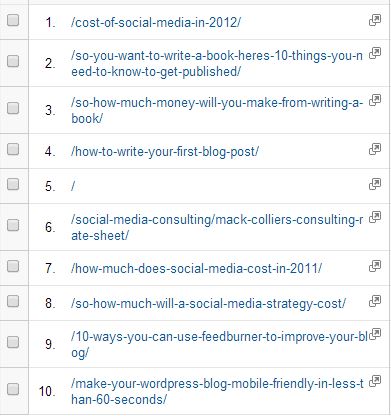
Here’s a list of the Top 10 most popular blog posts here last year:

BlogStatsNote the #2 and #3 blog posts are about book publishing.  I wrote these last year while I was launching my book.  I wanted to share what I had learned so that the information could benefit other consultants, marketers or really anyone that wanted to be a writer or was considering writing a book.  And the top search term that people used to find this blog last year was ‘I want to write a book’.  By a 10 to 1 margin over the #2 search term.

There’s just one (big) problem.  Current or potential writers that want to make money off writing a book is not my target audience.  Not even close.  So while these two posts were very popular, they helped connect me with an audience that I had no services for.  But I forgot this because I was focused on how these posts could be valuable to readers.  I just lost sight of the fact that they wouldn’t really create value for a big portion of my target audience.

This is one of the lessons I am always preaching here, to keep in mind the audience you are writing for.  I want to create helpful content for my desired audience.  The two posts on book publishing were very helpful, just not for the people I am trying to connect with.

Here’s a simple way to keep your content focused in 2014:

Create three content areas or buckets.  These will be the three areas of your business that you want to focus on with your content.

For example, if your blog is for your lawn care business, your three buckets could be:

1 – Killing insects in your lawn

2 – Growing healthier flowers for your yard

3 – Proper maintenance of your lawn

So for every post you write, you need to make sure it fits into one of these three buckets.  If it does not, you need to justify why you should publish the post.  This is a great way to keep your content on track and to make sure that you are only creating content that’s focused on your business.  An added benefit of this is that as you are creating content around the relevant areas of your business, you will be helping Google identify your blog with certain relevant keywords.  For example, I would rather people find my blog via a search term like ‘building a brand ambassador program for my company’ versus ‘i want to write a book’.

Additionally, you need to always consider who you are writing for.  For example, this blog is a business development tool for me.  Which means if I am creating content, I need to create content that is useful to the people that can give me business.  In evaluating my content here from last year, I noticed that too often I was creating content that was useful to solo bloggers.  I love helping solo bloggers (a big reason why I launched #Blogchat) but solo bloggers aren’t the audience I want to be getting business from.  So that’s why the majority of my content this year will be focused on how brands can market more efficiently, because brands and companies are the audience that I want to do business with.

It pays to go back every month or maybe every quarter and self-evaluate your content and your content strategy for your blog.  Look at what type of progress you are making on reaching your goals, and then make sure that you are still creating the type of content that you need to in order to reach those goals.

Share this:

  • Share on X (Opens in new window) X
  • Share on Facebook (Opens in new window) Facebook
  • Share on LinkedIn (Opens in new window) LinkedIn
  • Email a link to a friend (Opens in new window) Email
  • Share on Reddit (Opens in new window) Reddit

Like this:

Like Loading...

Filed Under: Blogging, Content Marketing, Social Media

January 7, 2014 by Mack Collier

Reaching a More Connected Customer Requires a More Connected Company

Over the Holidays I was reading an issue of the Wall-Street Journal about how companies are leveraging Twitter to improve its marketing.  Companies that sell cold medicines and items, especially those related to treating the flu, are closely monitoring Twitter.  They are tracking instances of people complaining on Twitter about having flu symptoms such as body aches, coughing and colds.  Then they will track where these people live, and make sure that local retailers are have sufficient inventory of any cold treatment products or medicines that the company sells.  Clorox and Kimberly-Clark (makers of Kleenex brand tissues) both reported double-digit sales growth by utilizing Twitter and online chatter to drive shipments of cold products during the previous flu season.

While this type of conversation-mining might seem revolutionary to many companies, it can seem a bit underwhelming to the customers these companies are trying to reach.  This type of functionality has long been available even in basic and free versions.  The now-defunct site Monitter.com provided users location-based searching based on zip code.  Even Twitter now provides this functionality, and you can even factor in user sentiment.

community building, online community

We’ve been chattering on Twitter for several years now.  When companies first arrived their goal was to market and promote.  As the above examples illustrate, now they are beginning to understand the value of listening.  One of the great marketing benefits of social media for companies is word of mouth in digital form.  Before social media and the internet, if customers in Nashville began complaining about flu-like symptoms in December, they did so via analog tools that were largely inaccessible to companies that sold products that could have helped them relieve their flu symptoms.  Today, we are increasingly using digital and social media tools, and as such, our word of mouth is now in digital form so companies can access it and act on it.

But the key is that companies must make the effort to access that customer feedback.  If your company is consistently tracking and analyzing this digital word of mouth from your customers, you will begin to notice trends and patterns.  You will begin to develop a deeper understanding of your customers.

Which means you can market more efficiently to them.  By 2014, most companies that do any business online are at least experimenting with social media.  But few companies are truly utilizing social media efficiently to drive real business growth.

If you want to be in the minority of companies that are using social media marketing correctly, start by leveraging these tools to better understand your customers.  Too many companies start using social media to better sell to customers.  That should come later.  Use this simple format:

1 – Listen first, then take what you learn and apply it to…

2 – Engaging with your customers.  Interact with them, help them, and create value for them.  That leads to…

3 – Sales

Instead, too many companies put the cart before the horse and jump in immediately trying to sell to people they don’t understand via tools they don’t understand.

Don’t put the digital cart before the digital horse.  It’s not about understanding the tools, it’s about understanding how and why your customers are using the tools.  Then you can move forward.


Share this:

  • Share on X (Opens in new window) X
  • Share on Facebook (Opens in new window) Facebook
  • Share on LinkedIn (Opens in new window) LinkedIn
  • Email a link to a friend (Opens in new window) Email
  • Share on Reddit (Opens in new window) Reddit

Like this:

Like Loading...

Filed Under: Social Media, Social Media Monitoring, Twitter

January 3, 2014 by Mack Collier

Behaving Badly Online and the Power of Eating Your Own Dog Food

A few months ago a well known ‘social media guru’ on Facebook said I was a hateful and fearful person, just because I disagreed with them on a particular social issue.  Actually, they didn’t single me out, they said that anyone that disagreed with them was hateful and fearful and intolerant (the irony of their intolerance was blissfully lost on them).  Then for good measure, another gooroo took the opposite stance on this same issue, and said that anyone that disagreed with them was hateful and fearful.  So we were screwed either way.

Over the last year or so, I’ve noticed an increase in people behaving badly online.  What’s most troubling to me is, a lot of this bad behavior is coming from ‘social media experts’ that advise companies on how to deal with customers online.  Consultants and agencies that train companies on how to respond appropriately online, then turn around and break their own rules when they get on their personal social media accounts.

Case in point, the recent episode with Justine Sacco’s tweet about her trip to Africa.  It was an incredibly bone-headed and immature tweet to leave, and it was pretty obvious as soon as she did that she was going to get canned, and she did.

What wasn’t expected was the near mob-mentality that erupted on Twitter especially.  It was as if her detractors on Twitter (and at this point there were many, mostly due to her own words) were waiting for a sense of closure that would only come from her being fired.  The longer it went without seeing her termination, the louder and angrier the mob got.  As my friend Ann Handley said:

I’m not trying to be sanctimonious here – I understand it’s human nature to grab a pitchfork and a club and join the march.

Or is it? Can’t we expect more from an evolved, networked, smarter world? Aren’t we better than that?

The challenge for companies is to treat content publishing as a privilege—to respect your audience and deliver what they want in a way that’s useful, enjoyable, and inspired. But the larger challenge for humans is to treat publishing with a similar respect—understanding the responsibility and power than comes with the ability to communicate with a global audience.

Additionally, I think that those of us that want to instruct companies on how to properly engage customers online should be held to a higher standard.  That means if you want to be noted as an expert in helping companies engage customers online, you lose the right to then go on Facebook and call Obama/Romney an asshole just because you’re a Republican/Democrat.

It means you have to eat your own dog food.

I’ll be the first to admit that I have slipped up a time or two and have discussed politics online.  I think most of us have, and there’s nothing wrong with that.  But if I start attacking people online simply because they support a different political party, I really do forfeit the right to call out brands for behaving badly.  We cannot hold brands to a higher standard than we hold ourselves.

We always talk about how brands need to be ‘more human.’ Sometimes we ‘humans’ do too.

Share this:

  • Share on X (Opens in new window) X
  • Share on Facebook (Opens in new window) Facebook
  • Share on LinkedIn (Opens in new window) LinkedIn
  • Email a link to a friend (Opens in new window) Email
  • Share on Reddit (Opens in new window) Reddit

Like this:

Like Loading...

Filed Under: Being Alive, Social Media

January 2, 2014 by Mack Collier

It’s 2014, Let’s Stop Talking About Social Media

5367598942_50a442693e_z

Happy New Year, y’all!  2014 begins my 10th year of being immersed in the world of social media.  I can remember when social media was simply blogs and MySpace.  Then Facebook and Twitter came along, and we all began to wonder when companies would begin to notice these amazing tools and what they could help them accomplish.

Finally, around 2008 0r 2009, companies start to pay attention to social media.  But in the five or so years since then, the conversation has largely remained focused on the tools themselves.  It’s long-overdue that we stop focusing on the tools and start focusing on understanding how and why people are using these tools.

Let’s stop focusing on social media and instead focus on how social media usage by our brand can relate to larger and far more valuable business objectives:

1 – Customer satisfaction

2 – Customer loyalty

3 – Sales

It’s time to elevate the conversation.  Actually it’s about 5 years past time to elevate the conversation.  We need to stop talking about the tools, and instead focus on the larger business goals that the tools help us reach.  For too long social media strategists/agencies and firms have been trying to sell companies on using social media with a tools-oriented argument.  Key executives that work within companies that approve marketing budgets don’t speak in terms of tools, they speak in terms of results.  A 15% increase in sales in Q3, a 10% reduction in product returns for the year or a 20% reduction in staff turnover.

When we change our conversation to stop focusing on the tools and instead focus on how the tools impact the bottom line, we earn the attention of companies.  It sends a completely mixed message to companies when we strategists say that companies need to invest in social media, but we talk about how that investment will lead to increased social media engagement, brand awareness, Likes and comments.  We tell companies that social media is important, then speak about that importance in metrics that are totally unimportant to the average company.  

So there’s no wonder they aren’t listening.  Neither are customers, because we are focused on ways to use social media to turn customers into digital billboards for our brands.

Stop the insanity!

If it’s 2014 and you are just now considering using social media to connect with your customers, I have good and bad news for you:

The bad news is: You’re way behind.

The good news is: Most companies that are using social media suck at it, so you can catch up quickly if you are smart.

It’s not about understanding the tools, it’s about understanding the people that use the tools.  That should be your focus in 2014.  Tools change but it’s always a good idea to understand who your customers are and how you can create value for them, regardless of the tools they (and you) use.

Pic via Flickr user DigitalLeica

Share this:

  • Share on X (Opens in new window) X
  • Share on Facebook (Opens in new window) Facebook
  • Share on LinkedIn (Opens in new window) LinkedIn
  • Email a link to a friend (Opens in new window) Email
  • Share on Reddit (Opens in new window) Reddit

Like this:

Like Loading...

Filed Under: Marketing, Social Media

December 18, 2013 by Mack Collier

I Quit

54389823_88dbffdf7d_z

One of my goals for this year was to launch a newsletter.  Consistently, I had heard from marketers I trust that they were seeing great traction from their newsletters.  Then Chris Brogan said that the engagement level he was seeing from his newsletter was far better than what he was seeing on his blog.

That clinched it for me, and I launched the Think Like a Rock Star newsletter in February.  The goal was simple, I wanted to leverage the newsletter as a way to get new work leads.  My plan was to publish the newsletter once a week, all original content.  The format was that I would create original content for the newsletter, focused on how companies can better create and cultivate fans.  And I would end each newsletter issue with a reminder of one or two relevant ways that subscribers can work with me.  My thinking was that I would give subscribers valuable and original content, and then a sales pitch at the end.

The results?  They stink.  So far after 10 months I have gotten a grand total of zero dollars of business from my newsletter.

What’s worse, both the open rates and click rates for the newsletter have consistently fallen.  After the first few weeks the open rate was 50%.  Then it fell to 40%, then over the next few months down to 35%, 30%, 25% and lately it’s been barely above 20%.  The click rate was even worse, rarely getting above 3%.

After 10 months, the newsletter was averaging a 24% click rate, and a 1.9% click rate.  Honestly over the last few weeks I’ve seriously considered pulling the plug on the newsletter.  I’m putting 5-10 hours a month into it and literally getting nothing from it.  No emails, no contact, no clicks, nothing.

I was ready to say ‘I Quit’.

But…it kept nagging at me that I must be doing something wrong.  The newsletter is a tool that’s proven to work for others.  So far my newsletter was a failure, but I wasn’t ready to quit on it.

So I decided to re-evaluate everything about the newsletter.  I started subscribing to the newsletters of marketers that were seeing success with their newsletters.  I immediately noticed that their format was different from mine.  They weren’t publishing original content with their newsletter, in fact they typically were using their newsletter as a tool to drive subscribers back to their blog.  Often they would give a short summary of their latest post, then a link.

So on Monday I sent out my latest issue of my newsletter and tried a different approach.  I gave subscribers a recap of the recent changes that Facebook had made to its News Feed algorithm, and how it was likely impacting the reach of its brand page.  After telling subscribers what was happening, I added that if they wanted to see my two suggestions for handling this change, that they should click over to my blog to read my thoughts.

So my goal for this particular issue was two-fold:

1 – I wanted to see if I could significantly increase the open rate.  I wrote what I thought was a pretty good headline for the email: “The One Change Facebook Made That Could Kill Your Brand Page”

2 – I wanted to see if giving subscribers a lead-in to the post, then asking them to click here to read ‘the rest of the story’ would significantly increase the click rate.

The results?

The list’s average open rate is 24%, after two days the open rate for this issue is at 30%.  That’s a 25% increase over the list average.

The list’s average open rate is 1.9%, after two days the click rate for this issue is at 12.4%.  That’s an increase of over 500% above the list average.

There’s a couple of lessons here:

1 – Quitting is worse than failure.  When you fail you can still learn how to improve, but you can only realize that potential improvement if you keep trying to get better.

2 – It’s ok to change your path if you are lost.  I started out with a set of goals for my newsletter and certain tactics I was using to try to reach those goals.  After 10 months, it clearly wasn’t working, so I decided to try something new.

Now to clarify, simply getting people to click over to my site/content still isn’t the ultimate goal.  The ultimate goal is to get actual work from the newsletter.  But at least now, I have something I can tinker with.  Before, I wasn’t getting emails from subscribers, I wasn’t getting clicks, and the open rate was falling like a rock.  Now at least I have a way to generate more clicks, so that’s something.  I’ll still need to keep tweaking the format and content in order to see those clicks convert into leads, but today I feel much better about the newsletter than I did just a week ago.

The point is to keep trying.  It’s the same with your blogging strategy, your mobile strategy, etc.  It really does pay to experiment sometimes, for example, the headline to this post is an experiment.  I wanted to see if a very short and provocative headline would draw interest in the post.  Maybe it will, or maybe it won’t.

But if it fails, I’ll try something else.  I won’t quit.

Pic via Flickr

Share this:

  • Share on X (Opens in new window) X
  • Share on Facebook (Opens in new window) Facebook
  • Share on LinkedIn (Opens in new window) LinkedIn
  • Email a link to a friend (Opens in new window) Email
  • Share on Reddit (Opens in new window) Reddit

Like this:

Like Loading...

Filed Under: Social Media

  • « Previous Page
  • 1
  • …
  • 3
  • 4
  • 5
  • 6
  • 7
  • …
  • 26
  • Next Page »

Recent Posts

  • My Substack Conversion Rate Went From 0.5% to 13% in Six Months, Here’s How
  • A Solid Conversion Strategy is Vital on Substack, Here’s the Proof
  • Empathy is Your Customer Service Secret Weapon
  • Understanding Substack’s Three Growth Stages
  • Blogging Isn’t Dead, it’s Morphed Into Substack

Categories

Archives

Comment Policy

Be nice, be considerate, be friendly. Any comment that I feel doesn't meet these simple rules can and probably will be deleted.

Top Posts & Pages

  • IKEA Fans Ask For a Sleepover So the Company Gives Them One
  • Why Did Jesus Send His Apostles Out With Nothing?
  • Understanding Substack's Three Growth Stages
  • "The serpent deceived me, and I ate"
  • A Solid Conversion Strategy is Vital on Substack, Here's the Proof
  • Case Study: Patagonia’s Brand Ambassador Program Focuses on Product Design and Development Over Sales
  • How Much Money Will You Make From Writing a Book?
  • How to Write Great Blog Comments
  • Monster Energy is the Red Bull That You've Never Heard Of
  • 40 Dead Simple Ways to Get More Comments on Your Blog

  • Blog
  • Mack’s Bio
  • Work With Mack
  • Buy Think Like a Rock Star
  • Book Mack to Speak

Copyright © 2026 · Executive Pro Theme on Genesis Framework · WordPress · Log in

%d