MackCollier.com

  • Blog
  • Mack’s Bio
  • Work With Mack
    • See Mack’s Work
  • Buy Think Like a Rock Star
  • Book Mack to Speak

July 8, 2020 by Mack Collier

How Twitch Streamers Are Taking Repurposing Content to the Next Level

Repurposing content means to get multiple uses out of one piece of content. For instance, it could mean writing a long blog post, then repurposing that blog post into a white paper, or a podcast episode, or an infographic. Repurposing content is especially important for companies with a smaller content team, where every piece of content needs to achieve maximum results.

For the last couple years, I’ve been watching how streamers on Twitch are building their communities. It’s been fascinating to watch these streamers leverage smart marketing tactics to create and build engagement around their streams. In fact, they really aren’t calling themselves ‘streamers’ anymore, they are now ‘content creators’. Whatever you call them, they are smart, and there’s a lot you can learn about how they are building their channels and brands, that you can apply to your own company’s content strategy.

For example, I recently started watching one streamer, excuse me…content creator, called NickMercs on Twitch. Basically, here’s what Nick does; He plays video games on Twitch most every day for about 8-10 hours a day.  So he has 8-10 hours a day of content he has created. He then takes that content, and distills it down to about 15-20 mins of the ‘best’ content (think of it as a highlight reel), then creates a new video from that content, and posts it on YouTube. Typically, the videos he posts on YouTube get 300,000-400,000 views in the first 24 hours!

This is a wonderful example of the power of repurposing content. Nick is able to monetize his Twitch content, then he takes that content and repurposes it as a shorter video for YouTube, and he can make ad revenue off it as well. So in essence, he’s found a way to monetize the same content, twice.

Now I can already hear many of you asking “That’s great, but you’re talking video games on Twitch and YouTube. How does that relate to my business and my content?”

You’re right, the odds are your business can’t create a video a day for YouTube that gets a few hundred thousand views. But what you can do is learn from what’s working for Nickmercs, and apply it to your own content creation efforts.

Nick is doing two things with his content that your business can and should replicate:

1 – He’s creating content for his audience where they are. The primary age group for Twitch viewers is around 18-24 years old and mostly male. This same audience that watches Twitch channels will often consume similar content on YouTube. So by taking his Twitch content and repurposing it into shorter YouTube videos, he’s getting a chance to reach a similar audience, but on a different platform. This is a smart content play, because if the people that watch his videos on YouTube enjoy them, he has a great chance to convert them into viewers of his Twitch channel.

You can do the same thing for your content. Whatever industry or space your content serves, there’s bound to be at least 2-3 main sites where your audience goes to get its content from. Think about how you could take your content and use it in multiple ways to reach a similar audience on different platforms. For instance, let’s say you’ve identified that your audience wants to consume content from blogs, and Twitter. You could post informative content on your blog, then turn around and have a Twitter chat around the same topic on Twitter. The end result is that one form of content helps promote and push people toward the other form of content.

2 – He’s customizing the content for each platform. On Twitch, Nick’s streams can last for several hours. But most people won’t watch an 8-hour stream on YouTube, in fact it may not even be possible to republish the Twitch stream on YouTube due to Twitch’s TOS. So what Nick does is, he changes the content from Twitch to make it more in line with what the YouTube audience wants.  He takes an 8 hour stream, and cherry-picks the ‘highlights’ or best plays, and condenses it down to a 20-min video, and posts that on YouTube. This results in content that’s better suited for YouTube, plus the content itself promotes Nick and the content he creates on Twitch. He is able to not only monetize the videos on YouTube, but he uses them to drive the YouTube audience back to his Twitch stream, and hopefully convert them to viewers or subscribers there.

Now if you think about what Nick did here, he basically took long-form content (his Twitch stream), and condensed it down and shared the ‘highlights’ as a YouTube video. So he got two very effective pieces of content from one. I like this idea of taking ‘highlights’ from your content and using that as new content or to promote other content. Think about the applications; You could take a series of blog posts about the same topic and condense them into a shorter white paper, and offer that as a freebie to newsletter subscribers. Speaking of your newsletter, you could publish an issue where you give pull quotes or highlights from multiple blog posts as a way to incite subscribers to read your blog. You could use those same pull quotes to promote the posts when you share them on social media platforms like Facebook and Twitter.

The end result for Nick is two standalone pieces of content that he can very effectively monetize, but that also work well together as one serves as promotion for the other. When you are looking at your own content, think about how you could take your long-form content and break it down into smaller pieces of new content, focuses on your ‘highlights’ or best content, and how could that content be used to build an audience for your business, but also push that audience back to your long-form content.

Now, speaking of pushing back to long-form content. There is one thing about Nick’s content strategy that I don’t like. Notice that in this example, the content he is creating and repurposing is going on two platforms that he does not own. I would much rather see the main content be on a platform that Nick owns, like a website, but I do understand that Twitch as a streaming platform is currently a much better alternative than any tech that Nick or another streamer could use on their own site. But the thing I’m always stressing to clients is to own the platforms where your content lives. Too many businesses even in 2020 feel that they don’t need a website as long as they have a brand page on Facebook.

Own your platform, own the experience. Then when the day comes that Facebook and even Twitch goes away, you’ll be ok cause you’ll still have your own platform where you can create all the content you want.

Share this:

  • Share on X (Opens in new window) X
  • Share on Facebook (Opens in new window) Facebook
  • Share on LinkedIn (Opens in new window) LinkedIn
  • Email a link to a friend (Opens in new window) Email
  • Share on Reddit (Opens in new window) Reddit

Like this:

Like Loading…

Filed Under: Content Marketing, Content Strategy, Twitch, YouTube

June 26, 2020 by Mack Collier

Dominos Shows You How to Respond to Trolls on Twitter

It seems everything is political during an election year. There was a great reminder of this recently when a ‘political activist’ dug through the old tweets of Dominoes on Twitter and somehow found a tweet from 2012 where Domino’s was thanking a customer for tweeting a compliment to the brand.

So what? This brand did what every brand should do, right? They acknowledged and THANKED a customer for complimenting them. How many times have I talked about how you ‘reward the behavior you want to encourage’? When a customer leaves you a compliment on ANY platform or via ANY channel, you thank them.

So what’s the problem? The problem is, the Domino’s customer in question who left a compliment to the brand in 2012, happens to be the Press Secretary for the Trump Administration in 2020.

That led to the ‘political activist’ tweeting to Domino’s that ‘you just killed your brand’.

Here’s how Domino’s responded:

Welp. It's unfortunate that thanking a customer for a compliment back in 2012 would be viewed as political. Guess that's 2020 for ya.

— Domino's Pizza (@dominos) June 16, 2020

Isn’t that the perfect response? They respond to the troll, but in a way that also shows how ridiculous their behavior is.

In my book Think Like a Rock Star, the 6th chapter is devoted to handling negative comments aimed at your brand via social media. In that chapter, I talked about how you need to identify the person leaving the negative comment to your brand, as that will dictate in part, how you respond. For instance, are they an actual customer of your brand, or do they appear to be a troll looking to draw attention to themselves and hassle your brand, as appears to be the case in the Dominoes example.

The problem I see many brands make when responding to trolls, is they treat them as if they were customers.  They engage them, they apologize, and they attempt to diffuse the situation as quickly as possible.  Which often has the opposite affect, trolls want and crave attention, and if they feel the brand is placating them, they will typically double-down on their efforts.

If you’re dealing with an upset customer, that upset customer will typically give you MORE details about SPECIFIC transactions with your business. They will often reference doing business with your brand on a particular date, maybe even at a particular retail location. Trolls tend to be very vague in their criticisms, as we see in the Dominoes example.

I do NOT envy social media managers having to manage brand accounts in 2020. It’s a mostly thankless job to begin with, but in today’s highly political environment, your brand may have to deal with people who are not your customers, leaving you negative comments in an attempt to make a larger political point or to simply troll your brand. It can be VERY upsetting to wake up at 6am and see 200 angry tweets toward the brand account you manage.

Just remember to act quickly, but act smartly. Figure out what happened, who is upset, and why they are upset. If the negative comments are coming from actual customers, absolutely address and do all you can to make it right for the customer. And clearly communicate to the customer what steps you are taking.  This communicates to the customer, and everyone following the exchange, that you take their concerns seriously. That also communicates to them and others that you respect your customers.

If you are dealing with an actual troll, in general, the less you respond, the better. Trolls feed off attention, if you attempt to engage and placate them, they will just double-down and troll you even harder.  And others will pile on once they see your brand is responding from a position of weakness. I know it’s hard to remember sometimes, but the Twitter/Social Media mobs get angry fast, and move on to something else just as fast. So many brands make the mistake of attempting to diffuse trolling by apologizing to the trolls or worse, changing behavior based on their demands. This typically has the opposite affect of what the brand intended, as changing behavior because of trolling will often anger your customers, since the change in behavior will often impact them.

Always keep two questions in mind:

1 – Is this negative comment coming from a troll or an actual customer?

2 – Is it more important that we do what’s best for the troll, or for our customers?


If you always do what’s best for your customers, your customers will always have your back when you defend them. Keep that in mind.

Share this:

  • Share on X (Opens in new window) X
  • Share on Facebook (Opens in new window) Facebook
  • Share on LinkedIn (Opens in new window) LinkedIn
  • Email a link to a friend (Opens in new window) Email
  • Share on Reddit (Opens in new window) Reddit

Like this:

Like Loading…

Filed Under: Customer Engagement, Social Media, Think Like a Rockstar, Twitter

June 14, 2020 by Mack Collier

Here’s How the Best Customer Loyalty Programs Create Happy Customers

Have you ever heard the saying ‘Money can’t buy you happiness’? It turns out, money CAN buy you happiness, depending on what you buy with it. Science has discovered that money spent on products does give you happiness, but it is short-lived, and decreases over time. For instance, think of how happy you were with your first smartphone purchase. It was likely a revolutionary change in technology from your boring flip-phone! Suddenly, you could browse the internet seamlessly on your phone. And the apps! Also, you could type on a semi-real keyboard, right on the screen of your phone!

It was all so magical, like something out of the movies. Then a few months later, a newer version of your smartphone came out. With new features that your smartphone didn’t have. Suddenly, your smartphone was obsolete. And so was your happiness with the purchase.

If buying products doesn’t give us lasting happiness, then what can we spend money on in order to make us happy?  Again, science has found the answer; If you want to buy happiness, spend your money on experiences. Here’s why this works; Let’s say you and you family have a trip planned to Italy for the Fall of this summer of next year. For all the time up till you leave for that trip, you and your family will plan out all the amazing sights and events you will enjoy while in Italy. Then while on the trip, you and your family will be experiencing Italy and all the wonderful sights and sounds. Then when you come home, and for all the years that follow, you and your family will relive the moments that you created while in Italy. As you and your family retell and relive the trip, your enjoyment of the trip will INCREASE over time. It’s precisely the opposite of when you spend money on products. Whereas your happiness with a product purchase decreases over time, your happiness with experiences such as travel typically increase over time.

So it stands to reason, if you want the members of your customer loyalty program to be happier as members, you should focus your loyalty program on offering members better experiences, as much as you offer products or discounts.


What does a customer loyalty program based around experiences look like?

You’re grocery shopping, and it’s time to buy cereal for your kids. They like Apple Circles and Honey Nut Loopies equally, so you typically grab whichever one is on sale.  But not today. Because you just joined the ‘loyalty’ club for Apple Circles, and they sent you a $1.00 off coupon, so today is an Apple Circles day! For most brands that offer a customer loyalty program, this is typically what it looks like. Members sign up, get some coupons, and go on their way.

Unfortunately, simply handing out coupons or giving a price reduction doesn’t build loyalty to the brand, it builds loyalty to the offer. The problem with competing on price is that as soon as another brand offers a cheaper product, you lose business.

But for many products, offering a lower price can actually hurt business. Let’s apply this same ‘coupon’ mentality toward loyalty programs for say…..a luxury brand.  Let’s say you just bought a new Ferrari for $400,000.  Next year when the new models come out, you are personally invited to join Ferrari’s Loyalty Program. Which offer do you think a Ferrari owner would be more interested in:

1 – A 10% discount on new models.

2 – A chance to buy one Ferrari from a limited production run of 50 cars that’s being offered strictly to members of the Ferrari loyalty program. Each of the 50 Ferraris will be signed on the dashboard by Piero Ferrari, son of Ferrari founder Enzo Ferrari. In addition, the owner will be flown to Italy to tour the Ferrari production plant and view his Ferrari as it is being assembled, then join other members of the Ferrari loyalty program for a private dinner at the Ferrari Estate.  The cost is one million.

If you’re buying a Ferrari, a lower price is likely a deterrent to purchasing the vehicle. Given this, Option B, even though it is almost three times as expensive than Option A, would likely be far more popular to Ferrari customers. Also note that with Option B, the experience is what’s so important.  You’re not just buying a Ferrari, you’re buying a Ferrari that only 49 other people in the world will own. In addition, you’ll get to go to Italy and personally watch your vehicle being assembled, then you’ll have dinner with the Ferrari family at their estate. If you have enough money to buy a Ferrari, the added experience of such a trip would be well worth the additional money to you.

But this extreme example also illustrates why it is so important to focus your customer loyalty program on offering a better experience than it is a better price. Let’s go back to the Ferrari example for a minute. Let’s say you wanted Option A, the 10% discount on a new Ferrari. That would likely save you $25k-$40k. A huge amount of money! But would even this massive savings really make you any more loyal to the Ferrari brand? On the other hand, if you took Option B, you would get a trip to Italy to Ferrari’s production plant. You’d get to talk personally to the engineers and craftsmen that were assembling your vehicle for you. Then you’d get to go to the Ferrari Estate and talk personally to the members of the Ferrari family, learning more about them and the brand all along the way.

Option B would give you a much better experience with the Ferrari brand, and as a result, it would do a much better job of making you more loyal to the Ferrari brand. Even if you took the 10% discount off a Ferrari in Option A, that wouldn’t make you more loyal to the Ferrari brand, it would only make you more loyal to the OFFER.  If Lamborghini came out with a loyalty program and offered a 20% discount on new models, well guess what you would do?

But when your brand creates a customer loyalty program based on giving members a better experience, it actually deepens loyalty to the brand. Let’s apply this thinking to our first example of shopping for breakfast cereal:

It’s a week later, and you and a friend are shopping together, and you’re on the cereal aisle. Since you are a member of the Apple Circles loyalty program, you have your $1.00 off coupon for Apple Circles in hand. You grab a box and smile to yourself, knowing that with this coupon, you’ll only be paying $1.86 for this box of Apple Circles. As you go to put the cereal in your buggy, you look over at your friend and notice she is buying a box of cereal that costs $4.57!  What is she thinking?!?  You decide it’s time to educate her.

“Why are you paying so much for that cereal?” You ask. “That’s almost $5, I’m paying less than $2 for mine!”

Your friend leans over and looks at what cereal you bought. “Honey, you couldn’t pay me to buy that stuff”.  “What?!?  Why not?”, you ask. Your friend then takes your box of Apple Circles and starts walking you through the ingredients, and how bad they are for your kids.  Artificial sweetener this, high-fructose corn syrup that, too much sugars, too much carbs, not enough vitamins, etc etc.  You can feel your face dropping as you learn that you were about to feed your children poison in a box.

“Wait a minute!”, you exclaim, “How do you KNOW all this!?!?”

You friend then tells you about her loyalty program. The one she’s involved with didn’t give her a coupon off that $5 cereal, instead, it gave her access to her own nutritional expert as well as a community of dietitians and online resources that educate her on what exactly goes into the foods she and her family eat. She receives education about ingredients and the effects they have on her health, so she can make more informed opinions when grocery shopping.

She points at two ingredients in your Apple Circles. “Just FYI, these have been shown to produce irritability and drowsiness in children under 10”.  On cue, your 9 year-old grabs your pants leg and starts tugging “Mooooommmmmm! We’ve been in here ALL DAY! I want to go home now now NOW!!!!!”  You look down at your watch, you’ve been in this store for 6 minutes. Your friend raises her eyebrows at you in a very “I told you so” way.

By offering a better experience, your friend’s program is able to generate more sales at a higher price-point. The reason why is because your friend’s loyalty program creates an experience for her that actually deepens loyalty toward the brand. Your friend appreciates the fact that her brand is giving her access to educational materials that allow her to better understand how the ingredients found in the foods she buys impacts the health of her family.

Your loyalty program saved you a dollar on a box of cereal.  Your friend’s loyalty program showed her which products to buy in order to have a healthier family. Which approach do you think does a better job of building true brand loyalty?


What are some examples of customer loyalty programs built around offering experiences to members?

Those were a couple of hypothetical examples, now let’s look at a couple of real-world examples of customer loyalty programs that offer better experiences for members. The first is Reebok’s Unlocked customer loyalty program, which launched in 2019. Unlocked is a tiered, points-based loyalty program. Meaning as you collect more points, you can move up a tier, and each tier has additional rewards. Starting with level 2, the program offers experiences as rewards, including access to special workouts, online access to personal trainers, access to cooks and recipes, and early access to new products.

Notice that these rewards are experiences, but more importantly, they are experiences that are consistent with the Reebok brand and how its customers would use its products. People that buy Reebok shoes and apparel are likely to be more active and more interested in healthy living and eating. So offering experiences based around activity, exercise, eating and cooking, is a perk that has value for members. Whether its a customer loyalty program, or a brand ambassador program, you should always offer perks that add value to the member. Give members access to advice, materials, even experiences that regular customers do not have. This creates excitement and interest in becoming a member. Which is what you want.

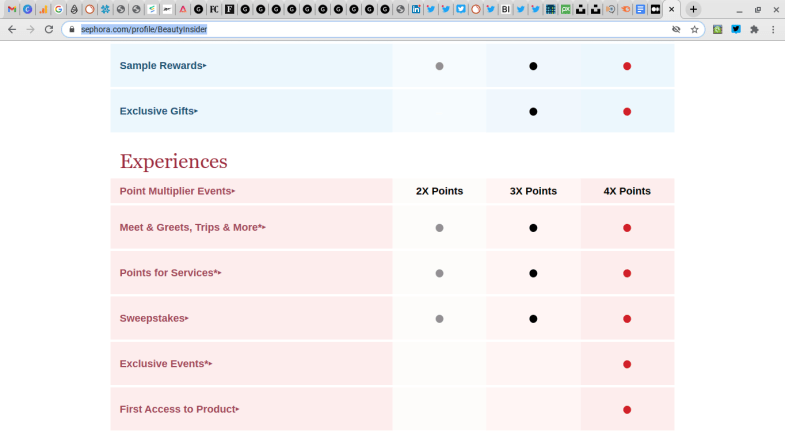
Sephora’s Beauty Insider loyalty program is another that has experiences and events as part of its rewards structure. At introductory levels of the program, perks are centered on shopping discounts, free shipping, etc. But as members accumulate more points, they unlock new benefits such as special events, in-person experiences with brand founders, etc.

Notice too that for both Sephora and Reebok’s loyalty programs, experiences are offered at higher levels, as a premium that members are encouraged to work for. This positioning suggests that in both cases, the brands understand that experiences can create a deeper connection with the brand, and also serve as a way to identify its most passionate customers.

Science tells us that money spent on experiences creates lasting happiness that increases over time. Knowing this, doesn’t it stand to reason that adding relevant experiences to your customer loyalty program will increase member happiness with not only the loyalty program, but with your brand as well?

Share this:

  • Share on X (Opens in new window) X
  • Share on Facebook (Opens in new window) Facebook
  • Share on LinkedIn (Opens in new window) LinkedIn
  • Email a link to a friend (Opens in new window) Email
  • Share on Reddit (Opens in new window) Reddit

Like this:

Like Loading…

Filed Under: Brand Advocacy, Customer Acquisition, Word of Mouth

June 8, 2020 by Mack Collier

Social Media is Toxic, Broken, and it Needs to Go Away

Adversity doesn’t create character, it reveals it.

I had my first exposure to what could be called a ‘social network’ when I joined Prodigy.net in 1991  I have two main memories of being a Prodigy member:

  • The users were insanely nice and courteous
  • There were very few users

I remember there being many message boards and forums, organized by interests. Some of these had decent activity, others had little to none. But if a forum had posts, there were friendly and civil discussions to read and join. As I said, it was a wonderful environment, and I had no qualms about reaching out directly to users and it was quite common to share a physical address with members and continue conversations via mail.

Lately I’ve been thinking a lot about those online conversations some 30 years ago, the civil tone as a stark contrast to the toxicity that many social media sites swim in these days.

The Rise of the Shame Culture

In theory, 2020 should have been social media’s finest hour. Never before have we needed to have conversation, communication. Never before have we needed to listen to each other, to understand each other, to learn from each other. So at a time when we all needed to listen to each other and understand each other, instead these social media tools are being used by many to shame others. If you don’t hold a certain opinion, you are being shamed for it. If you don’t hold a certain opinion on a certain issue, you are told to unfollow that person.

I’ve disconnected from probably 25% of my online network simply because these people were being judgmental assholes. And we are talking people I have been connected to for years, some over a decade. But all it took were a few hot-button issues, and suddenly these people turned into tyrants. And they used social media to do it. Many of these same people have advised clients to NOT do the very things they were doing every day on Twitter and Facebook.

Why is This Social Media’s Fault?

It’s easy to look at what’s happening on social media sites right now and say that you can’t blame the tools, you have to blame the people using the tools. I can’t completely agree with that. The reality is that social media sites aren’t built to facilitate conversations, they are built to facilitate engagement.

Let’s look at Twitter. I’m a bit of an outlier, in that I started using Twitter back in the social media stone ages of 2007. If you talk to any long-time Twitter user that joined prior to 2010, they will tell you that Twitter was a completely different environment ‘back then’. Organic conversations that were CIVIL sprung up like kudzu in the South in the Summer. If a day went by where you didn’t get sucked into at least one engrossing 30-minute conversation on Twitter, then you probably didn’t get on Twitter that day.

So what changed?  The celebs discovered Twitter:

And those of us that had been using Twitter before they arrived began to notice something: Literally every silly thing these celebs tweeted got hundreds, even thousands of Likes and Retweets! And they gained thousands of followers every day! If you’re using Twitter every day and you only have 237 followers and nothing you tweet seems to get a Like or Retweet, well it’s natural to envy the huge engagement numbers the celebs were getting!

Which often led to a change in behavior. Many Twitter users stopped focusing on engrossing conversations, and started trying to drive higher levels of engagement.

The Birth of the ‘Twitterbyte’

I was speaking at a conference in 2008, and at one point found myself chatting with my fellow presenters. One of the speakers had come up with what they felt was a brilliant idea that they had to share. The speaker remarked how as the audience was tweeting out our talks, they would condense our ideas into 140 characters or ‘Twitterbytes’, So on the fly, this speaker had bought that domain name. But this story is a great example of how we, as content creators, were working within the parameters of the Twitter platform. We were trying to distill complex ideas down into 140 chars so they would be easily memorable and…drive engagement.

As Twitter’s growth exploded, the sheer volume of tweets went through the roof as well. It made it increasingly hard for each individual tweet to stand out.  So again, content creators adapted. They started working on how to make their tweets stand out in a stream where dozens of new tweets are coming in every second. So of the changes were innocent enough, like simply adding a picture or a link.

But somewhere along the way, we all figured out a basic truth of social media: If you say something inflammatory, it’s more likely to have higher engagement. Everyone stops to watch the trainwreck. If you are yelling, people will pay attention. So again, user behavior adjusted. Yelling and being outrageous resulted in higher engagement levels.

Notice that we continue to get further and further away from the one thing that made social media so appealing from the start: The power of organic, civil conversations.

Think about this for a minute: How would the way you use Facebook and Twitter change if you had no idea how many Likes a Facebook update received, or how many RTs a tweet on Twitter had received?  I suspect you would spend more time actually reading the content and paying closer attention to what was said in order to decide if it was worth your time. I saw this coming years ago and began arguing that social media sites should remove all public engagement metrics.  Don’t tell me how many friends or followers someone has, don’t tell me how many Likes or RTs their content gets, don’t tell me how many comments it has.  FORCE me to judge the content’s value on the content itself, not on engagement metrics, which can easily be inflated.

Are Blogs Also Social Media? Should They Go Away As Well?

I’ve always had a problem with classifying blogs as being social media. Yes, I get that in simple terms, it probably makes sense to call blogs social media. But I’ve never really felt comfortable with the description. I think the reason why, is that blogs are a space that YOU control. And they are a place where you have the ability to clearly and completely explain your opinions. Whereas social media sites are geared toward engagement, blogs are geared toward conversations. Think of the mess it would be if I tried to take this same post, and put it on Twitter. I’d have to create a thread of probably 50+ tweets that would end up being a jumbled mess that most people would never read all of. A few tweets would get some engagement and shares, the majority would be ignored.

We need less engagement-driven content, and more conversations. I’ve reached a point where I would be fine if Facebook and Twitter went away today. But don’t take my blogs, don’t take my conversations. That’s what we need. We need more opinions, we need less shame, we need more humility, we need fewer closed minds.

At one point, social media was offered as the solution to our problems. Now it IS the problem. And we need to solve it.

Share this:

  • Share on X (Opens in new window) X
  • Share on Facebook (Opens in new window) Facebook
  • Share on LinkedIn (Opens in new window) LinkedIn
  • Email a link to a friend (Opens in new window) Email
  • Share on Reddit (Opens in new window) Reddit

Like this:

Like Loading…

Filed Under: Facebook, Social Media, Twitter

May 27, 2020 by Mack Collier

Twitter Begins ‘Fact-Checking’ President Trump’s Tweets

I try to avoid discussing politics in any shape, form or fashion here, but this story is too interesting to pass up,

For well over a year now, Twitter has been tip-toeing toward adding functionality that allows the platform to censor the content of tweets. Much of their ‘managing the conversation’ initiative was building toward this, and the suspicion was that one of the end goals was to limit President Trump’s ability to tweet. Love him or hate him, President Trump’s ability to use Twitter to get his message out is masterful, and it’s really interesting that most of the sites and blogs that cover case studies for great social media usage have completely ignored it. The President is able, via his tweets, to all but manipulate mainstream media into (accidentally) covering stories and issues that it would otherwise ignore.

And to be fair, a lot of what President Trump claims on Twitter is an exaggeration at best, and falsehoods at worst.

So yesterday, Twitter began ‘fact-checking’ President Trump’s tweets:

There is NO WAY (ZERO!) that Mail-In Ballots will be anything less than substantially fraudulent. Mail boxes will be robbed, ballots will be forged & even illegally printed out & fraudulently signed. The Governor of California is sending Ballots to millions of people, anyone…..

— Donald J. Trump (@realDonaldTrump) May 26, 2020


Note the ‘Get the Facts About Mail-In Ballots’ that Twitter has added to the bottom of the tweet. This is a very interesting development for three reasons:

1 – If Twitter is going to ‘fact-check’ President Trump, it will have to fact-check all politicians. Otherwise, it will lead to charges (rightly or wrongly) of election interference. And let’s be honest, an even application of its rules to all users has never been Twitter’s strong suit. This will simply lead to more yelling and screaming every time ANY major politician has a tweet ‘fact-checked’, but Twitter has backed itself into a corner where it almost has to start ‘fact-checking’ all politicians, in order to not give the impression that it is only targeting the President.

And already, there are questions about the objectivity of the person who is ‘fact-checking’ the President’s tweets:

Twitter spokesman Yoel Roth (@yoyoel) justifies labeling @realDonaldTrump tweets as misinformation: "Our goal is… to limit the spread of potentially harmful & misleading content."

The problem is, Yoel Roth once called Trump "actual Nazis" & a "racist tangerine." pic.twitter.com/dlbHI0qNCm

— Liz Wheeler (@Liz_Wheeler) May 27, 2020

2 – This opens the free-speech debate, as well as the discussion about if Twitter is a platform, or a publisher:

The law still protects social media companies like @Twitter because they are considered forums not publishers.

But if they have now decided to exercise an editorial role like a publisher then they should no longer be shielded from liability & treated as publishers under the law.

— Marco Rubio (@marcorubio) May 27, 2020

3 – President Trump is arguably the most influential Twitter user. The reality is, a lot of people are on Twitter mainly to read and follow the President’s tweets. And believe it or not, many of these people are his detractors, not his supporters. If this reaches a point where the President is either banned from Twitter or decides to move to another platform, it’s going to be a massive hit for Twitter, and a boon for whatever platform the President moves to. Which honestly might not be a bad thing for those of us that hate the political sniping that constantly plagues Twitter.


And just this morning, the President said he is revisiting the idea of regulating social media platforms like Twitter:

Trump Threatens To 'close social media platforms down' For Silencing Conservatives

“We will strongly regulate, or close them down before we can ever allow this to happen," Pres. Trump wrote.https://t.co/WdXohDC0wc

— Sara A. Carter (@SaraCarterDC) May 27, 2020

As you can see, all of this has created a huge mess for Twitter. Unfortunately, social media and mainstream media have become completely interwoven over the last few years. I remember around 2010 or so thinking how cool it was to see a CNN anchor reference what was being said on Twitter during a segment. “Look, they are showing actual tweets! How cool!” But over the years, the mainstream media has started to use social media posts as a proxy for public opinion, and that’s an incredibly inaccurate and potentially dangerous leap to make. It’s led to people rushing to Twitter and other social media channels to try to make a name for themselves by basically screaming the loudest about politics. It’s greatly polluted the entire Twitter community and it has made everyday interactions far more toxic. In the last few weeks I’ve started unfollowing people on Twitter, some that I had followed for over a decade, based on their political rants. But media is rewarding the voices that scream the loudest with coverage, and then says those voices represent what you and I think as well.

But perhaps the biggest takeaway from this episode is: Social media sites need to create simple, clear-cut rules for its users, and apply those rules evenly to all. As I said earlier, Twitter has been building up to this for well over a year. They began to talk about ‘managing the conversation’, or ‘taking into account the user’s intent’, or ‘how some people might be offended by certain topics’, and all of this sounds like code for ‘how can we make it so we can get rid of the people who say things we don’t like, but make it seem like we are still following our own rules?’

That’s not how you create trust among your users, that’s not how you build something that lasts. Twitter has had little to no direct competition for almost a decade. The days of also-rans like Identi.ca or Plurk are long gone. Perhaps it’s time for a new ‘micro-blogging’ site to enter the space.

Share this:

  • Share on X (Opens in new window) X
  • Share on Facebook (Opens in new window) Facebook
  • Share on LinkedIn (Opens in new window) LinkedIn
  • Email a link to a friend (Opens in new window) Email
  • Share on Reddit (Opens in new window) Reddit

Like this:

Like Loading…

Filed Under: Twitter

May 26, 2020 by Mack Collier

How Bear Bryant Cultivated Lifelong Alabama Football Fans in the 1960s

One of my hobbies is collecting autographed footballs from former Alabama teams. Often, former teams will have a 25th anniversary or even 50th anniversary reunion, and I like to attend these when I can and get members from that team to sign a football for me.

I attended one of these reunions for a team from the 1960s one time, and as the players were signing my football, I noticed how neat the signatures were, and how they stacked on top of each other as you see in this picture:

As one former player signed my football, I mentioned how neat and organized the signatures were. The player then told me why that was the case. He said that every summer, Coach Bryant would take the entire team to the cafeteria, and have everyone sit down, and they would spend all day signing footballs. So these players that signed my football so neatly, were simply going back to what they had done years ago when they were in college! Those footballs were then sent to fans who had written to the University requesting autographs!

If you think about it, this was exceptional marketing for the Alabama football program. The media landscape in 1960 was obviously far different than it is today. Many people in the Deep South at that time still didn’t have a television, radio and newspapers were how most people got their news.

Also, think about who would most likely write to the University of Alabama asking for autographs. It seems likely that most of the requests would come from children. The parents probably helped their son or daughter write the letter, and they probably expected a signed photo of Coach Bryant at best, as their reward. Then to receive a football signed by the entire team? It must have been a huge thrill for both the young fan and their parents!

This would have cultivated lifelong fans of the University of Alabama. These footballs and likely the letters accompanying would become display pieces that would spark admiration and the owners would recall how they acquired the football for years to come. Even today, brands do things like give children a small gift on their birthday. The idea is to create a devote to the brand early on, so that these people grow up to become adult customers.

Whenever I talk to companies about how they could better connect with their customers and grow advocacy efforts, I always stress that the WANT to connect with your customers has to be there. The tools and the tactics and programs are great, but you have to want to create and cultivate better relationships with your customers. It needs to be in your brand’s DNA to value your customers and to want to better understand and connect with them.

In the early 1960’s, Coach Bryant was still building the Alabama football program. He’d already had some success, but at the same time, in-state rival Auburn University was enjoying its own level of on-field success. So if we go back to the limited media landscape of the early 1960s, think about how important it was to create fans of your program at an early age. In the state of Alabama, most college football fans pick either Alabama or Auburn at a very early age, and rarely do they switch allegiance later in life. Most people are truly lifelong fans of one school or the other.

Coach Bryant was smart enough to know this, and that’s why he made sure that he surprised and delighted young fans with team-autographed footballs.

Knowing how to better connect with your customers is the easy part. But you have to WANT to do so, as well.

Share this:

  • Share on X (Opens in new window) X
  • Share on Facebook (Opens in new window) Facebook
  • Share on LinkedIn (Opens in new window) LinkedIn
  • Email a link to a friend (Opens in new window) Email
  • Share on Reddit (Opens in new window) Reddit

Like this:

Like Loading…

Filed Under: Brand Advocacy, Customer Acquisition, Customer Engagement, Customer Loyalty

May 7, 2020 by Mack Collier

The Difference Between a Brand Ambassador and a Brand ‘Spokesperson’

brand ambassador, brand spokesperson The terms ‘brand ambassador’, ‘brand spokesperson’ and ‘influencers’ are used almost interchangeably these days, so let’s talk about how each group is different. Once you understand the differences, you will have a much better idea of how to use each in your marketing strategies.

A brand ambassador is a person who works to promote and represent a brand in its marketplace. Brand ambassadors are often current customers who were already advocating for brands before they started working with them. Brand ambassadors have a working relationship with the brands they represent, and are given instruction on how to interact with customers in the marketplace, based on the business goals for that brand. Typically, a brand will have multiple ambassadors, and their involvement with the brand is organized and executed via a formal brand ambassador program.


A brand spokesperson is a person who works to promote and represent a brand in its marketplace. Brand spokespeople are typically chosen because they have a following either online or offline. Often, these people are viewed as ‘celebrities’ and are often known outside the industry where the brand exists. The term influencer is used almost interchangeably here with brand spokesperson. An influencer is more often someone who has built a following online, whereas a spokesperson is more often someone who has built a following offline. In either case, whether a brand is working with a spokesperson or influencer, there is typically a financial relationship in place. In short, the spokesperson or influencer will leverage their following to promote the brand and drive attention to the brand.


How to Select and Work With Brand Ambassadors

In my experience working with companies to help them create brand ambassador programs and in talking to companies that have launched their own efforts, the ultimate success of the brand ambassador program is typically impacted by the selection process for the ambassadors.  Your brand ambassador program will be more successful, all other things being equal, if the people you choose as ambassadors for your brand are currently fans of your brand.  Existing brand advocates make the best brand ambassadors.  Brand advocates have a higher level of understanding and passion for your brand.  They are already actively promoting your brand to other customers, you are simply going to better organize and empower their efforts by making them part of a formal brand ambassador program.

Another option is the so-called ‘open cattle call’ approach to finding brand ambassadors.  Typically, anyone is accepted (first come, first served), and the incentives offered are a chance to make money or get free products, etc.  Often, it can be positioned as a chance to get free products from major brands, and maybe even be paid for creating content that promotes the brand.

The problem with the ‘open cattle call’ approach is obvious.  That person’s prime motivation for wanting to become an ‘ambassador’ for a particular brand is to get free products and to be paid for creating content that promotes the brand.  Basically, they aren’t participating because they love the brand, they are participating because they love getting paid.

When money is the primary motivation for being involved in a brand ambassador program, it changes the behavior of that person.  The ‘ambassador’ will typically create content that isn’t authentic and based on actual opinions, but instead will focus on creating promotional content that the person feels the brand will pay them for.  And readers of the content can easily see the disconnect, it would be odd if I suddenly started blogging about how amazing Luv diapers are (as someone who has no kids), and noted at the end of my post that I was paid to write said post.

On the other hand, existing brand advocates want to become ambassadors for your brand because their motivation is based on seeing your brand succeed.  They literally LOVE your brand and will usually jump at the chance to work with it to better connect with customers and help move the brand forward.  Although compensation is involved with them as well, brand advocates usually prefer more direct access to the brand and maybe advance access to upcoming products versus simply getting paid.  Brand advocates prefer access over cash in most cases.

So if your company is thinking about creating a brand ambassador program, carefully consider who you want to be involved as ambassadors for your brand.  Do you want to bring in existing customers that love your brand, or ‘brand spokespeople’ that have little to no natural affinity for your brand?  The smart bet is on your existing customers that love your brand and want to see it succeed just as much as you do.


How to Select and Work With Brand Spokespeople and Influencers

Over the last 15 years, I’ve worked with many companies on their influencer and spokesperson campaigns. In fact, I’m in a bit of a unique position as I have ample experience working with brands to help them create and launch influencer programs, and I’ve also worked with brands AS an influencer in their influencer programs. So I can speak to this topic from both the brand and influencer perspective.

The biggest mistake I see brands make in choosing an influencer to work with, is the brand only looks at the size of the influencer’s following. The second biggest mistake I see brands make when choosing influencers is to ignore how much engagement the influencer can create around their content. These two areas work in tandem, because it is very difficult for an influencer to have personal interactions with their followers once the influencer’s following reaches a certain level. The influencers ability to connect individually does not scale very well. (Note: the one exception to this rule seems to be Twitch streamers. They have found a very unique way to reach a mass audience, at scale.)

When I work with companies to select and vet influencers to work with, I tell them to focus on the following:

  • Always select influencers who are actual customers of your brand. The importance of this cannot be overstated, as you want to work with influencers that already use and love your products if at all possilble.
  • The influencer’s ability to drive engagement is always more important than their following. What is influence? It’s a person’s ability to create a change of behavior in someone else. If an influencer can’t create engagement around their content, then they likely don’t have much influence over their network. In other words, their ability to create engagement is a great indicator of their ability to influence others.
  • When possible, select influencers who have a long history of working with brands. These influencers are more familiar with the process and more likely to understand what the brand wants from the arrangement.


The Key Differences Between Brand Ambassadors and Brand Spokespeople/Influencers

  • Compensation: An influencer will typically be compensated financially. An ambassador can be compensated financially, or with other perks such as products or early access to new products, access to key executives at the brand, etc.
  • A brand ambassador is typically a current customer of the brand, an influencer often is not.
  • Brand ambassadors often have a long-time working relationship with the brand that’s organized via a formal brand ambassador program. Most brands work with influencers on a more limited or specific amount of time.


Hopefully this helps you understand the differences from the brand’s perspective when it comes to working with ambassadors, spokespeople, and influencers. I’ve worked with brands since 2008 as both an influencer, and in helping brands craft amazing ambassador and influencer programs. If you have a question about how these processes work, feel free to contact me:

← Back

Thank you for your response. ✨

Was this post helpful and you want to say Thank You?  Please Buy Me a Coffee!

Want more insights into customer engagement and brand-building? Subscribe to Backstage Pass on Substack! Twice a week I give you the best instruction on how to build communities and improve your customer engagement efforts:

Share this:

  • Share on X (Opens in new window) X
  • Share on Facebook (Opens in new window) Facebook
  • Share on LinkedIn (Opens in new window) LinkedIn
  • Email a link to a friend (Opens in new window) Email
  • Share on Reddit (Opens in new window) Reddit

Like this:

Like Loading…

Filed Under: Brand Advocacy, Brand Ambassador Programs, Influencer Marketing, Marketing

February 20, 2020 by Mack Collier

Twitter is Not a Social Network

I was listening to a recent episode of eMarketer’s Behind the Numbers podcast when the host made a claim that I cannot source, but still believe. He claimed that Twitter CEO Jack Dorsey said that he doesn’t think of Twitter as a social network, but rather as an ‘interests’ network. As a place where everyone comes to discuss their interests. Such as TV shows, events like the big Wilder – Fury fight this weekend (Go #BombSquad).

Two points. First, Twitter has always been uniquely situated as the one social site that can best facilitate live ‘in the moment’ conversations around breaking news. Whatever the event is, planned or not, Twitter is where you go to learn what’s happening and what people are saying about what’s happening. No other social site can match Twitter’s ability in this area.

Second, Twitter has always tried to push its users toward using the platform to discuss events and interests rather than as a direct communications or networking tool. Twitter’s users have been smart enough to figure out ways to leverage the platform for their own needs, but Twitter’s leadership has always attempted to re-position the site away from simply being a platform where we go and talk to each other. They have always wanted us to be using Twitter to talk about someone or something else. That’s been how they view many of their monetization opportunities.

I mention all this because it’s important for any company using social media sites to consider two things:

1 – How are users engaging on the site? Why are they there, what are they trying to do?

2 – How would the site like to see its users engage with each other? How does Facebook want users to use the platform?  How does Pinterest? How do these sites want to position themselves as being different from the competition?  What unique experience do they want users to have?


Too many companies view social media sites as an homogeneous pot where every platform and user is the same. Nothing could be further from the truth, and one of the biggest reasons why most companies have lackluster results with their social media strategies is by not having platform-specific strategies as well. Social media is not one-size-fits-all at either the user or platform level.

Smart companies know the users are different, but I don’t think enough thought is given to how these platforms want to position themselves as being different and how they want to encourage different user behavior. It’s worth considering and factoring into your social media strategy.

Share this:

  • Share on X (Opens in new window) X
  • Share on Facebook (Opens in new window) Facebook
  • Share on LinkedIn (Opens in new window) LinkedIn
  • Email a link to a friend (Opens in new window) Email
  • Share on Reddit (Opens in new window) Reddit

Like this:

Like Loading…

Filed Under: Social Media, Social Networking, Twitter

February 18, 2020 by Mack Collier

Individuality is Fine, as Long as We All Do it Together

I was going through my WordPress app on my phone (BTW if you publish with WordPress, you really need this app, it’s great to keep up with your site, especially when you’re mobile), and came across this world map while checking my stats. This shows every country in the world that sent a visitor to this site in 2017. As you can see, almost every country in the world had at least one visitor come here in 2017.

I think we sometimes lose track of just what an amazing communications tool a blog can be. When I first started blogging in 2005, one of the very first people that linked to my blog (tracked with Technorati, anyone remember them?) was a 13 year-old girl in China. That opened my eyes to the enormous power of a blog to spread your message on a truly global scale.

The reality is, we’ve given up on the promise of blogging. Blogs give everyone a voice. As long as you have access to the internet and the blogging platform, you can share your voice with the world.

But over time, instead of sharing our unique voices, perspectives and personalities, we’ve become better at sounding like everyone else. We study blogging ‘best practices’ and try to ‘improve’ our writing to increase engagement, stats and visitors. It’s enticing, but if you aren’t careful, we all end up sounding like everyone else.

I’m just as guilty of it as anyone. I tell myself I can’t talk about certain topics here or in a certain way, because I always have to be mindful of who my audience is, and what they want.

But lost in that, is the fact that your audience wants to know YOU. They want to hear your unique take, your personality. They want to see something different, that’s how you catch attention. And if the content is good, then you hold it.

I love reading business success stories, learning how a particular company came out of nowhere to stand out in a crowded marketplace. More often than not, the founder or CEO’s explanation for what worked is simply “I zigged, when everyone else zagged”.

Here’s to more ‘zagging’ in the year ahead.  And a gold-star to whoever can be the first to tell me what TV character said the title of this post.

Share this:

  • Share on X (Opens in new window) X
  • Share on Facebook (Opens in new window) Facebook
  • Share on LinkedIn (Opens in new window) LinkedIn
  • Email a link to a friend (Opens in new window) Email
  • Share on Reddit (Opens in new window) Reddit

Like this:

Like Loading…

Filed Under: Being real, Blogging, Writing

February 18, 2020 by Mack Collier

Case Study: Patagonia’s Brand Ambassador Program Focuses on Product Design and Development Over Sales

Did you know Patagonia has a Brand Ambassador Program? Probably not, but the brand has had an ambassador program since at least 2000. This makes sense when you consider that Patagonia has never made advertising of any kind a priority for the brand. Patagonia founder Yvon Chouinard has often proudly proclaimed that the brand only spends one half of one percent of revenue on advertising.

Patagonia’s effort is a bit different from most brand ambassador programs in a few notable ways. Most brand ambassador programs, much to my disappointment, are structured largely to drive sales. Most brands view their ambassadors as potential promotional channels, with little or no thought given to how else these ambassadors could be leveraged to help the brand.

To be fair, Patagonia does use its ambassadors to promote the brand. But that’s not the only or even most important function that Patagonia’s ambassadors serve.

When you view Patagonia’s ambassador page, you’re immediately struck by how the ambassadors are organized based on the outdoor activities they excel at:

  • Climbing
  • Fly-fishing
  • Skiing
  • Snowboarding
  • Surfing
  • Trail-running

These are athletes, and typically athletes that are well-known and respected among their peers. So in that regard, you may consider this as more of an influencer marketing effort than a true brand ambassador program. But Patagonia has an ongoing, working relationship with these ambassadors, and they are paid a salary for their involvement in the program.

So when you consider that Patagonia is working with athletes who are well-known and influential within their respective disciplines, a working relationship based on sales promotion is assumed. Which makes this quote from the brand on the role and responsibilities of its ambassadors very interesting:

"Patagonia's ambassadors are known for not only being athletes, but for being integral to the company's product development and product testing. The company's ambassadors work closely with the design department to test, refine and validate products in the harshest and most remote locations on the planet."


I loved seeing this because as I've often written about here, leveraging brand ambassadors as a product feedback channel is one of the smartest things a brand can do. I'm sure Patagonia's thinking here is to put its products in the hands of elite athletes with the thinking being that they can give better feedback on how the clothing functions in their typical activities. Patagonia then can take this product feedback and leverage it to improve the product's design, durability, and function.

It's really the best of all worlds for Patagonia. They've created a program where the ambassador have real input into the products they use. This means the ambassadors will be far more knowledgeable about the product and how it functions, which also helps them better promote it to other customers. Which is beneficial for Patagonia, since it's ambassadors are elite athletes who are well-respected and who are very influential among their peers.

Now How Do You Apply This to Your Own Brand Ambassador Program?

When it comes to the influencer vs fan debate, I've always said that the best of both worlds is to find an influencer who is also a fan of your brand. In a way, this is what Patagonia has done. They aren't just asking the ambassadors to promote Patagonia's products to their following (as you would with an influencer), they are also stressing that they want the ambassadors to use their products and give them feedback after they have done so. In addition, they've also carefully picked ambassadors who are already engaging in the same type of activities that Patagonia's customers are when those customers buy Patagonia's products. So the products are getting a real-world testing, which results in better feedback.

For your efforts, follow the model that Patagonia uses and focus on ambassadors who either already use your products, or who live a lifestyle similar to that of your current customers. Basically, you want to make sure that the ambassadors you pick are people that will be using your products in the same way that your customers would. This means that your ambassadors can give you better feedback and it means your brand can apply that feedback to improve the product. 

Remember, leveraging your ambassadors to promote your brand is fine, but that's hardly the only way you can work with them in order to grow your brand. 

Share this:

  • Share on X (Opens in new window) X
  • Share on Facebook (Opens in new window) Facebook
  • Share on LinkedIn (Opens in new window) LinkedIn
  • Email a link to a friend (Opens in new window) Email
  • Share on Reddit (Opens in new window) Reddit

Like this:

Like Loading…

Filed Under: Brand Ambassador Program Case Studies, Brand Ambassador Programs, Customer Acquisition Tagged With: Brand Ambassador Programs, Patagonia

  • « Previous Page
  • 1
  • …
  • 27
  • 28
  • 29
  • 30
  • 31
  • …
  • 119
  • Next Page »

Recent Posts

  • My Substack Conversion Rate Went From 0.5% to 13% in Six Months, Here’s How
  • A Solid Conversion Strategy is Vital on Substack, Here’s the Proof
  • Empathy is Your Customer Service Secret Weapon
  • Understanding Substack’s Three Growth Stages
  • Blogging Isn’t Dead, it’s Morphed Into Substack

Categories

Archives

Comment Policy

Be nice, be considerate, be friendly. Any comment that I feel doesn't meet these simple rules can and probably will be deleted.

Top Posts & Pages

  • Why Did Jesus Send His Apostles Out With Nothing?
  • A Solid Conversion Strategy is Vital on Substack, Here's the Proof
  • My Substack Conversion Rate Went From 0.5% to 13% in Six Months, Here's How
  • Understanding Substack's Three Growth Stages
  • The Real Reason Why the Mona Lisa is So Popular Will Surprise You
  • Let's Take a Closer Look at Patagonia's Worn Wear Road Tour
  • How to Price Your Products and Services
  • How Is Twitter Impacting Search and SEO? Here's the (Visual) Proof
  • An Open Letter to Cathryn Sloane From Someone Over the Age of 25
  • What's the Difference Between a Blog and a Newsletter?

  • Blog
  • Mack’s Bio
  • Work With Mack
  • Buy Think Like a Rock Star
  • Book Mack to Speak

Copyright © 2026 · Executive Pro Theme on Genesis Framework · WordPress · Log in

%d