MackCollier.com

  • Blog
  • Mack’s Bio
  • Work With Mack
    • See Mack’s Work
  • Buy Think Like a Rock Star
  • Book Mack to Speak

June 30, 2011 by Mack Collier

The key feature that neither Google+ or Facebook really addresses

So like many of you, I finally got a Google+ invite, and plan on kicking the tires a bit over the next few days.  But as I was quickly scanning the features, and reading great previews like this one, I was looking for a specific feature.

I want the ability to follow content in addition to following people.

Let me give you an example (because I can already tell I’m not doing  a good job of explaining myself).  We all have our networks on Facebook and Twitter.  And we are probably following the people that aren’t family for a specific reason.  Maybe it’s for their social media knowledge, or because they are industry sources, whatever.  But come next year, a big portion of your network (at least those in the United States) will probably engage in discussing the same topic: Politics.  And if you are following a few dozen ‘A-listers’ for advice and wisdom on social media, it can be a jolt to see them suddenly on Facebook and Twitter every day saying that they think your favorite Presidential candidate is a blithering idiot.

So then comes the question: How do you handle this?  You are following a person because you want to hear their opinions on social media, not politics.  Do you unfollow them?  Do you grit your teeth and bear it?  Do you argue with them?  I do the same thing: Last fall, on Saturdays I started tweeting score updates from the 1 or 2 college football games I was watching.  Then I had friends tweeting me asking for the score to a particular game, and the next thing you know, I am all but live-tweeting about 5 different games at the same time.  Some of my followers absolutely loved it, and some of them unfollowed me because they weren’t following me for college football updates, they were likely following me for social media discussions.

The shortcoming I see from existing social media tools is that there’s no efficient way to filter based on content created.  Sure, you can create groups or lists of like minded individuals, but even that doesn’t guarantee that ‘unwanted’ content won’t be discussed.  And if you could filter someone based on content, would you even want to?  Is this a viable concern, or is it maybe an unintentional byproduct of following a lot of people that we really don’t know?

What do you think the solution is?  Do you unfriend/follow people that discuss topics that don’t interest you?  If you had the ability to filter their content based on type, would you?

Share this:

  • Share on X (Opens in new window) X
  • Share on Facebook (Opens in new window) Facebook
  • Share on LinkedIn (Opens in new window) LinkedIn
  • Email a link to a friend (Opens in new window) Email
  • Share on Reddit (Opens in new window) Reddit

Like this:

Like Loading...

Filed Under: Blogging, Facebook, Twitter, Uncategorized

June 28, 2011 by Mack Collier

Think Like a Rockstar: Create something amazing for the people that love you

So I was on Twitter late Friday night, and I saw this tweet from @AmandaPalmer.  It got my interest, so I did some checking.  I found dozens of tweets from Amanda’s fans either gushing about her and thanking her for letting them attend the secret show, or those that were angry that they missed it.

From Amanda’s blog, here’s how the secret show was set up:

p.s. for those of you who were waiting on more info about the SECRET-BOSTON-AREA-SHOW next saturday, we put together a little contest. if you wanna come, we’re picking about 50 lucky people who’re gonna join in on our crazy little loft party in arlington, and it’s your LAST CHANCE TO ENTER. get in on this shizzle NOW:

* head over to my profile on GetGlue. you can find it right here:http://getglue.com/recording_artists/amanda_palmer
– don’t have a GetGlue profile, yet? it takes about 20 seconds and you can do so athttp://getglue.com/signup (they also have an app for iPhone/iPad/iPod Touch, Blackberry, and Android – you can sign up on those, too)
* “Check-in” and tell us your favorite AFP-related concert memory, starting with something along the lines of I really want to see Amanda on tour this summer http://bit.ly/AFPtour or My favorite AFP-concert memory was…
– feel free to get creative about how you say that you wanna come, just make sure to include a link to the tour page
– if you haven’t ever seen me or the dolls or evelyn evelyn live, post a link to your favorite live YouTube or Vimeo clip and tell us why you’re excited to (hopefully) come
– bonus points for cross-posting to Twitter and Facebook, and for clicking “Favorite” on AFP (and other AFP-related stuff like The Dolls, Evelyn Evelyn, 8in8, etc)

and that’s it. any questions? post HERE and sean’ll get back to you, asap. we’ll be going through and contacting winners throughout tonight and tomorrow, getting e-mail addresses so that we can get your name for the guestlist, and know where to tell you the location of the show.


So Amanda created a free show for her biggest fans, with the requirement for getting in being that her biggest fans would have to share why they loved Amanda.  Which is something they were already doing anyway.  The lucky fans that got to attend were then treated to an amazing show, and they now love Amanda even more.  The fans that didn’t make the show are now extremely jealous of the ones that did, but still love Amanda for going out of her way to connect with her fans.

Attention big companies: You usually make this ‘marketing’ stuff a lot harder than it has to be.

I will once again go back to that wonderful quote from Steve Knox:

Think about what Amanda did here.  She didn’t use social media as a channel to generate sales, or connect with new customers.  She used social media to embrace her biggest fans, and give them a reason to love her even more.  Totally flies in the face of what most companies try to do, which is generate sales from new customers.  Instead, Amanda said she was going to create something totally amazing that customers want, but she not only wasn’t going to charge for it, she was going to give it to her existing customers.

This is why we don’t call these people ‘Amanda’s customers’, we call them ‘Amanda’s fans‘.  The next time Amanda has a paying gig, her fans that attended this show will be even more likely to pay to attend (because they love Amanda even more now) and they will be more likely to encourage their friends to come with them (because they want their friends to love Amanda like they do).  Amanda has created a way to embrace her biggest fans, and to let them do her ‘marketing’ for her.

Why is it that companies can’t get this?

To be fair, some companies are trying.  Ford recently had an event where they flew in influential bloggers to spend a day with them.  The focus was on Ford and its products, but there was also live entertainment and interesting speakers such as Malcolm Gladwell.  That’s definitely not the same as Amanda’s secret show, I think the focus with Forward with Ford was ‘how can we show you what we are doing and get you to like us more?’ while the focus with Amanda’s show was ‘how can I show you how much I love you?’

Which is a big reason why I think rockstars have fans, and companies have customers.  Because most companies view the relationship with their customers as being transactional, while most rockstars view the relationship with their fans as being emotional.

Companies, if you want to be successful, follow Amanda’s approach: Find a way to connect with your biggest advocates, and delight them.  Don’t worry about selling anything to them, create something amazing for them, and then watch as they take the initiative and promote you and maybe even gush about you to their friends and networks.  The end result is that you’ll get those sales you wanted to begin with, but the added bonus will be that you’ll also create a way to excite and delight your biggest advocates in the process.

Again, y’all make this ‘marketing’ stuff a lot harder than it has to be.

Share this:

  • Share on X (Opens in new window) X
  • Share on Facebook (Opens in new window) Facebook
  • Share on LinkedIn (Opens in new window) LinkedIn
  • Email a link to a friend (Opens in new window) Email
  • Share on Reddit (Opens in new window) Reddit

Like this:

Like Loading...

Filed Under: Blogging, Brand Advocacy, Community Building, Social Media, Think Like a Rockstar, Twitter

June 27, 2011 by Mack Collier

So how big is #Blogchat? Here’s the stats…

As those of you that follow #Blogchat and other Twitter chats know, recent changes to Twitter’s Terms of Service have made it more difficult for 3rd party sites/apps to provide the chat transcripts that so many of us rely on.  WTHashtag, a popular site many of us used to create our own transcripts for Twitter chats, was shut down by the move.

So I was looking for a replacement to WTHashtag, and the good people at Hash Tracking reached out to me to let me look at the transcript and statistics service they offer.  What I love about their service is that first, I now have a way to provide transcripts for everyone that follows #Blogchat!  But in addition to offering a transcript, Hash Tracking also gives me some decent stats behind #Blogchat, which is something that I really didn’t get from WTHashtag (other than volume of tweets).

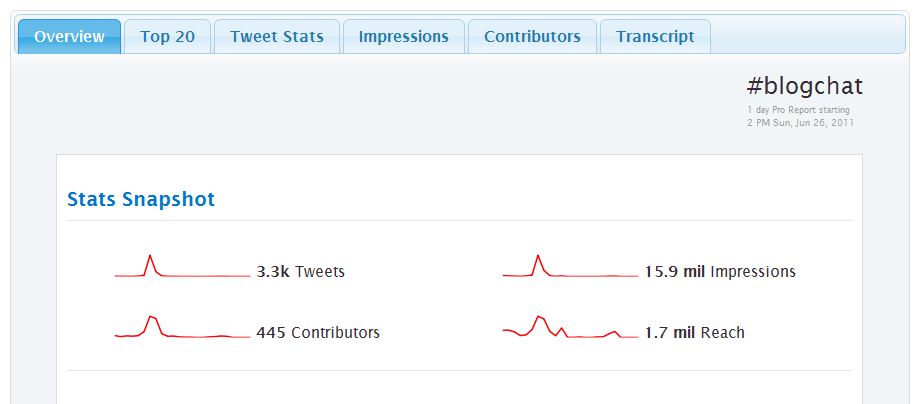
Here’s a screenshot of what the dashboard from last night’s report looks like:

If you’d like to view the report for yourself, you can find it here.

Now if you can’t see that picture clearly, it shows that last night’s #Blogchat had over 3,300 tweets, generated a staggering 15.9 MILLION impressions, had 445 contributors, and reached 1.7 MILLION people.  What I also love about the interface is that it gives me the ability to break down the stats and see who was tweeting the most, who was generating the most impressions, etc. And in case you were wondering, those numbers are actually down a bit from recent weeks.  For example, on May the 29th, the #Blogchat that night generated almost 20 million impressions.  I was able to break down the stats and see that several million impressions were generated by @JessicaNorthey and @ProsperityGal.  The interface also lets me see which users are the most active, so I know I need to make special effort to connect with them and thank them for participating.

Now think about what a company would have to pay to get 16 million online impressions.  Even if we assume a CPM of only one dollar, that would still cost a company $16,000 to buy as many impressions as #Blogchat generated last night.

This is one reason why I am such a big proponent of Twitter chats for companies.  If done correctly, a company could create a robust community that will help them extend and expand its brand awareness.  Just doing some quick math, if a company had a weekly Twitter chat that averaged 10 million impressions a week, that would generate  520 million impressions a year, and again assuming a CPM of $1.00, would save the company $520,000 in online advertising costs!

Something to think about, and if you or your company want to start your own Twitter chat, here’s how you can get started.

Share this:

  • Share on X (Opens in new window) X
  • Share on Facebook (Opens in new window) Facebook
  • Share on LinkedIn (Opens in new window) LinkedIn
  • Email a link to a friend (Opens in new window) Email
  • Share on Reddit (Opens in new window) Reddit

Like this:

Like Loading...

Filed Under: #Blogchat, Blogging, Twitter

June 9, 2011 by Mack Collier

Social Media is not a contingency plan for having a shitty product

For the last half decade, we’ve had it beaten over our heads that ‘it’s all about the conversation’. That all a company has to do is ‘be social’, to throw up a Twitter and Facebook account, and they have passed the marketing test. Add in a company blog for extra credit.

Of course, this is utter crap. If your product sucks today, it will still suck tomorrow if you start using social media. The only difference is that more people will know about it.

Now please understand that listening to your customers and monitoring what they are saying via social media is hugely important. But the quickest way to honk off your customers is to tell them ‘we’re listening’, and then prove to them that you are not.  You can’t simply monitor what your customers are saying, you need to apply their feedback and act on it.  You need to start a discussion with them.  You need to create a continuous feedback loop, so what your customers are saying about your product is understood internally at your company, and your company’s response is sent back to your customers.

The goal isn’t just to ‘be social’, it should be to establish connections with your customers that help you improve your existing products and business processes. For example, last year Dell had its first #DellCAP event in Austin.  This was where Dell brought in 30 customers that were actively using social media tools to discuss Dell and its products and services. Dell talked to these customers about several core areas of its business, as well as its products. Dell then took that feedback, and acted on it. A perfect example is its Facebook Tag Team app. One of the main feedback points that Dell customers gave during #DellCAP was that they would like a way to see how other customers are using Dell products. For example, if a Dell customer views himself as a hardcore gamer, he understands that fellow gamers will want Dell products that perform differently than a Dell customer that wants a PC to turn her home business.  So the Tag Team app was created with this feedback in mind. Here’s what Lionel Menchaca said when it was introduced:

Back when we invited customers to Dell for CAP Days, one of the clear requests we heard from customers regarding Dell.com is that we need to make it easier for them to find the system or accessories that will meet a specific set of needs.

Besides the request from CAP Days attendees, there’s  any number of studies that show most customers trust the opinions of their friends and family a heck of a lot more than what a company tells them. Here’s one of my favorite Hugh McLeod cartoons which illustrates that point beautifully.

How do we make it easier for customer to find the system they need based on how they plan to use it and augment that with content that’s written by our customers instead of us? The Tag Team app is our first attempt to bring those things together. We know a lot of our customers use Dell.com to research what kind of machine is right for them. That usually means starting with a product, browsing the product page, then digging into ratings and reviews from other customers.  With Tag Team, you can start by thinking about how you will use the machine and find the reviews from customers who are using reviews for that same thing.


Dell went beyond simply listening to the feedback its customers were giving, and actually used that feedback to improve its offerings based on its customers recommendations.  This is the difference between taking a crappy product and making it social, versus leveraging social media to improve your product.

Extra credit: Listening to your customers and then ACTING on their recommendations increases brand advocacy. Nothing impresses a customer more to tell them that you are listening, and to then prove that you are.

If you want to start using social media to actually improve your products and services, here’s some tips to get you started:

1 – Start monitoring what your customers are saying online. You should already be doing this, but if not, make sure you start ASAP.

2 – Make sure that information and feedback from Step 1 is collected and distributed internally within your company.  Marketing, PR, Product Design/Development, Customer Service, etc.

3 – Incorporate customer feedback as applicable. Just because one customer in Idaho says you should change a product feature does NOT mean you should spend millions of dollars to change your existing manufacturing process to accommodate one customers’s wish. But if thousands of customers are saying the same thing and many are saying they won’t buy your product as a result of this feature, then maybe its in your best interest to make the change.

4 – When changes are made based on customer feedback communicate that back to your customers. This will not only increase customer satisfaction once they see you are actually acting on their feedback, it will greatly increase the volume of feedback you get. And getting more feedback means the quality of that feedback improves. It becomes easier to distinguish between issues that are marginally important to your customers, versus ones that are affecting the majority, as illustrated in Step 3.


But make sure you push for Step 2, getting the feedback you collect via social media monitoring, distributed to relevant departments in your company or organization. That should get the ball rolling and help your customer move from being one that simply listens to social media conversations, to one that acts on them.

Share this:

  • Share on X (Opens in new window) X
  • Share on Facebook (Opens in new window) Facebook
  • Share on LinkedIn (Opens in new window) LinkedIn
  • Email a link to a friend (Opens in new window) Email
  • Share on Reddit (Opens in new window) Reddit

Like this:

Like Loading...

Filed Under: Blogging, Facebook, Social Media, Twitter

June 8, 2011 by Mack Collier

Fans, Friends, Followers, and the Reason Why None of it Matters

I’ve tried to stay off the soapbox for the most part here the past two years, but the first blog post from Kathy Sierra in 4 years has got my mind racing.

I’ve been blogging for 6 years now, and the blogging and social media spaces have gone through a lot of changes in that time. One significant change I’ve noticed is how we define who the ‘authority figures’ are in this space. In 2005, if you wanted to know who the top bloggers or the ‘A-Listers’ were, you asked around.  Robert Scoble, Jeff Jarvis, Hugh MacLeod, Kathy Sierra, Seth Godin and Jason Calcanis were some of the names you heard over and over again.  All people that were moving the needle, that were legitimate ‘thought leaders’.

Then, rankings aspects began to enter into the picture. Technorati started tracking the number of incoming links a blog had (later called the site’s Authority).  That changed the A-List a bit, as now a site’s ability to gain incoming links became more prized.

Later, around late 2006/early 2007, we all discovered Facebook, and that added a new layer to defining the A-List: Number of friends.  As a result, the A-List changed a bit more.

Then around 2008 or so, Twitter really started to gain steam. Which, you guessed it, meant that Followers now became a new way to define who the ‘A-Listers’ were.

What I’ve noticed is that how we define who the thought leaders are in this space has changed dramatically. In 2005, we figured out who the experts and A-Listers were by listening to each other.  The A-Listers were the ones that got talked about the most, and linked to the most, and who were on the most blogrolls.  There wasn’t really a way to ‘rank’ them, we just knew who was creating great and valuable content, and those were the people that we listened to, and whose opinions we valued and trusted.

Now, the rules for defining authority have changed. Yes, good content still matters. But so does your number of Facebook friends, your number of Twitter followers, and your Klout score.

The problem is, your number of friends, followers and your Klout score can be gamed.  Let’s be honest, I would be seen as a greater authority in the social media space by many people if I had 50,000 followers instead of my current 25K.  And we also know that all I’d have to do to hit 50K, is follow another 25K people.  That would be gaming the system.

A very unfortunate side-affect of using rankings such as friends and followers to determining authority is that the ability to teach isn’t as important as it once was.  Let’s revisit that list of A-Lister from 2005:   Robert Scoble, Jeff Jarvis, Hugh MacLeod, Kathy Sierra, Seth Godin and Jason Calcanis.  All teachers. But today, it seems that more of the supposed leaders want to tweet about how you should ‘be awesome’ instead of teaching us how to be awesome.

We don’t need another ranking board. We don’t need to know who has the most followers, or fans, or the highest stock price on Empire Avenue. We don’t need to know how to get more RTs or how to get on more lists.  And we sure as hell don’t need to deal with the grief of thinking we aren’t smart or influential if we don’t have X number of any of the above metrics.

We don’t need to see tweets telling us to ‘be awesome’, we need more teachers that will roll up their sleeves and teach us how. And if someone can’t do that, then do they really deserve to be viewed as authorities?

Share this:

  • Share on X (Opens in new window) X
  • Share on Facebook (Opens in new window) Facebook
  • Share on LinkedIn (Opens in new window) LinkedIn
  • Email a link to a friend (Opens in new window) Email
  • Share on Reddit (Opens in new window) Reddit

Like this:

Like Loading...

Filed Under: Blogging, Social Media, Social Networking, Twitter

June 2, 2011 by Mack Collier

Online Influence Is More Than Just Social Media Activity

I logged into Klout this morning, and was greeted by this pop-up ‘warning’.  It tells me that my Klout score is dropping, and that I can raise it by sharing more content, and engaging with my network.

Klout adds this explanation for what its score means: “The Klout Score is the measurement of your overall online influence.”

So Klout tells me that it measures online influence, but that in order to increase my score, I should increase my social media activity?  Then doesn’t that mean it’s measuring my activity instead of my influence?

Likewise, Empire Avenue also explains that your score there is dependent on your level of social media activity: “When you join Empire Avenue, you can connect your Social Networking accounts, and we’ll score activity and engagement in each account and give you a virtual share price.”

Essentially, Klout and Empire Avenue are measuring your level of social media activity, not your level of online influence.

Simply sharing more content and engaging with my network isn’t going to make me more influential over them.  In fact if it’s not the type of content and engagement that they are looking for, my influence over them will fall, not rise as I become more active.

Also note that both Klout and Empire Avenue are encouraging you to participate with their site.  EA includes activity on the site as part of your score, and Klout is already encouraging you to give +K to other members, and I’m betting they will come up with other ways to reward you for interacting more with other Klout members.  Which is smart of both sites to do, but it doesn’t help either of them more effectively measure my perceived online influence.

What do you think?  What role does social media activity play in online influence?  Does one lead to the other?

Share this:

  • Share on X (Opens in new window) X
  • Share on Facebook (Opens in new window) Facebook
  • Share on LinkedIn (Opens in new window) LinkedIn
  • Email a link to a friend (Opens in new window) Email
  • Share on Reddit (Opens in new window) Reddit

Like this:

Like Loading...

Filed Under: Blogging, Social Media, Social Media Monitoring, Twitter

May 31, 2011 by Mack Collier

Wait, my blog’s search traffic is down, what happened?

Welcome to another edition of ‘What can we learn about our own blog from watching Mack obsess over his?’

Ok, as most of you know, in January I decided to ramp up my posting schedule.  Since this blog’s launch 2 years ago (BTW Happy Birthday!) up till January of this year, I had kept to a pretty consistent schedule of 1-2 posts a week.  Sometimes I’d have a bit more, sometimes a bit less.

But if mid January, I decided to really boost my posting here.  I went from 1-2 posts a week, to 4-6.  I immediately saw a huge spike in traffic, and along with it, search traffic.  Now to be fair, search traffic here was already increasing at a steady pace, but as soon as I started posting more in mid January, the gain increased.  Here’s a graph of my weekly search traffic over the life of the blog:

The X marks the spot at which I started posting more often in January, and as you can see, the last 6 weeks or so has been sideways.  Also note the slow and steady growth, but it seemed to kick up an extra notch right after the X.

Now this graph bugs me, because I want to understand why search traffic has flattened over the past 6 weeks.  I did some checking and thinking and I’ve come up with two possibilities:

1 – I haven’t been posting as much. Every week since April the 10th, I have posted a consistent 4 posts a week here.  The next week is when search traffic started going sideways.  The three weeks prior to that, I posted 5-6 posts each week.  That’s one possibility.

2 – I haven’t been focusing as much on specific search keywords and phrases.  I honestly think this is it more than posting schedule.  From Jan through March I really tried to focus on specific keywords and phrases not only in my post title, but in the post as well.  And it really worked, I got excellent search rankings usually within a few hours for whatever search keyword/phrase I had targeted.

So here is the (very) inexact method I have come up with to test to see which is the cause of my flatlining search traffic.

This week, I will post 5 posts here.  This one is the second for this week, so there will likely be a new one here on Wednesday through Friday as well.

Next week, I will go back to posting 4 new posts here, but each one will be search optimized with a particular search keyword/phrase in the title and the post.

Then in a couple of weeks, I’ll report back and share the results with you.  My guess is that 4 search-optimized posts will produce more search traffic next week, than 5 non-optimized posts will this week.

And no, this isn’t a perfect test, and it won’t definitively prove anything.  This is more about me wanting to get a better understanding of how my blog works, and what impacts search results.  That way when I am at a conference and someone asks me a question about search traffic, I can give them my own experiences, instead of just regurgitating what some other blogger wrote 😉

If you obsess over your search traffic as well, what have you discovered that impacts it?  Do you think posting more often or spending more time optimizing for search will help me?

Share this:

  • Share on X (Opens in new window) X
  • Share on Facebook (Opens in new window) Facebook
  • Share on LinkedIn (Opens in new window) LinkedIn
  • Email a link to a friend (Opens in new window) Email
  • Share on Reddit (Opens in new window) Reddit

Like this:

Like Loading...

Filed Under: Blogging, Social Media, Social Media Monitoring, Twitter

May 27, 2011 by Mack Collier

Are we headed toward a Social Media snapback?

Let’s say you are presented with a unique and unexpected opportunity.  One that would require a several-month commitment, that would mean significantly shaking your life up, but could ultimately be the best thing that ever happened to you.

You need to ask some friends for advice.  People that know you completely, your life situation, and that you trust to give you good and sound advice.

Now if you needed to make a list of 5 people from your Twitter network to email (not including friends you know outside of Twitter or before you used Twitter), how long would it take you?  I ask because I often find myself in such a situation.  And every time I struggle to find more than 2-3 people that I would really trust to reach out to.  And every time I hear this tiny voice in my head saying ‘why is it that you are following these people?’

Which is a silly question to ask, because I am following everyone on Twitter and Facebook and wherever because I value the connections.  But do we reach a point at which adding more connections stops adding value?  Or worse, can we reach a point where adding more connections lessens the value of our existing connections?

Which becomes an interesting question to ask, when you consider that most social media sites and tools are built around making it easier to connect with more people.  But lately when I am on Twitter, for example, I’m often in Twitter chats.  I’m finding that I’m getting more enjoyment from Twitter chats, because even if the chat is huge like #Blogchat, I can zero in on a small discussion with just a few people, and really connect with them.  It becomes more like having dinner at a conference versus being with 500 people in a session.  I am seeing far more value in these discussions with smaller groups, and I’m finding that I am then starting to connect with them more outside of the chat.

So I have a couple of questions for you:

1 – Do you think in the next couple of years that we will see people begin to become more aggressive about ‘pruning’ their social networks, so that they have a deeper connection with the people they friend/follow versus just following them based on who they are?

And this is the far more interesting question to me…..

2 – If #1 holds true, will we begin to see a shift in the functionality of social media tools so that they encourage and facilitate smaller networks with deeper connections?  And what would that look like?  Simply limiting the number of connections you can have?  Maybe the ability to expand your network has to go through your existing network via an introduction or something similar?  Not sure, but I think the possibilities are endless.


What do you think?  Are you facing social media burnout?  Would you rather be loosely connected to 5,000 people, or closely connected with 50?

Share this:

  • Share on X (Opens in new window) X
  • Share on Facebook (Opens in new window) Facebook
  • Share on LinkedIn (Opens in new window) LinkedIn
  • Email a link to a friend (Opens in new window) Email
  • Share on Reddit (Opens in new window) Reddit

Like this:

Like Loading...

Filed Under: #Blogchat, Blogging, Facebook, Social Media, Twitter

May 25, 2011 by Mack Collier

How the CDC is Using its Blog to Prepare Us For the Zombie Apocalypse

One of the complaints you often hear from businesses and organizations about blogging is that they aren’t sure what type of content to create to reach their audience.  That they don’t know how a blog can help them build awareness for their particular product.  That it’s ‘too boring’ and that no one wants to read a blog post about….

A recent blog post by the CDC (Center for Disease Control) disproves the notion that there’s just some products and services you can’t blog about.  Let’s say you work for the CDC and your boss tells you to write a blog post that will explain how to build an emergency kit, and that will also raise awareness for the need to do so.  Oh, and you also need to get Twitter buzzing about the post.

Even with the recent horrible tornadoes and storms that have ripped through the South and Missouri, building an emergency kit is not something that is top of mind for most people.  And yet, the CDC has created a blog post that explains how to create an emergency kit that has Twitter buzzing and that currently has over 100 comments.

So how did the CDC take the topic of creating an emergency kit, and make it so interesting to so many people?  They explained that you need to create an emergency kit in order to prepare for the zombie apocalypse.

Genius!  What the CDC did is take a topic that’s not that interesting to a lot of people (building an emergency kit) and wrapped it in an analogy that is (the coming zombie apocalypse).  Check out some of the tips from the post:

  1. Identify the types of emergencies that are possible in your area. Besides a zombie apocalypse, this may include floods, tornadoes, or earthquakes. If you are unsure contact your local Red Cross chapter for more information.
  2. Pick a meeting place for your family to regroup in case zombies invade your home…or your town evacuates because of a hurricane. Pick one place right outside your home for sudden emergencies and one place outside of your neighborhood in case you are unable to return home right away.
  3. Identify your emergency contacts. Make a list of local contacts like the police, fire department, and your local zombie response team. Also identify an out-of-state contact that you can call during an emergency to let the rest of your family know you are ok.
  4. Plan your evacuation route. When zombies are hungry they won’t stop until they get food (i.e., brains), which means you need to get out of town fast! Plan where you would go and multiple routes you would take ahead of time so that the flesh eaters don’t have a chance! This is also helpful when natural disasters strike and you have to take shelter fast.

There’s several things I love about the approach of this post:

1 – It makes the CDC seem ‘more human’. They are showing they have a sense of humor, not to mention a knowledge of pop culture.  This post instantly makes the organization more accessible to more people.  That’s a good thing.

2 – They are spreading the message on terms that appeal to their target audience.  The CDC could have written this exact same post without the zombie references and verbiage, and it would have been far less interesting.  Which means it wouldn’t have been shared by nearly as many people.  But because the post was written focusing on a topic that’s more interesting to others, it will get shared by others.

3 – Even though the zombie analogy is added, the CDC’s core message still spreads.  This post still raises awareness of the need to create an emergency kit, and now the topic is more front-of-mind for a lot more people.  So the end goal of the CDC in creating this post, is achieved.

And the CDC was even smart enough to create badges you can add to your site/blog.

I love this approach, and I hope it will challenge you to think about how you can make your blog content more interesting to your readers.  BTW thanks to Geno for bringing this post to my attention via his excellent post on what Zombieland taught him about community-building.

Share this:

  • Share on X (Opens in new window) X
  • Share on Facebook (Opens in new window) Facebook
  • Share on LinkedIn (Opens in new window) LinkedIn
  • Email a link to a friend (Opens in new window) Email
  • Share on Reddit (Opens in new window) Reddit

Like this:

Like Loading...

Filed Under: Blogging, Social Media, Social Media Case Studies, Twitter

May 20, 2011 by Mack Collier

Live #Blogchat is Coming to the Marketing Profs B2B Forum!

In less than one month, we will have the second LIVE #Blogchat ever!  That’s right, LIVE #Blogchat is coming to the Marketing Profs B2B Forum in Boston next month!  We’ll be joining what is already a stellar agenda and speaker lineup including CK, Ann Handley, KD Paine, Chris Penn and dozens more.

This will be the second LIVE #Blogchat, following its highly-successful debut at South By SouthWest in March.  If you’re familiar with #Blogchat on Twitter, then this will be an offline version of what is the biggest Twitter chat on the planet.  We won’t be on laptops, just a room full of smart people chatting and learning from each other and having interesting discussions.  Following the same format as on Twitter, we will have a one-hour meetup, then the actual #Blogchat will follow immediately after that.  The LIVE #Blogchat will be on June the 14th from 7pm-9pm EST.  The paint is still wet on this announcement, so we make have a few more details and surprises to add and if so, I’ll be happy to update everyone!

Now, how do you participate in LIVE #Blogchat?  The LIVE #Blogchat is only open to B2B Forum attendees, and luckily, Marketing Profs has given us a special discount code we can use to save $100 on admission!  Register via this link and add in coupon code ‘Blogchat’ to get a $100 discount!

So I cannot wait to see everyone in Boston!  If you will be attending the LIVE #Blogchat, leave a comment and also let us know what topic you’d like to discuss!

PS: If you’d like to bring a LIVE #Blogchat to your event, here’s where you can learn more information.

Share this:

  • Share on X (Opens in new window) X
  • Share on Facebook (Opens in new window) Facebook
  • Share on LinkedIn (Opens in new window) LinkedIn
  • Email a link to a friend (Opens in new window) Email
  • Share on Reddit (Opens in new window) Reddit

Like this:

Like Loading...

Filed Under: #Blogchat, Blogging, Social Media, Twitter

  • « Previous Page
  • 1
  • …
  • 11
  • 12
  • 13
  • 14
  • 15
  • …
  • 26
  • Next Page »

Recent Posts

  • My Substack Conversion Rate Went From 0.5% to 13% in Six Months, Here’s How
  • A Solid Conversion Strategy is Vital on Substack, Here’s the Proof
  • Empathy is Your Customer Service Secret Weapon
  • Understanding Substack’s Three Growth Stages
  • Blogging Isn’t Dead, it’s Morphed Into Substack

Categories

Archives

Comment Policy

Be nice, be considerate, be friendly. Any comment that I feel doesn't meet these simple rules can and probably will be deleted.

Top Posts & Pages

  • The Real Reason Why the Mona Lisa is So Popular Will Surprise You
  • I Do Not Deserve to Suffer Like This...
  • Why Did Jesus Send His Apostles Out With Nothing?
  • Understanding Substack's Three Growth Stages
  • How Much Money Will You Make From Writing a Book?
  • The Difference Between a Brand Ambassador and a Brand 'Spokesperson'
  • Case Study: Patagonia’s Brand Ambassador Program Focuses on Product Design and Development Over Sales
  • How to Be An Amazing Public Speaker, Especially If You Are An Introvert
  • 10 Steps to Creating a Successful Twitter Chat
  • Have You Pre-Ordered Think Like A Rock Star Yet?

  • Blog
  • Mack’s Bio
  • Work With Mack
  • Buy Think Like a Rock Star
  • Book Mack to Speak

Copyright © 2026 · Executive Pro Theme on Genesis Framework · WordPress · Log in

%d